
(Publish from Houston Texas USA)
(By: Mian Iftikhar Ahmed)
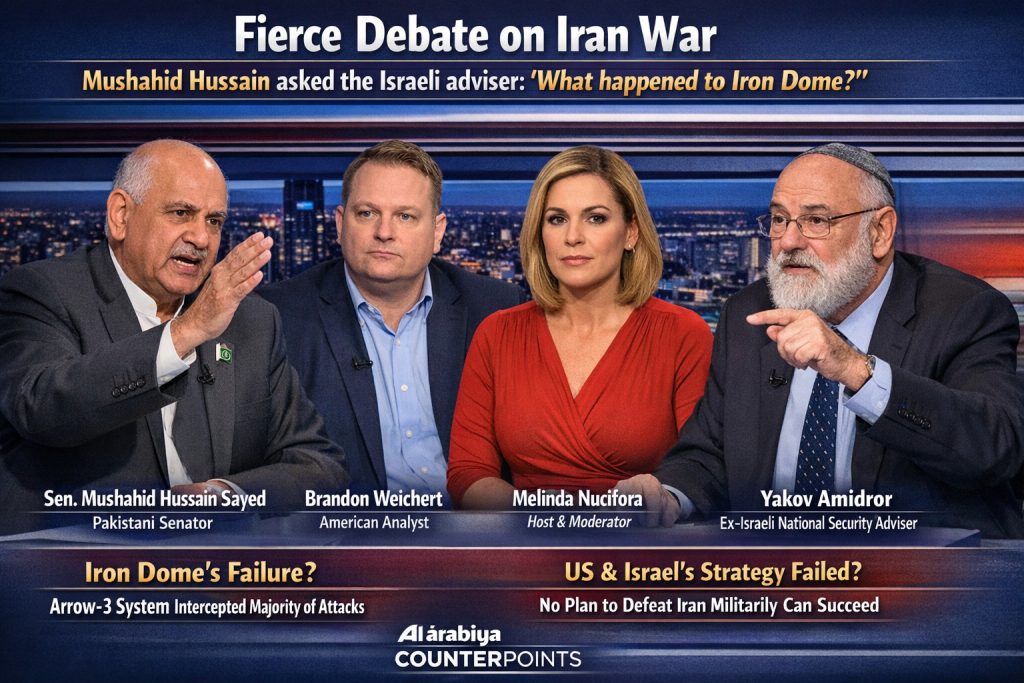
The majority of attacks were intercepted not by Iron Dome but by the Arrow-3 system, which is part of Israel’s layered defense network: Yakov Amidror Fierce debate on Iran war between Pakistani Senator Mushahid Hussain Sayed and former Israeli National Security Adviser Yakov Amidror
Islamabad (Monitoring Desk) : A heated debate on the Iran war took place between Pakistani Senator Mushahid Hussain Sayed and former Israeli National Security Adviser Yakov Amidror on Al Arabiya English’s program Counterpoints. Host Melinda Nucifora moderated the discussion alongside American analyst Brandon Weichert, which was held in the context of rising regional tensions following US and Israeli strikes on Iran on February 28. During the program, the three panelists engaged in a fiery exchange over topics including a possible peace agreement with Iran, the nature of military operations, the balance of power in the region, and the future outlook. Admission of Iron Dome’s Failure: Senator Mushahid Hussain directly asked Yakov Amidror why the Iron Dome, which was once touted as invincible, had failed to live up to its claims. Amidror initially responded by asserting that the Iron Dome was performing well and had successfully intercepted 90 percent of attacks. However, during the same conversation, he himself admitted that the majority of incoming threats were not intercepted by the Iron Dome but by the Arrow-3 system, which is part of Israel’s layered defense network. Amidror defended Israeli military operations by stating that the campaign was progressing according to plan and that Iran’s nuclear and missile capabilities had been significantly degraded. He further claimed that Israel could sustain these operations for weeks and that its defense resources remained far from exhausted. US and Israel’s Strategy Failed : Senator Mushahid Hussain responded by stating that the US-Israel Plan A had failed disastrously and that Washington had miscalculated the situation. He said President Donald Trump was now forced to beg for peace, and the contradictions in his statements reflected the failure of this strategy. The senator maintained that Iran had demonstrated extraordinary resilience and strength, and had gained strategic superiority through its influence over the Strait of Hormuz. He added that the conflict was part of the Greater Israel project and that neither Donald Trump nor Benjamin Netanyahu could have imagined Iran would remain at full strength into the fourth week of hostilities. Senator Mushahid Hussain asserted that the United States and Israel would now have to accept that no plan to defeat Iran militarily can succeed. American Analyst’s View: American analyst Brandon Weichert warned that the war could become protracted and costly, as neither side was willing to back down, raising the specter of further regional escalation. He said no immediate military resolution was in sight and the diplomatic chasm between the two sides was widening. Weichert added that there was no easy way out for the United States from this conflict, and Iran too was unwilling to compromise on its core interests. At the conclusion of the program, all three panelists appeared to agree that there was no quick solution to the current tensions and that the region faced the risk of further instability.
For more information please visit our International news.