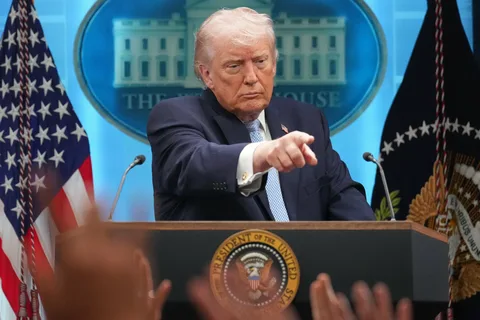

The US-Iran war has reached a critical breaking point. President Donald Trump has issued a firm Iran 48-hour deadline, demanding Tehran fully reopen the Strait of Hormuz by Tuesday, April 7, 2026, at 8 PM Eastern Time. Trump warned that failure to comply would trigger massive US strikes on Iranian power plants and bridges, threatening to wipe out the country’s infrastructure “in one night.”
Background
The US-Iran conflict began on February 28, 2026, when the United States and Israel launched joint strikes on Iran following months of failed nuclear negotiations. Trump had originally set a 60-day deadline for Iran to reach a nuclear agreement after sending a letter to Supreme Leader Ali Khamenei in April 2025.
The war has killed thousands and sparked a major global energy crisis since those initial strikes, which also resulted in the death of Iran’s Supreme Leader Ayatollah Ali Khamenei. The conflict has now entered its sixth week with no ceasefire in sight and global oil markets in turmoil.
Details: Trump Post About Iran and the Tuesday Ultimatum
The Trump Iran Tuesday showdown escalated dramatically over the weekend. Trump posted on Truth Social: “Remember when I gave Iran ten days to MAKE A DEAL or OPEN UP THE HORMUZ STRAIT. Time is running out 48 hours before all Hell will reign down on them. Glory be to GOD!”
On Sunday, Trump escalated further in an expletive-laced social media post, declaring “Tuesday will be Power Plant Day, and Bridge Day, all wrapped up in one, in Iran.”He told ABC News that if no deal was reached in 48 hours, the US would be “blowing up the entire country.”
At a White House press conference on Monday, Trump outlined a four-hour blitz plan, warning that “every bridge in Iran will be decimated by 12 o’clock tomorrow night” and “every power plant in Iran will be out of business, burning, exploding, and never to be used again.” n 48-hour deadline traces back to an original US threat in March to destroy Iran’s energy plants unless the Strait of Hormuz fully reopened. Trump extended the window several times as diplomatic contacts continued, settling on Monday, April 6, as the final cutoff before pushing it once more to Tuesday evening.
Iran Response to Trump
Iran on Trump news has been firmly defiant. Iranian central military command rejected Trump’s threat outright, with General Ali Abdollahi Aliabadi calling it “a helpless, nervous, unbalanced and stupid action.” He warned that “the simple meaning of this message is that the gates of hell will open for you.”
An Iranian security official quoted by the Fars news agency warned of “a big surprise” for the US and Israel, adding “it only takes a little time.”Iran’s parliamentary speaker had also stated the country was “locked, loaded and standing tall.”
Iran sent a 10-point proposal to the US through Pakistan as a mediator. The proposal included an end to regional conflicts, a protocol for safe passage through the Strait of Hormuz, the lifting of sanctions, and reconstruction guarantees.
However, Trump on Iran was unmoved. He told reporters the proposal was “a significant step” but “not good enough,” while confirming that intermediaries were “negotiating now.”
Iran’s foreign ministry spokesperson Esmail Baghaei separately rejected a proposed 45-day temporary ceasefire, saying it would only allow the US and Israel to “pause and prepare for the continuation of the war.”
Trump Iran Tuesday: The Strait of Hormuz at the Center
The Strait of Hormuz is the heart of this entire crisis. The strait a narrow passage along Iran’s southern coast is the world’s most critical oil shipping lane, normally carrying roughly one-fifth of global supply. Its closure has triggered what the International Energy Agency called the largest disruption to energy supply since the 1970s oil crisis, with roughly 10 million barrels per day lost. Oil prices have surged more than 60% since the war began.
Shipping through the Strait of Hormuz remains severely curtailed, with tracking data showing that only about 5% of pre-war shipping volume is currently getting through the strait.
Iran has proposed its own management system for the strait, requiring ships to obtain permits and special licenses to transit the waterway. The EU’s foreign policy chief rejected this concept, saying international law does not recognize “pay-to-pass schemes.”
Quotes
Donald Trump, US President: “The entire country can be taken out in one night, and that night might be tomorrow night.”
Iranian Foreign Minister Abbas Araghchi: “Iran’s power is the Hormuz Strait… the Hormuz Strait is not completely closed; it is closed only to our natural enemies.”
UN Secretary-General António Guterres: “We are on the edge of a wider war that could engulf the entire region. When the strait is strangled, the world’s most vulnerable cannot breathe.”
European Council President António Costa: “The targeting of civilian infrastructure, namely energy facilities, is illegal and unacceptable.”
Impact: US-Iran War Who Is Winning?
The question of who is winning in the US-Iran war remains deeply contested. Trump has repeatedly claimed victory, while Iran insists it is holding firm. The US military deployed 155 aircraft including four bombers, 64 fighters, and 48 refuelling tankers for a single rescue operation of downed American airmen, reflecting the scale of the ongoing conflict.
Iran’s leadership has remained defiant since the war began, and its foreign minister has left the door open for peace talks through Pakistan’s mediation, though Iran shows no sign of bowing to Trump’s core demands.
The UN Security Council has been attempting to pass a resolution to reopen the Strait of Hormuz, but the vote has been repeatedly delayed due to divisions among veto-wielding members China, Russia, and France, who objected to language authorizing countries to use “all necessary means” to secure the waterway.
Internationally, the targeting of civilian infrastructure has drawn sharp condemnation. More than 100 international law experts published an open letter warning that targeting civilian infrastructure violates the Geneva Convention and could constitute war crimes.
Conclusion: What Comes Next
As the Trump Iran Tuesday deadline expires tonight at 8 PM Eastern Time, the world watches with deep concern. Egyptian officials involved in back-channel talks told NPR that Iran is open to a 45-day ceasefire that guarantees a permanent end to the war, during which Tehran would discuss opening the Strait of Hormuz.
A White House official confirmed the 45-day ceasefire was “one of many ideas” under consideration but that Trump had “not signed off” on it, and that “Operation Epic Fury continues.”
Whether diplomacy prevails or a catastrophic military escalation unfolds in Iran’s energy heartland remains the defining question of this crisis. The next 24 hours will be critical not just for the US and Iran, but for global energy security, oil markets, and the international rules-based order.
FAQs
What is the 60-day deadline for Trump Iran?
Trump originally set a 60-day deadline for Iran to reach a nuclear peace agreement after sending a letter to Iran’s Supreme Leader Ali Khamenei in April 2025. When that deadline passed without a deal, Israel attacked Iran, igniting the current war.
Why did Trump start the war with Iran?
The war was triggered by a joint US-Israeli military operation launched on February 28, 2026, targeting Iran’s nuclear and military infrastructure. The stated goal was to prevent Iran from developing nuclear weapons. The conflict followed months of failed diplomacy over Iran’s uranium enrichment program and Trump’s repeated threats of military action if no deal was reached.
Did Trump lift sanctions against Iran?
No. Sanctions on Iran remain in place. Iran’s 10-point peace proposal explicitly includes the lifting of US sanctions as one of its key conditions for ending the war, but the Trump administration has not agreed to this demand so far.