
A massive wave of worker unrest has shaken Noida, one of India’s largest industrial cities. Police lobbed tear gas shells to quell a factory workers’ protest in the Indian capital’s suburb of Noida after it turned violent on its fourth day, with vehicles torched and stones pelted in parts of the satellite city.The Noida protest today remains a top news story as workers continue demanding fair pay. The Uttar Pradesh government has responded but many say it is not enough.
Background: What Started the Noida Protest?
The Noida protest today did not erupt overnight. It began as a simmering anger over wages that had failed to keep pace with rising costs of living. Living costs across the world have risen as the US-Israel war on Iran curbed fuel supplies, making the situation worse for low-income workers across India.
The trigger for the India minimum wage protest Noida workers launched was a decision by a neighbouring state. The protests in Noida erupted after the Haryana government announced a 35% hike in minimum wages for various categories of workers. Workers in Noida demanded a similar increase, pointing out that their counterparts in the neighbouring state were being paid more for comparable work.
The demonstrations quickly spread across Noida’s industrial zones. Noida news live channels covered the clashes extensively as the unrest escalated from peaceful marching to full-scale violence.
Details: What Happened During the Noida Protest?
Noida is among the largest planned industrial townships of Asia and houses thousands of industrial units.When its workers take to the streets, the impact is felt far and wide.
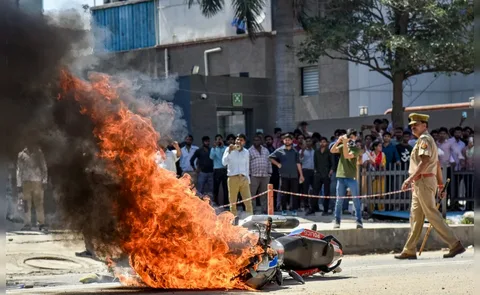
Visuals showed dozens of protesters marching on the street and chanting slogans, while an overturned vehicle with flames rising from it appeared in other footage, with protesters hurling stones and trying to break through barricades.
Noida news today reports confirmed that the unrest was centred around the Phase-2 Hosiery Complex. The April 13–14 violence was marked by arson, vandalism, and clashes in Noida and Greater Noida.The scale of the Noida protest today shocked both industry and government officials.
Workers described the personal toll of stagnant wages. One worker, Abhishek, said he came to Noida 10 years ago hoping to earn Rs 12,000 to Rs 15,000, but after a decade, his salary has only increased by Rs 9,000. Another worker, Preeti, told reporters that after paying rent and household expenses on her Rs 11,000 salary, she is left with nothing each month.
UP Government’s Response: 21% Wage Hike Announced
The Noida news live updates brought a swift government reaction. The Yogi Adityanath-led Uttar Pradesh government on April 14, 2026, announced an interim increase in minimum wages for unskilled, semi-skilled, and skilled workers, just a day after the violent protests in Noida.
Unskilled workers in Noida and Ghaziabad will see their monthly wages rise from ₹11,313 to ₹13,690, while semi-skilled workers’ wages increase from ₹12,445 to ₹15,059. Skilled workers will now earn ₹16,868, up from ₹13,940.
The government plans to constitute a Wage Board next month to determine long-term wage structures while urging industries to ensure fair pay and worker benefits.The hike is effective retrospectively from April 1, 2026. Noida news today confirmed the announcement was made to prevent further escalation of the India minimum wage protest Noida workers had launched.
Workers Still Not Satisfied: Protests Continue
Despite the announcement, the Noida protest today did not end immediately. Private company employees in Noida continued their protests on Tuesday against the minimum wages despite the Uttar Pradesh government’s new salary increase. The employees said they are dissatisfied with the minor increment and demanded that the minimum salary should be at least Rs 20,000.
The state government clarified that it has not raised the minimum wage to Rs 20,000 per month and rejected claims suggesting otherwise, emphasising that employers must adhere to the notified rates.
Workers also raised other grievances beyond just salaries. Workers demanded that malpractices by employers be addressed, saying that some companies treated skilled workers on par with unskilled labour with regard to allowances.Noida news in Hindi coverage showed that anger among factory floors remained high even after the government’s partial concession.
Quotes: What Officials and Workers Are Saying
Narendra Kashyap, a lawmaker in Uttar Pradesh, called on protesters to discuss their demands with the government, while Gautam Budh Nagar police stated that senior officials are making persistent efforts to counsel the workers and urge them to maintain peace and restraint.One worker at the heart of the India minimum wage protest Noida workers organised explained their motivation directly. Vinay Mahoti, 30, who hails from Bihar and works at a hosiery company in Noida, said: “Duty hours should be fixed, overtime hours should be paid.”
Police confirmed their approach during the Noida protest today. Local police said “minimum force” was used to maintain law and order during the violent phase of the demonstrations.
Conspiracy Angle: Police Investigate Deeper Links
Noida news live updates took a dramatic turn when investigators revealed more about the protest’s origins. What initially appeared to be a spontaneous labour protest over wage hikes in Noida’s Phase-2 Hosiery Complex has now taken a dramatic turn, with police claiming the April 13–14 violence was the result of a premeditated conspiracy involving local operatives and possible foreign-linked digital interference.
According to investigators, the alleged mastermind is Aditya Anand, a B.Tech graduate from NIT Jamshedpur. Police say Anand orchestrated the unrest with the help of Rupesh Roy, an auto-rickshaw driver from Bihar, and Manisha Chauhan. While Roy and Chauhan were arrested, Anand remains absconding.
Noida news today reports indicate that authorities have also detained four individuals suspected of planning the events, with investigators analysing WhatsApp data and digital trails to identify local collaborators and a broader network behind the unrest.
Impact: What This Means for India’s Labour Sector
The Noida protest today is not just a local story. It signals a wider crisis in India’s industrial wage structure. India’s minimum wage system is highly complex, with the latest revision effective April 1, 2026, reflecting an increase of 11.28 CPI points resulting in an upward adjustment across centrally regulated scheduled employments.
The central floor wage of ₹178 per day translates to about ₹22.25 ($0.27) per hour for an 8-hour workday, placing India at the lower end of the global wage spectrum.Workers in Noida and across Uttar Pradesh argue that this is simply not enough to survive in a modern urban economy with rising rents and food costs.
India now has over 1,202 minimum wage rates for different types of industries and skill level, making it one of the most complex wage systems in the world. The India minimum wage protest Noida workers carried out is pushing the conversation toward simplification and a living wage standard.
Conclusion: What Comes Next for Noida?
Following the announcement of a wage hike, workers and industry stakeholders have resumed operations, and factories across Noida are now functioning normally. Security has been tightened, and authorities continue to monitor the situation closely.
However, the underlying causes of the Noida protest today stagnant wages, employer malpractice, and rising costs have not gone away. A Wage Board is set to be constituted next month to begin finalising a long-term minimum wage structure based on its recommendations.
Noida news live will continue to track whether the government delivers on its promises. The India minimum wage protest Noida workers led has put labour rights back at the centre of national debate, and the coming months will determine whether real reform follows.
FAQs
Q1: What is the Noida worker protest?
The Noida worker protest is a series of demonstrations by factory workers in Noida’s industrial zones, particularly the Phase-2 Hosiery Complex. Workers demanded a minimum wage hike similar to the 35% increase announced in neighbouring Haryana, as they pointed out that their counterparts were being paid more for comparable work.The protests turned violent on April 13, 2026, prompting police action and a government response the following day.
Q2: What is the minimum salary in Noida?
Following the UP government’s interim revision effective April 1, 2026, unskilled workers in Noida and Ghaziabad now receive ₹13,690 per month, semi-skilled workers earn ₹15,059, and skilled workers receive ₹16,868 per month.However, protesting workers are demanding a minimum of Rs 20,000 per month, saying the revised amounts are still insufficient to cover basic living costs.
Q3: What is the lowest minimum wage per hour in India?
The central floor wage in India stands at ₹178 per day, which translates to approximately ₹22.25 (around $0.27 USD) per hour for an 8-hour workday.The minimum wage in India ranges from ₹178 to ₹1,035 per day depending on the state, making it one of the most varied wage systems globally.States like Delhi offer significantly higher rates, particularly for skilled workers.