Desecration of Sacred Figures of Abrahamic Faiths and the Test of Global Conscience
The world has once again witnessed an incident that has not only hurt religious sensitivities but also shaken the global conscience. In southern Lebanon, an image surfaced showing a soldier smashing a statue of the crucified Jesus Christ. Subsequently, the Israel Defense Forces confirmed the authenticity of the image, terming the act inconsistent with its military values and announcing an investigation, while Israeli leadership, including Benjamin Netanyahu and Gideon Saar, condemned the act and expressed regret.
On the surface, it is being described as an individual act, but its impact does not remain confined to one individual; rather, it affects the beliefs, emotions, and religious attachments of millions, especially when the matter concerns a sacred figure of the Abrahamic traditions, the sensitivity of which multiplies many times over. These religions are not merely a set of rituals but represent a complete civilizational, spiritual, and moral framework built upon shared principles of respect, sanctity, and humanity.
Islam, Christianity, and Judaism are all connected through a common historical and spiritual continuum rooted in the monotheistic teachings of Abraham, and this is precisely why followers of these faiths consider reverence for prophets an essential part of their belief systems.
In Islam, this principle is even more explicit and unequivocal: every prophet—whether Moses, Jesus Christ, or Muhammad—is regarded as a chosen messenger of God and a source of guidance for humanity, and disrespect toward any one of them is seen as an affront to the entire chain of prophethood.
On this basis, Muslims categorically reject the notion that insulting any prophet can be justified under the pretext of freedom of expression, because the concept of freedom cannot be separated from responsibility. When freedom begins to wound the beliefs, emotions, and sacred values of others, it ceases to be freedom and instead becomes a manifestation of anarchy and moral decline.
The incident under discussion must be viewed in this broader context: in a region already engulfed in war, tension, and instability, targeting a religious symbol is not only irresponsible but akin to pouring fuel on the fire. In southern Lebanon, where ongoing conflict between Israel and Hezbollah has already claimed thousands of lives, such actions further inflame hatred and mistrust, undermining efforts toward interfaith harmony.
While it is true that Israeli authorities have condemned the act and described it as an individual wrongdoing, an important question arises: why do such incidents repeatedly surface, and are they merely isolated occurrences or indicative of a broader pattern of negligence or attitude?
History shows that when respect for religion weakens within a society, its consequences do not remain confined to religious circles but instead push the entire society toward intolerance, extremism, and conflict. In today’s global environment, where Islamophobia, religious prejudice, and narratives of civilizational clash are increasingly common, incidents of this nature become even more dangerous, as they not only provoke followers of a particular faith but also erode trust between different religious communities.
Islam, in this regard, offers a balanced and clear message: respect for all prophets is obligatory, and insulting any religious figure or symbol is unacceptable. This is why Muslims regard Jesus Christ with the same reverence as other prophets, often invoking peace upon him as a mark of deep respect, which reflects the strong foundation of interfaith respect within Islamic teachings.
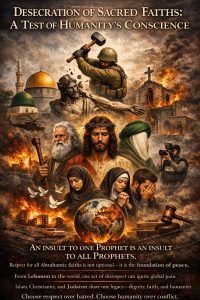
In this context, harming any prophet or religious symbol is not merely an issue for one religion but a moral and principled concern. Therefore, we strongly condemn this act and make it clear that such behavior cannot be acceptable in any civilized society.
The international community must abandon double standards, because if the desecration of sacred symbols of one religion is dismissed in the name of freedom of expression while similar acts concerning another religion provoke strong reactions, such inconsistency itself violates the principles of justice.
There is a pressing need to establish a global code of conduct that ensures equal respect for the sacred symbols of all religions and prevents anyone from using the pretext of freedom to hurt the beliefs of others. At the same time, states and institutions bear responsibility to incorporate religious sensitivity and cultural respect into the training of their personnel to prevent such incidents from occurring.
The role of the media is equally critical, as it not only highlights such events but also shapes public opinion; therefore, it must act responsibly, presenting facts while promoting interfaith harmony.
Ultimately, it would not be an exaggeration to say that the world stands at a delicate crossroads where wars, political interests, and power struggles are overshadowing the fundamental principles of humanity. In such a time, respect for religion and mutual tolerance remain the only viable path to prevent further destruction.
It must be understood that hatred and desecration do not solve problems; rather, they create new ones, whereas respect, dialogue, and justice are the foundations upon which a peaceful and balanced global order can be built.
Therefore, this incident should not be dismissed as just another piece of news but must be taken as a warning: if the principles of religious respect are not strengthened, the consequences in the future could be far more severe, and this is the moment when the global community must decide whether it wishes to follow the path of hatred or embrace the path of respect and humanity.