
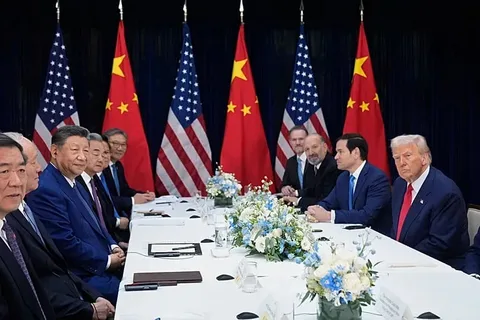

US-China relations are at a defining crossroads as President Donald Trump prepares to meet Chinese President Xi Jinping in Beijing this week. The high-stakes summit comes amid a fragile trade truce, an ongoing war in Iran, and rising tensions over Taiwan. What happens in Beijing could reshape US-China relations history for decades to come.
The Breaking News Trump Flies to Beijing for Xi Summit
Trade negotiators from both countries are meeting in Seoul, South Korea, ahead of Trump’s face-to-face meeting with Xi Jinping, scheduled for Thursday and Friday this week. This is the most significant diplomatic encounter in US-China relations news in years.
The meetings in Beijing could be a watershed moment for the adversarial superpowers, whose fragile relationship has been snarled by a flurry of economic and political conflicts in the past year alone. Analysts studying US-China relations whether through news reports, a US-China relations PDF, or a US-China relations book agree: the stakes have rarely been higher.
The packed itinerary reflects the regional dynamic at play in US-China relations, with the summit being closely watched by leaders globally. From Europe to Southeast Asia, every capital is tracking what comes out of Beijing this week.
US-China Relations History How Did We Get Here?
Understanding what is going on between the US and China today requires a look at US-China relations history. The two countries have oscillated between cooperation and confrontation since China’s economic opening in the 1970s. For decades, trade was the glue that held the relationship together.
That began to change dramatically during Trump’s first term. The US launched a trade war against China, imposing sweeping tariffs and technology restrictions. US-China relations history entered one of its most turbulent chapters, with both sides decoupling supply chains and weaponizing trade as a geopolitical tool.
Since Trump last visited Beijing more than eight years ago, US-China merchandise trade has fallen by more than one-third. That single statistic captures the collapse at the heart of US-China relations history a relationship that once promised mutual prosperity now defined by mutual suspicion.
The Trade War Where Things Stand in 2026
The trade dimension of US-China relations news has dominated headlines for years. Last year, the Trump administration imposed tariffs ranging from 34% to 125% on Chinese goods, triggering a sharp economic response from Beijing.
In October 2025, the two countries reached a trade agreement that reduced tariffs on Chinese goods and secured US access to critical minerals. Even so, Chinese exports to the US have continued to fall, dropping by 11% year-on-year in early 2026.
China, however, has not simply absorbed the blow. In the first two months of 2026, China’s exports grew by 21.8% year-on-year, reflecting a reorientation toward non-US markets that has helped cushion the impact of declining trade with the United States. This is a critical data point for anyone researching US-China relations through a US-China relations PDF or US-China relations book China is adapting faster than many predicted.
US-China trade tensions, risk management, and US tariffs on Chinese exports were the top three most important reasons cited for companies considering moving capacity outside of China. The business world is restructuring around US-China tensions in real time.
What Is on the Summit Agenda?
The Trump-Xi summit agenda covers a wide range of issues that touch every dimension of US-China relations news. Trade is the headline item, but it is far from the only concern.
US Trade Representative Jamieson Greer has openly discussed the idea of a “Board of Trade” to formalize and rebalance bilateral trade flows, including defining priority goods for import and export. This would be a structural shift in US-China relations moving from ad hoc tariff battles to a managed trade framework.
The US is expected to push for continued access to critical and rare earth minerals alongside large-scale commercial agreements. This includes a potential Chinese purchase of 500 Boeing aircraft and sustained Chinese imports of US agricultural products.
Expected topics also include the creation of a bilateral board tasked with managing trade between the two countries, and another group intended to provide a government-to-government forum for discussing investment-related issues. Both sides are trying to institutionalize their rivalry turning US-China tensions into something manageable rather than explosive.
Taiwan The Most Dangerous Flashpoint in US-China Relations
No discussion of US-China relations is complete without addressing Taiwan. The self-governing island sits at the center of the most dangerous potential military conflict in Asia what many observers fear could become a US and China war.
During a phone call between Trump and Xi in February, Xi emphasized that “the Taiwan question is the most important issue in China-US relations” and urged the United States to handle arms sales to Taiwan with prudence.
Trump, however, confirmed that arms sales to Taiwan are on the summit agenda. A professor of international studies warned that the US focus on Iran has drawn attention away from the Pacific, potentially creating vulnerabilities for Taiwan that China may seek to exploit. “If China were to contemplate an attack, this might be the opportune moment to do it,” the professor said.
This is the nightmare scenario in US-China relations a US and China war triggered by a move on Taiwan while American military attention is consumed elsewhere. It is the subject of countless analyses in every US-China relations book and US-China relations PDF published in recent years.
Iran The Wild Card Reshaping US-China Relations
The ongoing war in Iran has added a volatile new layer to US-China relations news. China has deep economic and strategic ties with Iran, formalized through a 25-year strategic partnership agreement.
The war has disrupted global energy markets and added a new layer of strain to an already fragile US-China relationship. The China-Iran relationship was largely formalized in a 25-year strategic partnership agreement signed in 2021 that focused on economic, security and technology cooperation.
Iran’s foreign minister traveled to Beijing for the first time since the Iran war last week, and China is one of the few countries with relations with both Iran and Gulf states. A Chinese professor noted that Beijing would want to help resolve the tensions and that Iran will definitely be discussed during the Trump-Xi summit.
Iran is therefore not just a Middle East issue it is a stress test of US-China relations. Whether both sides can find common ground on Iran will signal how much trust actually exists behind the diplomatic smiles in Beijing.
Expert Quotes What Analysts Are Saying
Kyle Chan, a US-China relations expert at the Brookings Institution, said Trump and Xi want to “reconfirm their relationship and have that kind of stability,” noting that everything else at the summit is secondary to that core goal.
“The basic tension is that Trump wants to reassert the US as the most powerful country, and Xi wants the same. They cannot both succeed, even if Xi only wants China to be recognised as pre-eminent rather than as the hegemon,” one analyst observed.
President Xi Jinping told party members at the Central Economic Work Conference that, amidst the turbulent tariff and trade wars, China has “demonstrated the resolve, integrity, and confidence of the Chinese people, showcased our core strength, and won the respect of the international community.” China, in other words, believes it has already won the first round of US-China tensions.
Impact What This Means for the World
US-China relations do not exist in a vacuum. The ripple effects of US-China tensions touch every continent, every supply chain, and every stock market on earth.
Europe is especially worried about a trade deal that cuts it out and accelerates its declining position of strength on the world stage. EU leaders have agreed on wide-ranging commitments to curb dependency on the US for liquefied natural gas and on China for critical rare-earth minerals.
India, Brazil, and other major emerging economies within the BRICS grouping also view growing US-China relations as a challenge to their own global superpower aspirations. For the Global South, a US-China deal could redirect investment and attention away from developing nations.
US-China tensions continue to weigh on investment and business decisions, with 26% of respondents in a recent survey stating that uncertainty in the bilateral relationship was a reason for considering reductions to their investments in China in 2026. The business cost of US-China tensions is measured in the hundreds of billions of dollars annually.
Conclusion What Comes Next in US-China Relations?
The current trade truce provides much-needed breathing room for companies to recalibrate supply chains and reassess investment strategies. However, a range of unresolved issues and lingering political flashpoints have the potential to reignite tensions.
The Trump-Xi summit this week is just a start of more discussions, according to Chinese analysts. As for the greater question of US-China relations, the two presidents’ meeting is the beginning, not the end, of a long process.
The world is watching Beijing this week with equal measures of hope and anxiety. US-China relations history tells us that summits can reset relationships or expose how broken they truly are. Whether this one produces a genuine shift in US-China tensions, or merely a temporary pause before the next escalation, will define the geopolitical landscape for years ahead.
FAQs
Which country is a good friend of China?
China’s closest strategic partner today is Russia, with whom it has built a “no-limits” partnership covering trade, military cooperation, and diplomatic alignment. Pakistan is also a longstanding ally, tied to China through the China-Pakistan Economic Corridor (CPEC). In the context of US-China relations, China has also deepened ties with Iran, Saudi Arabia, and several African nations deliberately building a network of relationships that reduces its dependence on the US-led international order.
Can China survive without US trade?
China is actively proving that it can reduce its exposure to the US economy. China’s exports grew by 21.8% year-on-year in early 2026, reflecting a reorientation toward non-US markets that has helped cushion the impact of declining trade with the United States. China cannot fully replace US trade overnight the US remains its largest single export market. But through Belt and Road investments, BRICS trade expansion, and domestic consumption growth, China is steadily building a future where US-China trade tensions cause less economic pain than they once would have.
What is China’s biggest export to the USA?
China’s biggest exports to the US are electronics and electrical equipment including smartphones, computers, semiconductors, and consumer electronics. Machinery, furniture, plastics, and toys also rank among the top categories. These trade flows sit at the heart of US-China relations news because they represent both economic interdependence and strategic vulnerability. The US has sought to reduce reliance on Chinese electronics through the CHIPS Act and export controls on advanced semiconductors a move that has deepened US-China tensions in the technology sector specifically.