
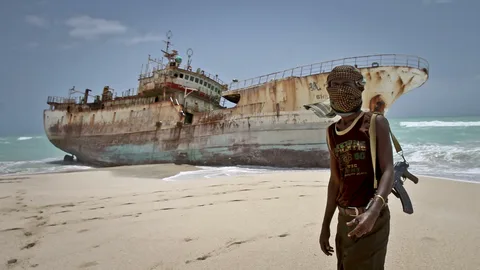
Piracy off the coast of Somalia is making a dramatic and dangerous comeback. In April 2026, Somali pirates seized an oil vessel loaded with nearly 18,500 barrels of fuel along with 17 crew members from multiple nations. This is not an isolated event it is part of a pattern of escalating attacks that has alarmed maritime authorities, shipping companies, and international naval forces worldwide.
A Dangerous Return Piracy Off the Coast of Somalia Surges in 2026
For several years, the waters off Somalia had grown quieter. International naval patrols had pushed piracy down to near-zero levels. But that calm is now over. On 22 April 2026, the oil tanker Honour 25 was hijacked by pirates off the Somali coast, about 30 nautical miles offshore. The ship carried 17 crew members of mixed nationalities and around 18,500 barrels of oil, and was later anchored near the Puntland coast between Xaafun and Bander Beyla.
This Somali pirates oil vessel attack sent shockwaves through the maritime industry. It was not the only incident that week. At least four vessels were targeted in suspected piracy incidents in a single week, including a fishing vessel and the oil tanker. The UK Maritime Trade Operations (UKMTO) warned that weather conditions were favorable to small boat operations, advising vessels to transit with extreme caution.
The Honour 25 A BBC Pirates Story the World Watched
The hijacking of the Honour 25 quickly gained global attention, with BBC pirates coverage putting the story in front of millions of readers worldwide. According to the BBC, the oil tanker had 17 crew members on board, including people from Pakistan, Indonesia, India, Sri Lanka, and Myanmar. Six pirates targeted the tanker loaded with approximately 18,000 barrels of oil off the coast of the semi-autonomous state of Puntland.
Somali maritime officials and regional security forces came under intense pressure to secure the vessel and ensure the crew’s safe release, with no ransom demands publicly issued at first. The BBC pirates coverage underscored how vulnerable oil vessels in the region remain, despite years of international effort to suppress such attacks.
The Latsco Vessel A Name That Emerged From the Crisis
The name Latsco vessel entered the conversation during this wave of attacks. The Maltese-flagged tanker Hellas Aphrodite was attacked while en route from India to South Africa. The ship’s manager, Latsco Marine Management, confirmed ongoing contact with the crew and coordinated with authorities to ensure their safety while EU NAVFOR Operation Atalanta assets, including the frigate ESPS Victoria, actively responded and monitored the situation.
The Latsco vessel situation demonstrated both the terrifying speed of modern Somali pirate attacks and the critical role that professional ship management companies play in crisis communication. All 24 crew members of the Hellas Aphrodite were confirmed safe and sheltering in the vessel’s citadel, following BMP5 protocols, with no reports of injuries.
Somali Pirates Fishing The Root of a Decades-Old Crisis
To understand piracy off the coast of Somalia fully, you have to look at Somali pirates fishing communities and the grievances that drove the original rise of piracy. After the Somali Navy dissolved around 1991, a vacuum was exploited by large foreign fishing boats that threatened the livelihoods of local Somali fishing communities. The fishing community responded by forming armed groups to deter what they perceived as invaders groups that would sometimes hold vessels and crew for ransom.
In September 2025, Puntland authorities seized several fishing vessels accused of illegal fishing. Many pirate groups responded, claiming their actions are justified to protect their livelihoods, given limited fishing opportunities. Locals also faulted the government for distributing more licences while failing to increase enforcement of regulations.
This fishing grievance narrative remains central to piracy off the coast of Somalia. It does not excuse attacking oil vessels and taking crews hostage but it explains why, without tackling the root causes, piracy never truly disappears.
How Somali Pirates Have Modernized Their Methods
The Somali pirate attacks of 2025 and 2026 are not the same as those of a decade ago. By 2025, new pirates emerged with satellite phones and heavy weapons, based on evidence of increased arms sales between al-Shabaab and the Houthis. The fundamental Somali piracy model, however, remains unchanged they still prefer to capture crew for ransom.
These motherships now allow pirates to project force 300 to 600 nautical miles offshore, representing a significant leap in operational range. The resurgence revealed a structured campaign by Somali networks capable of long-range coordination and sustained operations across the Somali Basin.
On 1 January 2026, pirates boarded and commandeered the fishing vessel Liao Dong Yu 578 off Puntland in Somalia, an incident that coincided with an increase in Somali piracy as armed groups increasingly targeted vessels using mother ships as platforms for attack. Somali pirates have shown the ability to operate over 1,000 nautical miles from shore.
The Global Economic Impact of Piracy Off the Coast of Somalia
The cost of piracy off the coast of Somalia is staggering. According to the World Bank, the annual impact of piracy off Somalia on the global economy was as high as $18bn during the height of the crisis. Between 2005 and 2012, ransoms totalled between $339m and $413m, with 2011 alone seeing around 212 attacks recorded one of the highest numbers in a single year.
The surge in petrol prices amid the US-Israel war on Iran has also likely made fuel tankers, such as the Honour 25, more valuable to pirates. Brent crude prices have risen by more than 50 percent since the start of the war, at more than $110 per barrel. A Somali pirates oil vessel attack is no longer just a regional crisis it is a direct threat to global energy supply chains.
International Response Operation Atalanta and Naval Patrols
The international community has not stood idle. An international coalition composed of NATO’s Operation Ocean Shield, EUNAVFOR Operation Atalanta, the Combined Maritime Task Force, and the Somali authorities began patrolling the waters to suppress piracy during the height of the crisis.
The Maltese-flagged tanker Hellas Aphrodite, attacked with small arms and RPGs, was responded to within 24 hours by the Spanish frigate ESPS Victoria, which secured the ship and ensured all 24 crew were unharmed. These naval interventions save lives but they cannot be everywhere at once across an ocean that covers millions of square miles.
With international naval assets partly redirected to the Red Sea due to Houthi-related operations, pirates have exploited reduced patrols in the Somali Basin. This gap has been costly, and it explains much of the 2025 to 2026 resurgence of Somali pirate attacks.
The Captain Phillips Story When Somali Pirates Made History
No account of piracy off the coast of Somalia is complete without the story of Captain Richard Phillips and the Maersk Alabama. On 8 April 2009, four pirates in the Somali Basin seized the Danish/U.S. cargo ship Maersk Alabama at a distance of 240 nautical miles southeast of Eyl, Somalia. It was the first successful pirate seizure of a ship registered under the U.S. flag since the early 19th century.
Captain Phillips surrendered himself to the pirates to safeguard his crew and the ship, boarding a lifeboat to be taken ashore in Somalia. The next day, the U.S. Navy destroyer USS Bainbridge arrived on the scene and began negotiating with the pirates for the release of Captain Phillips.
On Sunday, 12 April, US Navy SEAL Team Six snipers of Red Squadron fired shots from the Bainbridge’s fantail, killing the three remaining pirates after the fourth pirate had boarded the Bainbridge to negotiate. Captain Phillips was rescued uninjured. Commander Castellano, with prior authorization from higher authority, ordered the action after determining Phillips’ life was in immediate danger, citing reports that a pirate was pointing a rifle at Phillips’ back.
Opinion The World Cannot Afford to Look Away Again
The resurgence of piracy off the coast of Somalia is a policy failure as much as a security failure. The international community invested years and billions of dollars in suppressing piracy and then quietly turned its attention elsewhere. The moment naval patrols thinned, the pirates returned.
Somali pirate activity in 2025 does not signal a broader resurgence by itself. But the rise of new criminal networks and the creation of opportunity gaps serve as fertile ground for piracy’s return, with soldiers in Puntland distracted by other conflicts and a tense political environment.
The world has a choice. It can treat each Somali pirates oil vessel attack as a separate, unfortunate incident or it can recognize that piracy off the coast of Somalia is a symptom of deeper failures: political instability, illegal fishing, economic desperation, and reduced international engagement. Only by addressing all of these will the waters off the Horn of Africa become genuinely safe again.
Conclusion What Comes Next for Maritime Security in Somalia
The attacks come as maritime routes already face severe disruptions due to the blockage of the Strait of Hormuz during the United States-Israeli war on Iran, making an already volatile region even more dangerous for global shipping.
Naval forces must return in greater numbers to the Somali Basin. Shipping companies must equip vessels with armed guards and follow Best Management Practices. And the international community must invest in addressing the economic grievances of Somali fishing communities because Somali pirates fishing grievances, left unaddressed, will continue to fuel the cycle of piracy.
The Latsco vessel, the Honour 25, the Sward these are not just shipping incidents. They are warnings. The world ignored those warnings before, and piracy grew into a billion-dollar crisis. The question now is whether leaders will act before history repeats itself entirely.
FAQs
Who took the shot that saved Captain Phillips?
US Navy SEAL Team Six snipers of Red Squadron fired the shots that saved Captain Phillips, operating from the fantail of the USS Bainbridge. The action was ordered by Commander Frank Castellano after it was determined that Phillips’ life was in immediate danger, with a pirate pointing a rifle at his back. Three pirates were killed simultaneously in a coordinated sniper action.
Did the crew blame Captain Phillips?
Some crew members of the Maersk Alabama did express frustration after the hijacking, with reports suggesting a degree of resentment over decisions made during the incident. However, Captain Phillips was widely portrayed as a hero who had surrendered himself as a hostage in return for the release of his crew and the ship, enduring five days in captivity before being rescued by Navy SEALs. The full account of events was later told in Phillips’ own memoir and the 2013 film starring Tom Hanks.
Did the Navy SEALs really rescue Phillips?
Yes. On Easter Sunday, April 12, the captain of the Bainbridge, Commander Frank Castellano, determined that Captain Phillips’ life was in danger and ordered the SEAL snipers to take the shot. Three shots were fired simultaneously, killing the three pirates holding Phillips, and he was rescued unharmed. The operation has since become one of the most celebrated examples of precision Navy SEAL hostage rescue in modern history.