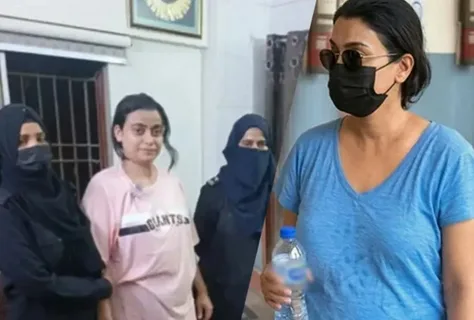
The investigation into the Anmol alias Pinky drug network has taken a transnational turn. Karachi Additional Inspector General (AIG) Azad Khan confirmed on May 15, 2026 that African nationals based in Lahore are believed to be part of the cocaine supply chain run by the alleged drug queenpin. Anmol, 31, is currently in police custody on a three-day remand.
Background Who Is Anmol Alias Pinky?
Despite being on the law enforcement agencies’ radar for years, 31-year-old aspiring model-turned-drug queenpin Anmol Pinky operated her nationwide network from Lahore and Karachi with impunity for years. She, along with her brothers and other accomplices, had built a network that used WhatsApp and social media to supply narcotics, particularly cocaine, to their clients in upscale areas.
She belonged to a family of modest means. Her father, Murad Bakhsh, a Kolachi Baloch, was a taxi driver by profession. She left her studies when she was in eighth grade and moved to Lahore to pursue a modelling career.
It was her first husband and brothers who brought her into the world of crime, as she initially worked for the husband to traffic cocaine from Lahore to Karachi. She started building her own network after getting separated from her first husband and later tied the knot with a retired police official.
Anmol Alias Pinky Drug Network Foreign Connection Revealed
Karachi AIG Azad Khan shared details during a press conference on Friday of the investigation conducted against Anmol thus far, saying that the case could turn out to be a transnational one as investigators had come across information about the involvement of foreigners in the drugs networks allegedly run by the suspect.
In his own words:
“We have come across information that some foreigners from African countries are involved in this network who are in Lahore. They may be six to eight in number. Similarly, some Lahore-based women are also involved in this network.” AIG Azad Khan, May 15, 2026
20 Cases in Sindh, 3 in Lahore
The official said 20 cases against Anmol had surfaced in Sindh, in which 17 were old cases and three were registered recently. Moreover, three cases against her were also registered in Lahore. Further details about the status of those cases had been sought.
How the Pinky Drug Network Operated
Since she was already booked in multiple criminal cases prior to her recent arrest, the police had her Computerised National Identity Card (CNIC) blocked. But this did not stop her from doing business as she used benami accounts and SIMs issued under someone else’s names to stay in touch with her network and customers.
She dealt specifically in cocaine and built her own so-called brand. As cocaine entered the country through smuggling networks, she learned to increase the quantity by mixing certain chemicals and drugs without compromising the quality to boost her profit. Investigators estimated that she sold drugs worth millions of rupees daily, and her clients included important personalities and students. They conceded that a portion of her earnings went to certain law enforcement officials for protection.
Murder Case Also Registered
Apart from narcotics-related cases, police have also registered a murder case against Pinky. According to the FIR on May 9, 2026, the body of an unidentified drug addict was found on a footpath near a school in Baghdadi. A packet of narcotics was allegedly recovered from his pocket bearing the slogan: ‘Queen Madam Pinky, Don, Nam Hi Kafi Hai, Enjoy.’ The FIR alleged that the drugs sold by Pinky led to the death of the unidentified man.
Official Quote
“We have come across information that some foreigners from African countries are involved in this network who are in Lahore. They may be six to eight in number.” Karachi AIG Azad Khan, Press Conference, May 15, 2026
Impact What the Anmol Pinky Case Reveals About Pakistan’s Drug Problem
The Anmol alias Pinky drug network case is more than just the arrest of one individual. It exposes three serious systemic problems. First, a nationwide cocaine supply chain operating through social media and encrypted messaging. Second, alleged protection money paid to law enforcement officials, allowing the network to run for years unchecked. Third, transnational links with African nationals now identified as part of the supply chain based inside Pakistan.
The case has also put a spotlight on Karachi and Lahore’s upscale drug market, where cocaine is increasingly in demand among wealthy clients and students.
Frequently Asked Questions
What is the net worth of Anmol KC in rupees?
Note: “Anmol KC” refers to the popular Indian rapper Anmol Kochar, not Anmol alias Pinky. These are two completely different people. Anmol KC’s net worth is estimated at around ₹5–10 crore Indian rupees based on his music career and social media presence. Anmol alias Pinky (the Karachi drug suspect) is not related to Anmol KC in any way. Investigators say she sold narcotics worth millions of Pakistani rupees daily but did not hold a bank account operating entirely through benami accounts and unregistered SIMs.
Is KC a caste?
“KC” in the name Anmol KC refers to the Indian rapper’s initials, not a caste. In Pakistan and India, “Khatri Caste” is sometimes abbreviated KC in historical references, but this is unrelated to the rapper or to Anmol alias Pinky. The Khatri community is a business and trading community historically found across Punjab in both Pakistan and India.
Which is the No. 1 caste?
Pakistan and India do not have an official ranking of castes. Both countries’ constitutions prohibit caste-based discrimination. In Pakistani society, communities like Syeds, Rajputs, Jats, Arains, Khatris and Baloch are among the most prominent, but none holds a legally or officially recognised “number one” status. Any such ranking is a social construct and not factual. In the context of this article, the caste question is unrelated to the Anmol alias Pinky drug case.
Conclusion What Comes Next in the Anmol Pinky Drug Case
Anmol had been arrested earlier this week from her apartment in Karachi in a joint raid conducted by police and a civilian intelligence agency in connection with two cases pertaining to the possession of narcotics and an unlicensed weapon. On Wednesday, a court in Karachi granted police her three-day physical remand.
Investigators are now tracing the six to eight African nationals believed to be based in Lahore as part of the wider network. Lahore-based women linked to the supply chain are also being identified. The case is expected to expand significantly as interrogation continues.