(Publish from Houston Texas USA)
(By Mian Iftikhar Ahmed)
An in-depth analysis of Buddo and Bundal Islands near Karachi and the possibility of transforming them into a Dubai-style economic hub.
The Reality of the Islands – An Analysis of Buddo and Bundal Islands, Dubai’s Magic – The Laws That Turned a Desert into Paradise : The idea of introducing a Dubai-like model in Pakistan is not new; various governments in the past have announced such projects. At a time when there is a possibility of investment outflow from Gulf countries, thinking that Pakistan could attract this capital is very appealing. Pakistan has two important islands, Buddo and Bundal, spanning 35 to 40 square kilometers. Can they be turned into Dubai? These are two islands located off the coast of Karachi in Sindh. The total area of these islands is approximately 12,000 acres or 49 square kilometers. These islands are environmentally extremely important due to mangrove forests, rare green turtles, and migratory birds. The idea of developing these islands is not new; such projects have been announced several times in the past. In 2006, during General Pervez Musharraf’s era, a 43 billion dollar agreement was reached between Port Qasim Authority and Dubai’s renowned construction company Emaar Properties to build a modern city on these islands. The project was named Diamond Bar Island City and was expected to be completed in 13 years. However, this project stalled due to various conflicts. In 2013, Bahria Town signed a 20 billion dollar agreement with American investor Thomas Kramer to build the world’s tallest building and the world’s largest shopping mall. This project also could not reach completion for various reasons. In 2020, President Arif Alvi issued the Pakistan Islands Development Authority Ordinance, under which the federal government took control of developing these islands. The Sindh government reacted strongly to this, and Bilawal Bhutto Zardari termed it an unconstitutional occupation of Sindh’s islands.
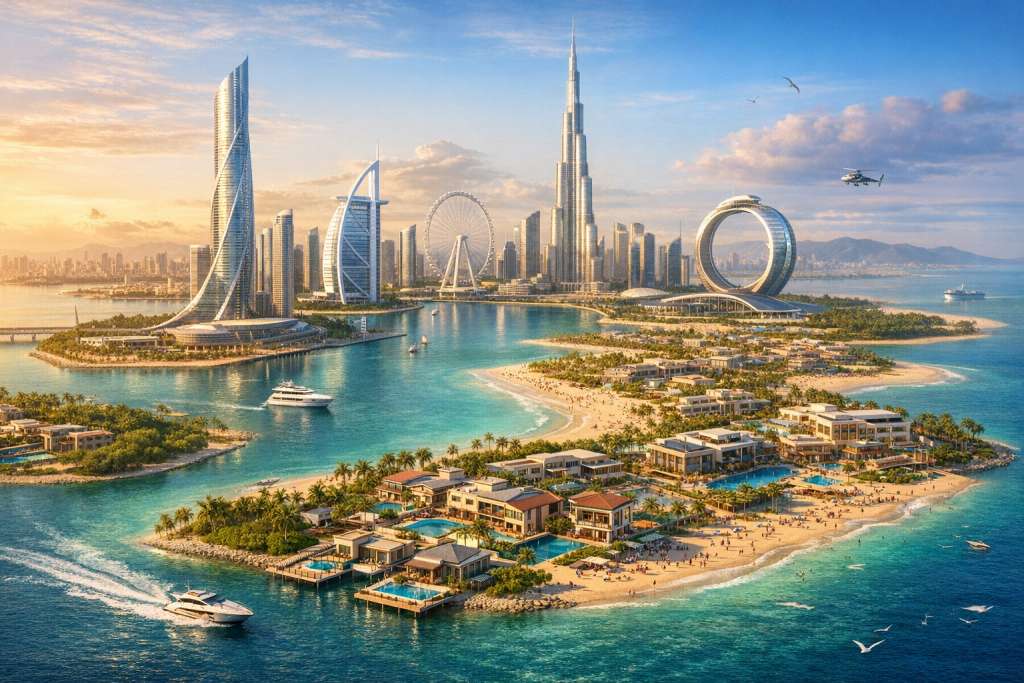
The biggest issue with these islands is the conflict of authority between the federal and provincial governments. The dispute over ownership of these islands between Port Qasim Authority and the Sindh government has been ongoing for years. The Sindh Cabinet has declared these islands protected forests, while the federal government has established the Pakistan Islands Development Authority. This conflict is the biggest obstacle in the way of any development project. Constitutionally speaking, under Article 172 of the Constitution of Pakistan, any property that has no rightful owner, if located in a province, belongs to the provincial government. The Sindh High Court has also given decisions in favor of the provincial government in this matter. Environmentally, these islands are extremely sensitive. According to WWF Pakistan, the delicate ecosystem here is already under pressure from pollution, and concrete development will cause further severe damage. According to the International Union for Conservation of Nature, these islands are among high-priority areas, and there are 10,000 hectares of mangrove forests here. The livelihood of local fishermen is also connected to these islands, and development will affect their sustenance. Despite all these difficulties, these islands have immense development potential. Proximity to Karachi city, the presence of deep water, and natural beauty make them attractive for investment. If the federal-provincial conflict is resolved, a modern city can be built here that could transform Pakistan’s economy. The Dubai model is not just about erecting tall buildings; it is a complete system of laws and institutions. Today, Dubai is a center of world trade, tourism, and finance, and the real reason for its success is its legal system. Two types of zones operate in Dubai: Jebel Ali Free Zone Authority, which is for trade and industry, and Dubai International Financial Centre, which is for finance and law. A partnership has recently been established between these two zones so that companies can easily operate in both zones. The real reason for Dubai’s success is its legal system. The Dubai International Financial Centre has a common law framework, separate courts, and arbitration centers. This system gives international investors confidence that their disputes will be resolved fairly.
Some notable features of Dubai’s legal system are as follows.
The first feature is a separate judicial system. The Dubai International Financial Centre has its own separate courts that operate under English common law. These courts have internationally renowned judges, and cases are decided quickly.
The second feature is currency freedom. In Dubai, there is complete freedom to transact in dollars, and any company can do business in the currency of its choice.
The third feature is tax exemptions. Companies operating in Dubai’s free zones are given tax exemptions for up to 50 years. Income tax, corporate tax, and customs duty are all zero.
The fourth feature is property laws. In Dubai, foreign nationals can also buy property and have complete ownership rights.
The fifth feature is labor laws. In Dubai, international workforce is easily given visas, and there are separate labor laws for them.
The sixth feature is investment protection agreements. The UAE has signed bilateral investment agreements with countries around the world that provide protection to investors.
The seventh feature is transparency. All procedures for doing business in Dubai are transparent and online. From company registration to obtaining a visa, everything is done online.
The eighth feature is infrastructure. Dubai has built the world’s best infrastructure. State-of-the-art airports, ports, roads, and communication systems have connected Dubai to the world.
The ninth feature is political stability. The UAE has been politically stable for the past fifty years, and this stability is very important for investors.
The tenth feature is visa policy. Dubai has one of the most flexible visa policies in the world. There are special visas for investors, professionals, and tourists.
All these features combined have made Dubai one of the world’s most successful economies. Today, more than 20 percent of the world’s astronomical capital works in Dubai, and millions of foreigners reside here. Currently, Pakistan has the Special Economic Zones Act 2012, which provides a legal framework for the establishment and operation of zones. Under this Act, companies operating in zones are given facilities such as customs duty exemptions and income tax exemptions until 2035. But this Act is very limited compared to the Dubai model; it does not include facilities like a separate judicial system, personal laws, and currency.
Legal Revolution – What Laws Does Pakistan Need, The Game of Time – How Many Years Will It Take for the Dream to Be Realized
If we really want to make Pakistan a Dubai-like model, we will have to make the following laws. This is no easy task because these laws require constitutional amendments and political consensus.
The first and most important law is a new special law that brings these islands under the direct control of the federation and grants them exemption from provincial laws. This law will go against provincial autonomy under Articles 154 and 157 of the Constitution and will face strong resistance from the provincial government. Under this law, the islands will be declared a federal territory, and only federal laws will apply here.
The second law relates to the establishment of a separate judicial system. This will require a constitutional amendment because the structure of the judiciary is clearly defined in the existing Constitution. In the new judicial system, English common law will apply, and international arbitration will be recognized. International judges may also be included in these courts, and cases will be decided quickly.
The third law relates to currency. The State Bank of Pakistan’s laws currently do not allow transactions in dollars except in specific cases. In the new law, there will be complete freedom to transact in dollars on the islands, and international companies will be able to do business in the currency of their choice.
The fourth law relates to labor and immigration. Under this law, international workforce will be easily granted visas, and separate labor laws will be made for them. The hiring of workers, their salaries, and their rights will be determined in the new law.
The fifth law relates to property. Under this law, foreign nationals will also be able to buy property here and will have complete ownership rights. All procedures for buying, selling, registering, and inheriting property will be transparent and online.
The sixth law relates to taxes. Under this law, there will be zero percent tax on the islands. Income tax, corporate tax, customs duty, and sales tax will all be zero. These concessions will be a major attraction for international companies.
The seventh law relates to investment protection. Pakistan will have to sign bilateral investment agreements with countries around the world that provide protection to investors. Under these agreements, investors will be protected from nationalization and confiscation.
The eighth law relates to company registration. There will be a separate system for company registration on the islands that will be online and transparent. From company registration to obtaining a visa, all work could be completed in a single day.
The ninth law relates to environmental protection. Along with the development of the islands, environmental protection is also essential. Under this law, development will be carried out while preserving mangrove forests, and pollution will be controlled.
The tenth law relates to the rights of the local population. Fishermen and other local people associated with the islands will be included in the development and will be provided compensation and employment.
Making these laws requires broad political consensus because constitutional amendments require a two-thirds majority. This is very difficult in the current political situation. Additionally, these laws could be challenged in courts.
Implementation of this project can be divided into three phases. Each phase will involve different types of work and different difficulties. Let us examine this journey of time.
The first phase is legislation and resolution of conflicts. This will take at least two to three years. Resolving the conflict between the federation and the province, facing cases in courts, and obtaining a majority in parliament for legislation is no easy task. During this time, environmental protection organizations and local people will also resist.
The following work will be done in this phase: reconciliation efforts between the federation and Sindh government, consultation with political parties for constitutional amendments, preparation of the bill and presentation in parliament, facing cases in courts and their resolution, approval of the environmental protection plan, agreement with the local population and including them in the project, preliminary agreements with international investors, work on public-private partnership models, and detailed engineering design of the project.
The second phase is infrastructure construction. This will take five to ten years. To build a city on 49 square kilometers of area, roads, water, electricity, sewage, and communication systems will have to be built. Being islands in the sea, this work will be more difficult and expensive.
The following work will be done in this phase: leveling the land and preparing it for construction, laying a network of roads and building highways, installing water purification plants and sewage systems, constructing power plants and transmission systems, installing communication systems and internet connectivity, building ports and developing sea routes, constructing an airport and establishing air links, beginning construction of residential and commercial buildings, building hotels and tourist attractions, and establishing parks and recreational areas.
The third phase is attracting investment and populating the city. This will take another ten to fifteen years. It took fifty years for Dubai to become what it is today; Pakistan will also need at least twenty-five to thirty years.
The following work will be done in this phase: organizing international road shows and investment conferences, attracting investment in various sectors, inviting international companies to establish offices, selling residential projects and settling people, promotional campaigns to attract tourists, establishing educational institutions and hospitals, organizing international events and conferences, branding and marketing the city, and continuous improvement and development.
Completing all these phases will take at least twenty-five years. During this time, economic conditions may change, the political situation may change, and international conditions may also change. Therefore, it is essential that the project is made flexible so that it can adapt to changing circumstances.
The Shadow of War – Will Current Circumstances Give Us a Chance, The Search for Capital – Can Gulf Investment Come to Pakistan
But will the current geopolitical situation give us this time, and how can war affect our dream? This is the most important question: will Pakistan have peace for such a long time in the current geopolitical situation? Pakistan is currently facing challenges both internally and externally.
At the internal level, there is the issue of terrorism. Pakistan has been suffering from terrorism for the past two decades, and terrorist incidents have increased in recent days. In February 2026, Pakistan launched Operation Ghazab-e-Haq against the Taliban in Afghanistan, in which dozens of terrorists were killed. As a result of this operation, relations between Pakistan and the Afghan Taliban have become further strained, and there is concern that terrorists may carry out retaliatory actions in Pakistan.
Political instability is also a major problem. In Pakistan, there are severe differences between political parties, and governments are unable to complete their terms. Due to this instability, long-term projects are affected.
The economic crisis is also severe. Pakistan is currently suffering from inflation, unemployment, and a debt crisis. In such circumstances, raising funds for large-scale development projects will be difficult.
At the external level, there is tension with Afghanistan. Relations between Pakistan and the Afghan Taliban are strained, and clashes continue on the border. Due to this tension, regional peace is at risk.
Relations with India are not normal. Tensions persist between the two countries, and clashes continue on the Line of Control. India is also campaigning against Pakistan at the international level.
There is also frequent tension with Iran. Incidents of terrorism and smuggling occur in border areas.
At least twenty-five years of peace is required for the success of this project. In the current circumstances, it is difficult to say that Pakistan will have peace for such a long time. However, if Pakistan actually starts this project, the project itself could become a stimulus for peace because international investors and world powers will be interested in protecting this project.
Under the China-Pakistan Economic Corridor, development is also taking place in Gwadar, and there is talk of adopting the Dubai and Shenzhen model there. Work on the Gwadar project is already underway, and China has heavily invested in it. This project is also an opportunity for Pakistan. International powers are also interested in Pakistan’s stability. The US, China, and Gulf countries want peace in Pakistan because instability also affects their interests.
The possibility of investment outflow from Gulf countries does exist, especially due to the growing interest in digital currency and crypto. If Pakistan makes the right policies, it can attract this investment. There is enormous capital in Gulf countries. The UAE, Saudi Arabia, Qatar, and Kuwait have trillions of dollars in capital that is being invested in foreign countries. These countries want to diversify their economies and reduce dependence on oil. In recent years, interest in digital currency and crypto has increased in Gulf countries. Dubai has made special laws for crypto, and crypto companies are operating here in large numbers.
There is also interest in crypto in Pakistan, and several crypto exchanges are operating here. If Pakistan makes friendly laws for crypto, Gulf investment could come to Pakistan.
But Pakistan faces intense competition. The UAE itself is making new laws to retain investment. In March 2025, Dubai made a new law under which free zone companies can now also operate on the mainland. Saudi Arabia has the Neom project. Neom is a 500 billion dollar project in which a modern city is being built. This project is expected to be completed by 2030 and is attracting investment from around the world. Qatar is also making large investments. After the 2022 World Cup, Qatar has started large projects to further develop its economy.
Under the China-Pakistan Economic Corridor, development is also taking place in Gwadar, and there is talk of adopting the Dubai and Shenzhen model there. Work on the Gwadar project is already underway, and China has heavily invested in it.
The biggest challenge for Pakistan is the lack of trust. International investors are afraid of Pakistan’s political instability, terrorism, and corruption. Without solving these problems, attracting large investment will be difficult.
The second challenge is the complexity of the legal system. In Pakistan, doing business requires going through dozens of laws and regulations. This process is not only lengthy but also expensive.
The third challenge is the lack of infrastructure. In Pakistan, there is load shedding of electricity, roads are not good, and there is a shortage of water. Without solving these problems, no modern city can be built.
The fourth challenge is the visa policy. Pakistan’s visa policy is very strict, and foreigners face difficulties in obtaining visas.
The fifth challenge is the devaluation of currency. The Pakistani rupee is continuously falling, and international investors are afraid of this.
Despite all these challenges, there are investment opportunities in Pakistan. Pakistan’s large population, strategic location, and natural resources can attract investors.
Conclusion and Recommendations – Can the Dream Come True
Building a Dubai-like model on Buddo and Bundal Islands is technically possible because the area is sufficient and these islands are uninhabited. But the legal, political, and environmental obstacles are very high.
Resolving the federal-provincial conflict is the biggest challenge without which no development is possible. Environmental concerns must be addressed, and the local population must be included in the project.
Changing laws requires broad political consensus because constitutional amendments require a two-thirds majority. This is very difficult in the current political situation.
Time is an issue; this project needs twenty-five years, while war and instability can hinder it. However, if the project starts, it could itself become a cause of stability.
Competition regarding investment is very intense. Dubai, Saudi Arabia, and Qatar are already working on large projects, and Pakistan will have to compete with them.
To make this project successful, an agreement should be reached between the federation and the province in which the province is given an appropriate share of the profits and its powers are protected. The Sindh government should be assured that the province will benefit from this project and its autonomy will not be affected.
A comprehensive plan should be made for environmental protection, and development should be carried out while preserving mangrove forests. International environmental organizations should also be included in this project so that they can monitor it.
Changes in laws should be made gradually; first, the Special Economic Zones Act should be expanded, and then gradually more concessions should be given. A separate authority should be established to oversee the implementation of these laws.
To build the confidence of international investors, bilateral investment agreements should be signed and their protection guaranteed. Investors should be assured that their investment is safe and their disputes will be resolved fairly.
The local population should be included in the project and provided employment opportunities. Fishermen should be given alternative employment, and their settlements should be provided with modern facilities.
A public awareness campaign should be conducted so that people understand the importance of this project and support it. The media should also cover this project so that public confidence is built.
Consensus should be developed among political parties so that this project continues even if the government changes. All major political parties should sign this project so that it becomes a national project.
International experts should also be included in this project so that the best practices of the world can be adopted. Experiences from Dubai, Singapore, and other successful cities should be learned.
The project should be divided into phases, and targets should be set for each phase. In the first phase, small projects should be started so that the chances of success increase.
Transparency should be ensured, and all details of the project should be made public. An online portal should be created where the progress of the project can be seen.
In conclusion, it can be said that Pakistan’s dream of becoming Dubai is not impossible, but it is certainly extremely difficult. It requires political stability, legal reforms, public support, and international investment. If all these come together, Buddo and Bundal Islands really can change Pakistan’s destiny.
For more reading please visit our Articles.