
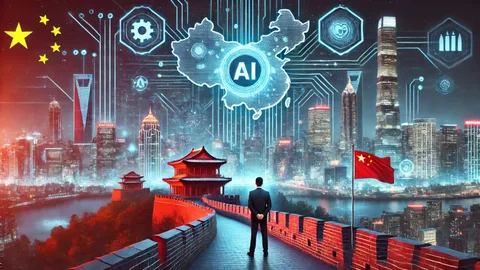

China’s rise as an artificial intelligence superpower is no longer a distant forecast it is unfolding right now. From the remarkable emergence of DeepSeek AI to the rapid spread of Chinese AI websites offering free tools to global users, the world is witnessing one of the most dramatic technological shifts in history. The sleeping giant has awakened, and its eyes are fixed firmly on AI dominance.
This opinion piece explores the Chinese artificial intelligence growth story, how China compares to global rivals, what the best Chinese AI models look like today, and why the world must pay close attention.
BACKGROUND
How China Built Its AI Foundation
China’s ambition in artificial intelligence did not happen overnight. Back in 2017, the Chinese government released its New Generation Artificial Intelligence Development Plan — a landmark document setting the goal of making China the world’s primary AI innovation center by 2030. That single policy decision unleashed hundreds of billions of dollars in state and private investment.
Chinese technology giants such as Baidu, Alibaba, Tencent, and Huawei poured resources into AI research, cloud infrastructure, and big data. Universities expanded AI programs rapidly, and thousands of Chinese students returned home after studying machine learning abroad. The foundations were being laid quietly, systematically, and at enormous scale.
What truly shocked the world, however, was not slow corporate investment. It was the sudden, dramatic arrival of DeepSeek AI on the global stage forcing a complete reappraisal of everything the West believed about Chinese artificial intelligence growth.
DETAILS
DeepSeek AI: The Model That Shook Silicon Valley
DeepSeek AI is a Chinese AI research company that released its flagship model, DeepSeek-R1, in early 2025 and stunned the global technology community. What made DeepSeek remarkable was not only its performance, which matched or exceeded leading Western models on several benchmarks, but the extraordinary efficiency with which it was built. The company reportedly trained its model at a fraction of the cost of comparable American systems, even while operating under strict US semiconductor export restrictions.
This revelation sent shockwaves through Wall Street, with shares of major chip companies falling sharply. It raised urgent questions across boardrooms and government offices alike. How did a Chinese AI company achieve this? And is the Western world once again underestimating Chinese artificial intelligence growth?
DeepSeek AI is now widely considered one of the best Chinese AI models available anywhere. Its open-weight versions have been downloaded millions of times globally, and several Chinese AI websites now offer free access to DeepSeek-powered tools for everyday users around the world.
The Broader Chinese AI Ecosystem
DeepSeek AI is impressive, but it is only one chapter of a much larger story. China’s AI ecosystem is vast, diverse, and accelerating. The country is home to hundreds of Chinese AI companies working across computer vision, natural language processing, robotics, autonomous vehicles, and drug discovery.
Kimi, developed by Moonshot AI, is another Chinese AI name that has gained strong international traction — offering a long-context AI assistant popular among researchers and professionals. Baidu’s ERNIE Bot has attracted tens of millions of registered users. Alibaba’s Qwen model family has demonstrated competitive performance across multiple global AI benchmarks.
For those searching for the best Chinese AI tools today, several Chinese AI websites offer free access to powerful models. Platforms such as Kimi.ai, Doubao by ByteDance, and the official DeepSeek website allow users to access AI in China for PDF generation, text analysis, coding assistance, and much more often at no cost whatsoever.
Hardware, Chips, and the Nvidia Question
One of the most dramatic claims in recent technology discourse involves Chinese chip development. Huawei’s Ascend AI chips have drawn serious global attention. While no Chinese chip has been independently verified as 1000x faster than Nvidia as of April 2026, China’s semiconductor ambitions are real, well-funded, and growing fast.
US export controls on advanced Nvidia chips intended to slow Chinese artificial intelligence growth have instead accelerated China’s domestic chip development. Huawei, SMIC, and dozens of smaller Chinese semiconductor firms are all racing to close the technology gap. Most credible analysts place China one to three generations behind the very best US chips, but the trajectory is improving faster than most Western observers predicted.
If China develops competitive AI hardware at scale, the last major technological leverage point the West holds may disappear within this decade.
QUOTES
“China’s AI capabilities have been systematically underestimated by Western observers for years. DeepSeek was not a surprise to those paying close attention it was the inevitable result of enormous talent, capital, and government commitment.” AI Researcher, Oxford Internet Institute
“The question is no longer whether China can compete in artificial intelligence. The question is whether the rest of the world is prepared to compete with China.” Technology Policy Analyst, Council on Foreign Relations
What China’s AI Rise Means for the World
The global impact of Chinese artificial intelligence growth is already being felt across multiple domains. In geopolitics, AI has become a central dimension of strategic competition between the United States and China, with both governments racing to set standards, build alliances, and shape international AI governance in line with their own values.
For developing nations across Asia, Africa, and Latin America, Chinese AI presents a genuine and affordable alternative to Western platforms. China’s approach offering capable tools free of charge, often bundled with infrastructure investment is winning real influence in regions where American and European companies price themselves out of reach.
For businesses globally, the rise of Chinese AI names like DeepSeek, Qwen, and Kimi means more competition, lower prices, and faster innovation cycles. Small businesses and independent developers in lower-income countries now have access to powerful AI tools that simply did not exist for them two years ago.
For workers in knowledge industries writers, coders, analysts, translators the rapid spread of AI in China and beyond is accelerating automation pressures that were already transforming labour markets worldwide.
CONCLUSION
The Giant Is Fully Awake
The story of AI in China a sleeping giant awakens is no longer a metaphor. It is operational reality. China has built a world-class AI research community, deployed artificial intelligence at scale across its economy, and produced globally competitive models like DeepSeek AI that have genuinely surprised even the most informed international observers.
The years ahead will determine whether the world moves toward a fragmented AI landscape with distinct American, Chinese, and European ecosystems or whether cooperative international AI governance becomes possible. What is certain is that Chinese artificial intelligence growth will continue at pace, and the world will be shaped by it whether prepared or not.
For policymakers, the task is no longer to stop China’s AI rise that moment has passed. It is to engage thoughtfully with a world in which multiple AI superpowers coexist. For businesses and individuals, the practical reality is simpler: the best Chinese AI tools are here, they are often free, and they are very, very capable.
FAQs
Is China big on AI?
Yes, China is one of the world’s leading nations in artificial intelligence. The Chinese government has invested hundreds of billions of dollars in AI since publishing its national development strategy in 2017. China produces more AI research papers than any other country and is home to a fast-growing ecosystem of companies including DeepSeek AI, Baidu, Alibaba, and Huawei. Chinese artificial intelligence growth consistently ranks among the fastest in the world.
Is China’s chip 1000x faster than Nvidia?
This claim has circulated widely but lacks verified independent evidence as of April 2026. No Chinese chip has been publicly benchmarked and confirmed to be 1000x faster than Nvidia’s best processors. However, China’s semiconductor ambitions are serious and advancing rapidly. Huawei’s Ascend chips have made meaningful progress, and the domestic chip industry is pushing hard under pressure from US export restrictions. Most analysts place China one to three generations behind leading US chips but the gap is narrowing.
Which country is No. 1 in AI?
The United States currently leads in overall AI capability, especially in frontier model development, chip design, and private sector investment. However, China is a very close second, and by some measures including AI patents filed and AI researchers trained annually has already surpassed the US in certain categories. The UK, Canada, France, and Israel are also significant AI powers. The global race is intensely competitive, and China’s continued rise means the gap with the US is shrinking with each passing year.