Israel’s interception of the Global Sumud Flotilla in international waters has sparked one of the most severe diplomatic crises the country has faced in recent memory. The incident, which unfolded in mid-May 2026, drew global condemnation after nearly 430 flotilla activists were detained, humiliated, and ultimately deported with videos of the ordeal going viral worldwide.
The crisis did not end with the deportations. On May 23, 2026, fresh violence broke out at Bilbao Airport in flotilla Spain, where Basque police beat and detained returning flotilla activists, adding yet another chapter to an already explosive international incident.
Background: What Is the Global Sumud Flotilla?
The Global Sumud Flotilla is an international solidarity movement formed in direct response to calls from Palestinians inside Gaza. The word Sumud is an Arabic term meaning steadfastness and resilience reflecting the spirit of the Palestinian people against occupation and siege.
In Spring 2026, the Gaza flotilla set sail from Spain with a fleet of more than 50 vessels and nearly 500 participants from dozens of countries. The mission aimed to break Israel’s 18-year-long naval blockade of Gaza and deliver desperately needed food, medicine, and humanitarian supplies to Palestinian civilians trapped inside the territory.
The Global Sumud Flotilla described itself as a nonviolent mission, backed by grassroots movements across the world. Prominent activists, including Swedish climate campaigner Greta Thunberg, were among those on board. The flotilla represented the largest maritime solidarity effort for Gaza in history.
Details: How Israel Intercepted the Gaza Flotilla
On May 19, 2026, Israeli naval forces intercepted the Gaza flotilla while it was sailing in international waters in the Mediterranean Sea approximately 600 nautical miles from Israel’s own coastline. Israeli forces boarded over 50 vessels and detained around 430 crew members and flotilla activists.
According to Israel news reports, including coverage by The Jerusalem Post, Israeli officials justified the operation by stating that the naval blockade of Gaza is a lawful measure and that no breach would be permitted. Israel’s Foreign Ministry stated that “Israel will not permit any breach of the lawful naval blockade on Gaza.”
Two activists Spanish-Swedish national Saif Abukeshek and Brazilian citizen Thiago Ávila were taken directly to Israel, where they were held on terrorism charges and faced interrogation for approximately one week before being deported. The United Nations Human Rights Office (OHCHR) demanded their immediate and unconditional release, stating that showing solidarity and attempting to deliver humanitarian aid to Gaza is not a crime.
Amnesty International also condemned the interceptions, describing Israel’s action as “brazen and unlawful” and warning that the arbitrary detention of the flotilla activists underscored decades of impunity for human rights violations against Palestinians.
Ben-Gvir’s Shocking Videos Cause Diplomatic Firestorm
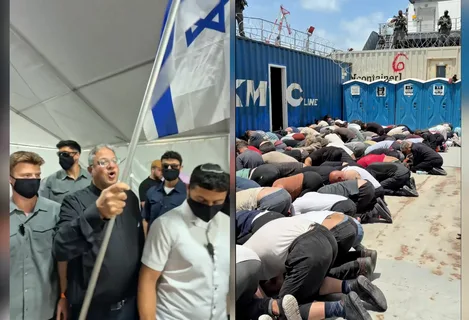
The crisis escalated dramatically when Israel’s far-right National Security Minister Itamar Ben-Gvir posted videos online showing him walking among the detained flotilla activists at Ashdod Port. In the footage, detainees were forced to kneel on the ground with their hands tied behind their backs, heads touching the floor in what appeared to be a makeshift detention area on a ship’s deck.
In one widely circulated clip, Ben-Gvir pushed down the head of a detained woman who called out “Free, free Palestine,” responding in Hebrew with a command to be silent. In another clip, he was seen waving an Israeli flag and shouting “Welcome to Israel!” to the bound prisoners.
The videos immediately ignited a global firestorm. Multiple countries including Britain, France, Portugal, Australia, New Zealand, Spain, Poland, and Italy summoned their respective Israeli ambassadors or chargés d’affaires to formally register their outrage. British Foreign Secretary Yvette Cooper described being “truly appalled” by Ben-Gvir‘s conduct, stating that it “violates the most basic standards of respect and dignity.”
Even within Israel, Ben-Gvir’s actions were condemned. Prime Minister Benjamin Netanyahu issued a rare public rebuke of his own minister. According to Jerusalem Post reports, Netanyahu acknowledged Israel’s right to stop “provocative flotillas,” but stated clearly that the manner in which Ben-Gvir dealt with the flotilla activists was “not in line with Israel’s values and norms.” Foreign Minister Gideon Sa’ar went further, accusing Ben-Gvir of knowingly damaging the state’s reputation with what he called a “disgraceful display.”
Around 90 of the detained Israel flotilla activists began a hunger strike in protest of their conditions. Flotilla organizers reported that at least 15 activists alleged incidents of sexual assault or rape while in Israeli custody. Israeli prison authorities denied all allegations of mistreatment.
Quotes: Officials and Experts Respond
Prime Minister Benjamin Netanyahu stated: “Israel has every right to prevent provocative flotillas of Hamas terrorist supporters from entering our territorial waters and reaching Gaza. However, the way that Minister Ben-Gvir dealt with the flotilla activists is not in line with Israel’s values and norms.”
Spanish Foreign Minister Jose Manuel Albares condemned Ben-Gvir’s treatment of flotilla activists, calling it “monstrous, undignified, and humiliating.” Spain also called on the European Union to suspend its trade agreement with Israel over the matter.
Amnesty International’s Senior Director Erika Guevara Rosas stated that Israel’s interception of the Global Sumud Flotilla vessels “underscores the dangerous consequences of decades of impunity for Israel’s ongoing atrocity crimes against Palestinians.”
The OHCHR called on Israel to investigate “disturbing accounts of severe mistreatment” of the two activists taken to Israeli soil, and demanded those responsible be brought to justice.
Ben-Gvir himself disagreed with the eventual decision to deport the flotilla activists, and alluded to threats from Turkey as one factor behind the deportations.
Spain Flotilla: New Violence Erupts at Bilbao Airport
Even after deportations were completed, the flotilla Spain story took another dramatic turn. On May 23, 2026, six Global Sumud Flotilla activists landed at Bilbao Airport in Spain’s Basque Country after being flown back from Turkey. A group of supporters and family members had gathered in the arrivals hall to welcome them home.
Footage quickly spread on social media showing Basque regional police the Ertzaintza striking activists and supporters with batons and dragging them across the terminal floor. When a relative of one of the returning activists attempted to approach them, an officer forcefully intervened, triggering violent scuffles. Four people were arrested and taken to Deusto police station in Bilbao.
Amnesty International condemned what it described as the “excessive use of force” by Basque police officers, stating that images showed “no legitimate cause for the use of force” and raising alarm over the use of batons against people already on the ground. The Basque regional police launched an internal investigation into the officers’ conduct.
In an ironic twist, Israel’s Foreign Ministry shared footage of the Bilbao clashes on social media, demanding an explanation from the Spanish government regarding “its treatment of the flotilla anarchists.” This drew sharp criticism from observers who noted that Israel was mocking Spain’s police violence just days after Ben-Gvir had posted his own videos of bound and kneeling detainees.
Spain’s Podemos party leader Ione Belarra condemned the police response at Bilbao Airport, stating that the flotilla activists had risked their lives at sea and “should not have been beaten” upon arriving home. Left-wing Basque nationalist party EH Bildu also called the police action unjustified and demanded accountability.
Impact: Global Diplomatic Fallout and Mass Protests
The Israel flotilla crisis has had sweeping international consequences. The foreign ministers of ten countries including Spain, Brazil, and India jointly condemned Israel’s interceptions as “blatant violations of international law and international humanitarian law.”
Turkey played a central role in the aftermath, evacuating 422 flotilla activists on chartered flights, including 85 Turkish citizens. Ankara also deployed doctors and ambulances to treat returning participants. Crowds of supporters waving Palestinian flags welcomed the activists at Istanbul Airport.
According to Israel news reports from The Jerusalem Post, Israel’s Hasbara (public diplomacy) budget was already projected to leap from roughly $15 million in 2023 to an unprecedented $700 million by 2026 yet analysts noted that Ben-Gvir’s viral videos effectively dismantled this heavily funded narrative effort in an instant.
Massive street protests erupted across Europe in response to the Gaza flotilla interceptions. In Spain, 70,000 people demonstrated in Barcelona. Tens of thousands gathered in Rome. The Global Sumud Flotilla declared that despite the interception, the movement would continue and would not be deterred.
Conclusion: What Comes Next
The Israel flotilla crisis shows no signs of fading quickly. Israel has completed the deportation of all detained flotilla activists, but the diplomatic damage continues to mount. Multiple European governments have signaled they will push for stronger measures against Israel at the European Union level, with Spain leading calls to suspend Israel’s trade agreement with the EU.
The Global Sumud Flotilla has declared that it will continue its mission. Organizers have announced plans to regroup at the Turkish port of Marmaris and press forward with their campaign to break the Gaza blockade by land, sea, and across borders.
Meanwhile, the internal Israeli political fallout over Ben-Gvir’s conduct continues to grow. Whether Netanyahu’s rare rebuke of his own minister leads to any formal consequences remains to be seen. As Jerusalem Post reporting has noted, Israeli officials view the flotilla primarily as a narrative and diplomatic challenge and Ben-Gvir’s videos have made that challenge far more difficult to manage.
For the hundreds of flotilla activists who lived through detention at Ashdod, then clashes at Bilbao Airport, and for the families of the two activists held in Israel on terrorism charges, the human toll of the crisis is already very real. The world is watching closely to see what the Global Sumud Flotilla does next and how Israel and the international community respond.
FAQs
Can the British enter Israel?
British citizens can generally travel to Israel, though the UK government advises checking current travel advisories before departing. As of 2026, British nationals do not require a visa for short visits to Israel. However, travelers with Palestinian heritage or who have visited certain countries may face additional scrutiny at Israeli border control. The UK Foreign Office maintains updated guidance on its official website for those planning travel.
Which country is Israel’s best friend?
The United States has historically been Israel’s closest and most significant ally. The relationship is built on deep strategic, military, and diplomatic ties stretching back to Israel’s founding in 1948. The US provides substantial military aid to Israel annually and has repeatedly used its United Nations Security Council veto to shield Israel from resolutions it opposes. While other countries such as Germany, the United Kingdom, and some Gulf states maintain strong bilateral ties with Israel, the US-Israel relationship remains uniquely close.
Who is the biggest supplier of weapons to Israel?
The United States is by far the largest supplier of weapons and military equipment to Israel. This includes fighter jets, precision-guided munitions, artillery shells, and other advanced military hardware. Germany has historically been the second-largest arms supplier. Following the Hamas attacks of October 7, 2023, and Israel’s subsequent military campaign in Gaza, several countries including the UK, Canada, and others paused or reviewed arms sales, while the US continued its military support. The scale of US arms transfers to Israel during the Gaza conflict became a major point of international debate through 2025 and 2026.