

The men who built their careers on China-bashing went quiet. That silence is itself the story. The Trump Beijing trip ended on Friday with no major breakthroughs on trade, no tangible help from Beijing on the Iran war, and a $14 billion Taiwan arms sale left dangling yet not a single prominent MAGA China hawk publicly challenged the president on any of it.
The Trump China visit 2026 has raised a fundamental question about the MAGA movement’s China hawkery: was it always ideological or was it always just about Trump?
What Actually Happened in Beijing
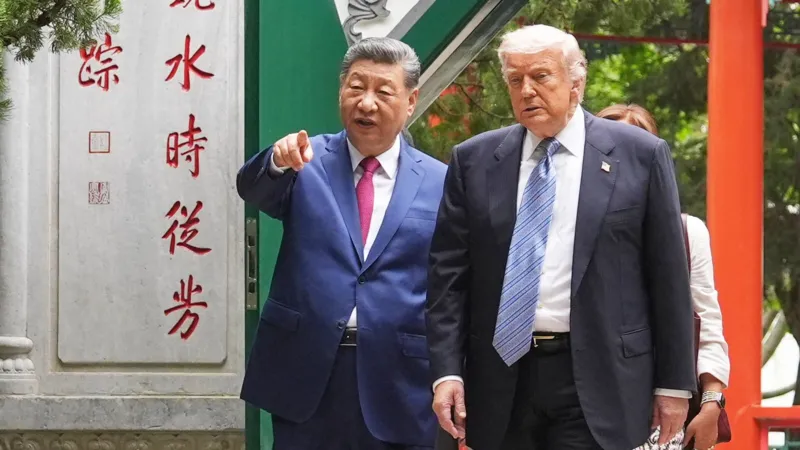
Trump arrived at the Great Hall of the People on May 13 to hundreds of flag-waving children and a military band playing the Star-Spangled Banner. He called Xi Jinping a “great leader,” a “friend,” and “a man I respect greatly” and invited him to the White House in September. The Trump China visit schedule included a state banquet, a tour of Zhongnanhai, and two days of talks that produced a Chinese commitment to purchase 200 Boeing aircraft and vague pledges of cooperation. What it did not produce was a deal on trade tariffs, a framework for resolving the Iran war, or clarity on Taiwan. Trump returned to Washington with Xi’s warm words and precious little else.
MAGA Hawks Went Silent And That Silence Speaks Volumes
The most revealing element of the Trump Beijing trip aftermath was the absence of criticism from within Trump’s own coalition. Secretary of State Marco Rubio, Vice President JD Vance, and senior economic counsellor Peter Navarro all architects of the anti-China tariff strategy and all present in Beijing said nothing that contradicted the president’s warm tone. Capitol Hill China hawks, who had sent a bipartisan letter before the trip urging Trump to move ahead with the Taiwan arms sale, offered little follow-up criticism when Trump returned non-committal. For China experts in Washington, none of this came as a surprise the MAGA movement’s China hawkery has always been conditional on Trump’s own posture.
Taiwan The Biggest Unanswered Question
The Trump China visit 2026 produced its most alarming moment on the Taiwan question. Xi opened the first day of closed-door talks with a stark warning mishandling Taiwan could lead to “clashes and even conflicts” that would put the entire US-China relationship in jeopardy. The White House readout of those talks made no mention of Taiwan. China’s readout made it the central point. Trump told reporters he had discussed the pending $14 billion arms sale which includes missiles and air defence interceptors in “great detail” with Xi and would “make a determination over the next fairly short period.” He also said he had discussed the arms deal despite a 1982 agreement that the US would not consult China on such sales. “What am I going to do, say I don’t want to talk about it?” Trump said.
What Trump Conceded Without Announcing It
The Trump China trip itinerary included several concessions that received far less attention than the Boeing aircraft deal. Trump agreed to sell Nvidia’s advanced AI-powered semiconductor chips to China a significant reversal of the export control policies his own administration had championed. He suspended a planned $13 billion arms sale to Taiwan before the trip even began. He also said he was “considering” lifting sanctions on Chinese companies buying Iranian oil a move that would directly benefit Beijing’s energy strategy. And he echoed Xi’s talking points that Taiwan had been part of China “for thousands of years” a statement that alarmed US allies in Taipei, Tokyo, and Seoul. Japanese Prime Minister Sanae Takaichi, who received a briefing call from Trump aboard Air Force One, has found her hawkish Taiwan line increasingly at odds with Washington’s posture.
Xi Called America a Declining Nation Trump Agreed
The single most extraordinary moment of the Trump Beijing trip came after the cameras were off. Xi reportedly told Trump privately that the United States was perhaps a declining nation a reference to the Thucydides Trap theory about how rising and declining powers come into conflict. When the remark leaked, Trump did not push back. Instead, he endorsed it saying Xi was “100% correct” that America had declined, but insisting Xi was referring specifically to the Biden years. Reports from Beijing suggest Chinese officials privately view Trump not as a strong negotiating adversary but as evidence of American institutional decline. Trump, meanwhile, called the roses at Zhongnanhai “the most beautiful roses anyone has ever seen.”
What the Hawks Are Telling Themselves
For those MAGA figures who built their platforms on confronting China, the Trump China visit 2026 requires a certain amount of mental gymnastics. Some are framing the trip as tactical patience Trump is managing multiple crises simultaneously, and a stable US-China relationship is necessary to resolve the Iran war before taking a harder line. Others are pointing to the Boeing deal and chip sales as economic wins that justify the diplomatic tone. A smaller number mostly outside the administration have privately acknowledged that Trump’s softening on China reflects something more fundamental: a president who was never truly ideologically committed to confronting Beijing, and who has now discovered that cooperation serves his immediate interests better than confrontation.
Empty-Handed The Verdict From Beijing Watchers
The consensus among China experts who watched the Trump Beijing trip closely is unambiguous. Trump left Beijing having given more than he received. China got semiconductor access, a suspended Taiwan arms sale, and a US president willing to discuss future arms sales with Beijing directly. The US got a Boeing order and a verbal pledge from Xi not to send military equipment to Iran neither of which is legally binding. David Firestein of the George HW Bush Foundation said that even fifty presidential summits would not resolve issues on which the two sides are “simply never going to agree.” What the trip did was confirm something many in Beijing had already suspected: that Xi currently holds the stronger hand.
Frequently Asked Questions
Has Trump ever been to Beijing before the 2026 trip?
Yes. Trump’s first Trump China visit was in November 2017, during his first term, when he met Xi Jinping for a state visit that included a tour of the Forbidden City. That trip was widely described as producing few concrete results. The Trump Beijing trip in May 2026 is his second visit to Beijing and by most expert assessments, the second trip produced even fewer substantive deliverables than the first, despite significantly higher geopolitical stakes.
What is Trump’s issue with China and has it changed?
Trump built his political brand partly on confronting China accusing Beijing of “ripping off” America on trade, stealing technology, and flooding US streets with fentanyl. His first and second terms both began with aggressive tariffs on Chinese goods, eventually reaching 145% in April 2025. China retaliated with 125% tariffs and rare earth export restrictions. A partial truce reached in Geneva in May 2025 reduced tariffs to 30% on both sides. The Trump China visit 2026 suggests Trump’s confrontational posture has softened significantly driven by the Iran war, China’s leverage over rare earth exports, and Trump’s personal relationship with Xi.
Is it safe to go to China in 2026?
China remains open to international visitors in 2026, with no active travel bans in place for most nationalities. The Trump China visit schedule in May 2026 proceeded without incident, with tight security around the presidential delegation but normal conditions elsewhere in Beijing. Standard travel precautions apply travellers should be aware of China’s internet restrictions, register with their embassy, and check their government’s latest travel advisory before departing. The US State Department currently rates China at Level 2 Exercise Increased Caution primarily due to the risk of arbitrary law enforcement actions against foreign nationals.