
(Publish from Houston Texas USA)
(By: Mian Iftikhar Ahmed)
US sees Mohammad Baqer Qalibaf as a potential negotiator as Iran grapples with a deepening leadership crisis
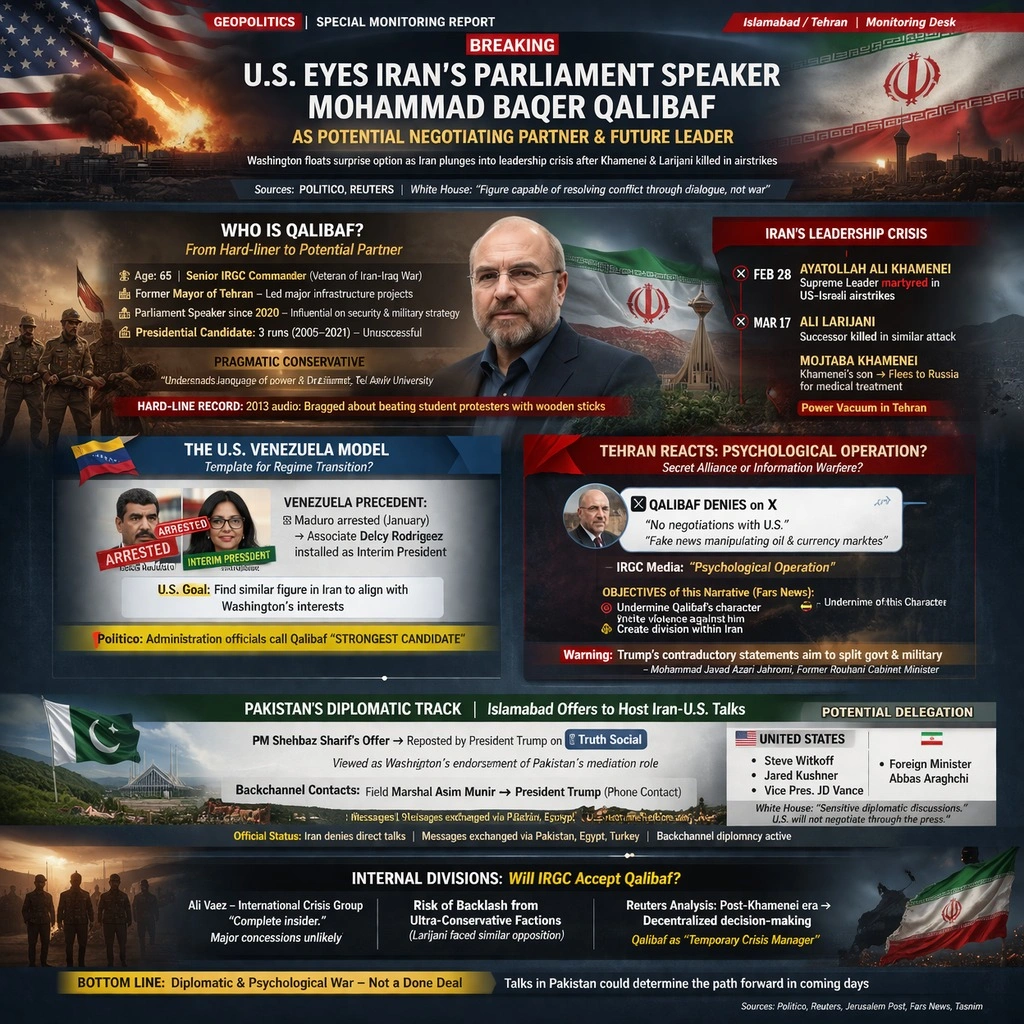
Islamabad / Tehran (Monitoring Desk): In a startling development in global politics, the US administration is evaluating Iran’s Parliament Speaker Mohammad Baqer Qalibaf as a potential negotiating partner and future leader. According to reports by the renowned American magazine Politico and the news agency Reuters, the White House has described Qalibaf as a figure capable of resolving the conflict through dialogue rather than war. This news comes at a time when Iran is facing a severe leadership crisis. Reports indicate that Iran’s Supreme Leader Ayatollah Ali Khamenei was martyred on February 28 in US and Israeli airstrikes, while his successor Ali Larijani was also killed in a similar attack on March 17. Khamenei’s son, Mojtaba Khamenei, who was a candidate for the new Supreme Leader, has left for an undisclosed location in Russia for treatment.
Who is Mohammad Baqer Qalibaf? From Hard-liner to Potential Partner: Mohammad Baqer Qalibaf, 65, is not merely a politician. He is a senior commander of the Islamic Revolutionary Guard Corps (IRGC) and fought on the front lines during the Iran-Iraq war. Subsequently, he served as the mayor of Tehran, where he played a significant role in the city’s infrastructure development. Since 2005, he has run for president three times but has not succeeded. He has been the Speaker of the Iranian Parliament since 2020, and in this role, his influence extends to national security and military strategy. According to Dr. Raz Zimmt, a national security expert at Tel Aviv University, Qalibaf understands the language of power and interests. He is known as a pragmatic conservative who prioritizes practical interests over ideology. However, he also has a history of hard-line stances. In a 2013 audio recording, he was heard saying that he struck student protesters with wooden sticks and took pride in it.
The US’s Venezuela Model and Mohammad Baqer Qalibaf’s Role: According to US media reports, the Trump administration seeks to apply the Venezuela model to Iran. Under this model, Venezuelan President Nicolás Maduro was arrested in January and his close associate Delcy Rodríguez was appointed interim president. The US wants a similar figure to emerge in Iran who can cooperate with Washington’s interests. According to Politico, administration officials are calling Qalibaf the strongest candidate for this role. However, experts remain skeptical. According to an analysis by the Jerusalem Post, while Qalibaf might be more manageable than Khamenei, he remains a guardian of the IRGC’s regional dominance, making him highly dangerous. Qalibaf himself continues to make hard-line statements. He has stated that not only US military bases but also entities providing them financial support are legitimate targets, and that the Strait of Hormuz will not return to its pre-war state.
Political Storm in Tehran: Psychological Operation or Secret Alliance?: The news published in US media has caused significant political upheaval in Tehran. Qalibaf himself has strongly denied these reports on the social media platform X. He wrote that no negotiations have taken place with the US and that fake news is being used to manipulate financial and oil markets. Media outlets affiliated with the IRGC have labeled these reports a psychological operation. According to Fars News, there are three objectives behind this narrative: to undermine Qalibaf’s character, incite violence against him, and create division within the country. Tasnim News has described it as a complex scheme orchestrated by the enemy to create an impression of internal strife. Mohammad Javad Azari Jahromi, who served as a minister in Hassan Rouhani’s cabinet, has also warned that Trump’s contradictory statements aim to create a rift between the government and military forces.
Pakistan’s Role: Will Talks Be Held in Islamabad?: In this entire matter, Pakistan has positioned itself as a key mediator. Prime Minister Shehbaz Sharif has publicly offered to host Iran-US talks in Pakistan. President Trump himself reposted Shehbaz Sharif’s offer on his social media platform Truth Social, which is being viewed in diplomatic circles as Washington’s endorsement of Pakistan’s role. According to sources, Pakistan’s military leadership is also actively engaged in this regard. Field Marshal Asim Munir has had telephone contact with President Trump. The White House said about these talks: These are sensitive diplomatic discussions and the US will not negotiate through the press. Sources indicate that the US delegation may include Steve Witkoff, Jared Kushner, and Vice President JD Vance. On the Iranian side, Foreign Minister Abbas Araghchi could lead the negotiating team. While Iran has officially denied direct talks with the US, it has acknowledged that messages are being exchanged through countries such as Pakistan, Egypt, and Turkey.
Internal Divisions: Will the IRGC Accept Mohammad Baqer Qalibaf?: Experts say that although Qalibaf appears pragmatic on the surface, he is fully committed to preserving the Islamic system. According to Ali Vaez of the International Crisis Group, he is a complete insider and major concessions are unlikely. If he were to strike a deal with the US, he could face severe threats from ultra-conservative factions. It is worth recalling that Ali Larijani had also attempted negotiations with the US in the past but was unable to reach any agreement due to opposition from hard-liners. Reuters has analyzed that in the post-Khamenei era, Iran is moving toward a decentralized structure rather than a single leader, where decisions are made collectively. In such a scenario, figures like Qalibaf could emerge as temporary crisis managers. In summary, while the US has identified Qalibaf as a potential negotiating partner, Iran’s internal system has rejected this narrative. For now, this represents an intense diplomatic and psychological war, not a predetermined political change. In the coming days, possible talks in Pakistan will determine the direction of this matter.
For more information please visit our International news.