
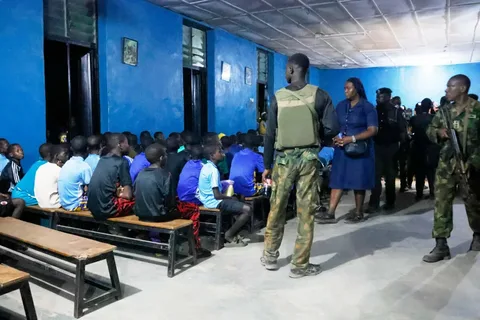
Armed gunmen stormed a school in Nigeria’s northeastern Borno State on Friday morning, kidnapping dozens of students in broad daylight. The brutal attack at Mussa Primary and Junior Secondary School in Askira-Uba Local Government Area has shaken the nation once again. It is a grim reminder of Nigeria X the never-ending cycle of violence that has turned Nigeria’s education struggle into a national tragedy.
Background
Nigeria has been battling an insurgency for over 17 years. The northeastern region, particularly Borno State, has been the epicenter of attacks carried out by extremist armed groups. The most haunting chapter of this crisis remains the April 2014 abduction of the Chibok girls — when more than 270 schoolgirls were taken from their school in Chibok by Boko Haram fighters.
That single event changed how the world saw Nigeria. The Chibok girls story sparked a global campaign with the hashtag #BringBackOurGirls, putting enormous pressure on Nigerian authorities. Yet years later, history appears to be repeating itself. The ovey Friday Nigeria education struggle continues, as students remain soft targets for armed groups seeking leverage, money, and attention.
What Happened: The Borno State School Attack
On the morning of Friday, May 16, 2026, armed fighters arrived at Mussa Primary and Junior Secondary School in Askira-Uba, Borno State, at around 9 am local time. Classes were in full session when the attackers descended on the school.
A local resident named Ubaidallah Hasaan, who lives near the school, confirmed to international media that several students were forcibly taken away by the gunmen. The attack was swift, calculated, and deeply disturbing.
A teacher at the school provided a harrowing eyewitness account. The attackers arrived on motorcycles, moving fast and leaving chaos behind. “Despite some students escaping to the bushes, many were taken away,” the teacher said. The school was immediately thrown into panic, with frightened children fleeing in all directions.
No armed group has yet claimed responsibility for the raid. However, security analysts say the nature and tactics of the attack strongly suggest involvement of Boko Haram or a faction linked to it.
Nigeria X: A Pattern That Refuses to End
This is what many Nigerians are calling Nigeria X not a hashtag, but a cross that the country has been forced to bear. It is the intersection of poverty, extremism, and a failing security apparatus that has made ordinary Nigerians, especially students, perpetually vulnerable.
The community of Mussa sits dangerously close to the Sambisa Forest, long known as a stronghold for armed insurgents. Despite years of military operations in the area, fighters continue to use the dense forest as a base to plan and execute attacks on civilian targets.
Local lawmaker Midala Usman Balami described the attack as “heartbreaking” and urgently called on authorities to act without delay. His words reflect the frustration felt across the region a frustration that has been building for almost two decades of broken promises and repeated failures.
The Ovey Friday Nigeria Education Struggle
The attack has once again brought the ovey Friday Nigeria education struggle to the forefront of national conversation. Every Friday, in communities across northern Nigeria, parents face a quiet dread will their children return home from school?
The problem runs deeper than security. Nigerian writer and public servant Gimba Kakanda explained that violence in northern Nigeria is not sustained by ideology alone. It thrives on chronic poverty, educational exclusion, and the absence of a reliable state presence in vulnerable communities. “Violence in northern Nigeria is sustained by a combination of doctrinal extremism, chronic poverty, educational exclusion, and a state whose presence is often too limited to command confidence,” Kakanda noted.
This points to a structural failure that goes beyond military responses. Children in the northeast are growing up in communities where going to school carries life-threatening risk. Teachers are traumatized. Parents are torn between keeping children safe and giving them access to education. The ovey Friday Nigeria education struggle is a weekly reality, not a political talking point.
Chibok Girls: The Shadow That Never Leaves
No discussion of school kidnappings in Nigeria is complete without returning to the Chibok girls. In April 2014, Boko Haram fighters entered the Government Girls Secondary School in Chibok and abducted 276 students. The world was horrified. Years passed, and while some girls were released or escaped, many were never found.
The Chibok girls case defined a generation’s understanding of what was at stake in the Nigeria education struggle. It showed that no school in the northeast was truly safe. It showed that the Nigerian state, despite its resources and military power, had failed to protect its most vulnerable citizens children in classrooms.
Now, over a decade later, the cycle has not been broken. The Borno State attack of May 2026 carries the same DNA as the Chibok girls abduction. Same geography. Same tactics. Same devastating impact on families and communities. The Chibok girls became a global symbol, and the latest attack risks becoming another chapter in a story that Nigeria desperately needs to end.
A Second Attack on the Same Day
In a separate and alarming development on the same Friday, gunmen also targeted a school in a completely different part of Nigeria. Armed attackers abducted students from Baptist Nursery and Primary School in Oyo State, located in southwestern Nigeria hundreds of kilometers from Borno.
This second attack on the same day signals that the crisis is no longer confined to the northeast. Local authorities in Oyo State ordered schools in the affected area to close immediately while police launched a search operation for the abductors.
Two school attacks in a single day in different regions of Nigeria represents a deeply troubling pattern. It suggests that kidnapping for ransom has become a widespread criminal enterprise that now threatens children across the entire country, not just in conflict zones.
History of Mass Kidnappings in Nigeria
Nigeria’s kidnapping crisis did not begin with Chibok, nor will it end with Borno. Over the past decade, mass abductions of students have become a recurring weapon in the arsenal of both jihadist insurgents and criminal gangs.
Just a few weeks before the Borno attack, gunmen raided an orphanage in Nigeria’s Kogi State and kidnapped at least 23 children from an isolated area. That attack, carried out in the state capital of Lokoja, demonstrated that even urban centers are no longer safe.
The common thread running through all these incidents is the absence of effective state protection in rural and semi-urban areas. Mass kidnappings have become a way for armed groups to generate income quickly, exploit the emotional vulnerability of families, and demonstrate that the government cannot protect ordinary citizens.
Regional and Global Impact
The international community has watched Nigeria’s kidnapping crisis with growing alarm. The United Nations has previously called for independent investigations into civilian casualties resulting from military operations in the region. Human rights organizations have repeatedly documented the toll of the insurgency on civilian populations.
For Nigeria’s neighbors in the Lake Chad Basin Chad, Niger, and Cameroon the situation in Borno State directly affects their own security. Insurgent groups operate across borders, making this a regional problem that requires coordinated responses. Chad itself recently declared national mourning after a deadly ambush attributed to Boko Haram.
Internationally, the Chibok girls case set a precedent for how the world responds to school kidnappings in conflict zones. Nigeria X this ongoing cycle of violence against education — continues to damage the country’s reputation and hinder development efforts. Foreign investors, international organizations, and development partners all factor in security conditions when making decisions about engagement with Nigeria.
Quotes From the Ground
Ubaidallah Hasaan, local resident near Mussa school: Confirmed that gunmen entered the school during class hours and forcibly took students, causing mass panic in the community.
A teacher at the school: “Despite some students escaping to the bushes, I can tell you many were taken away.” The teacher’s account revealed that the attack was rapid and that the attackers arrived on motorcycles.
Local lawmaker Midala Usman Balami: Called the attack “heartbreaking” and demanded immediate government action to recover the students and address the growing security vacuum.
Gimba Kakanda, Nigerian writer and public servant: Said the expansion of territory controlled by armed groups matters because insurgencies are sustained not just by ideology but by terrain, supply routes, and the ability to move through spaces where the state is absent.
What Needs to Happen Next
Security experts and civil society groups have long argued that military responses alone will not solve Nigeria’s kidnapping crisis. Addressing the ovey Friday Nigeria education struggle requires a multi-pronged approach.
First, the government must improve physical security around schools in high-risk areas. Armed patrols, surveillance systems, and rapid response units dedicated to school protection are all necessary steps.
Second, Nigeria must invest seriously in the economic development of marginalized northern communities. Poverty and unemployment are the soil in which extremism grows. Without addressing root causes, military operations will keep fighting symptoms rather than disease.
Third, the Chibok girls case and every case like it must be treated as a national emergency with the urgency it deserves. Families of the missing deserve transparency, regular updates, and meaningful government action.
Conclusion
The school attack in Borno State on May 16, 2026 is more than a news story. It is a continuation of the deepest wound in Nigeria’s recent history the Nigeria X of perpetual insecurity, broken childhoods, and unanswered cries for help. The echo of the Chibok girls still reverberates across the nation, and the ovey Friday Nigeria education struggle continues to define life for millions of families in the northeast and beyond.
Nigeria stands at a crossroads. The government must demonstrate that protecting schoolchildren is not a secondary priority but the most urgent obligation of the state. Until that commitment is made real in resources, in accountability, and in results the cycle will continue.
The students of Mussa Primary and Junior Secondary School deserve to be brought home. Their families deserve answers. And Nigeria deserves better.
FAQs
Is Nigeria safe for tourists now?
Nigeria remains a complex destination for tourists. While major cities such as Lagos and Abuja have functioning tourist infrastructure, large parts of northern and northeastern Nigeria including Borno State are considered high-risk due to ongoing insurgent activity, kidnapping threats, and armed group operations. The UK, US, and other governments continue to advise against all but essential travel to the northeast. Tourists visiting Nigeria should stay informed, avoid rural areas in the north, and consult current government travel advisories before making any plans.
Which state in Nigeria has the highest crime?
Borno State in northeastern Nigeria has been the epicenter of insurgency-related violence for nearly two decades. It has consistently recorded the highest number of attacks, abductions, and casualties linked to armed groups. However, criminal kidnapping for ransom has also spread to states such as Kogi, Oyo, Kaduna, and Zamfara. Lagos, as Nigeria’s most populous city, also experiences high levels of urban crime. Overall, the northeast particularly Borno carries the heaviest burden of both insurgency-related and criminal violence.
Who is most at risk for kidnapping in Nigeria?
Students, particularly those in rural schools in northern and northeastern Nigeria, face the highest risk of abduction by armed groups. Women and children are disproportionately targeted in insurgency-related kidnappings. Wealthy individuals and business owners across the country are also targeted by criminal gangs seeking ransom. Humanitarian workers and government officials in conflict zones face elevated risks. Rural communities near forests or ungoverned border areas such as those close to the Sambisa Forest in Borno are especially vulnerable due to limited state presence and security coverage.