
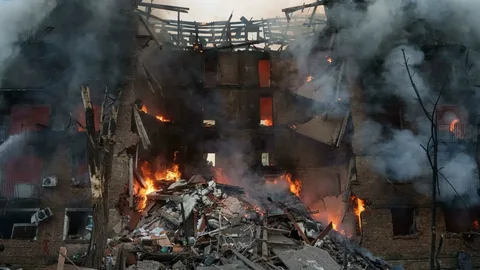
Russia has escalated its campaign against Ukraine with a large-scale ballistic missile and drone attack on the capital Kyiv in the early hours of May 24, 2026. The Russian attack on Ukraine today is one of the most intense strikes on the capital in recent weeks, with officials confirming damage and civilian casualties across the city.
The assault comes just days after Ukrainian President Volodymyr Zelensky publicly warned that Russia was preparing a broader assault, including a possible Oreshnik hypersonic missile strike on Ukrainian territory. The war, which began with Russia’s full-scale invasion in February 2022, now enters its fifth year with no clear end in sight.
Background: How Did the Russia Ukraine War Start in 2022?
The Russia Ukraine war 2025 has its roots in events that began on February 24, 2022, when Russian President Vladimir Putin announced what he called a “special military operation” against Ukraine. The Russian attack on Ukraine 2022 was launched by land, sea, and air, marking the largest military conflict in Europe since World War II.
Putin justified the invasion by claiming Ukraine needed to be “demilitarized and denazified” — a claim rejected as false by Ukraine, Western governments, and international legal bodies. NATO and the European Union condemned the Russian attack on Ukraine as a blatant violation of international law and Ukrainian sovereignty. Analysts widely agree the invasion was planned months in advance, contradicting Kremlin claims of a sudden response to regional security concerns.
Russia Ukraine War Update: What Is Happening Right Now?
Kyiv Struck by Ballistic Missiles and Drones
The latest Russian attack on Ukraine today targeted Kyiv with a combination of ballistic missiles and Shahed-type drones. Ukrainian air defense units were scrambled across the capital, but damage and casualties were reported in multiple districts. Officials are still assessing the full scale of destruction.
Russian strikes also injured civilians in Odesa and Kharkiv oblasts during the same overnight operation on May 23–24. These cities have been repeat targets throughout the Russia Ukraine war update cycle this month.
Drone Strike on Sumy Funeral Procession
In one of the most disturbing incidents this week, a Russian drone struck a funeral procession in the Sumy region on May 23, killing one person and wounding 14 others. Ukrainian officials called the attack “cynical” and deliberate, accusing Russian forces of specifically targeting civilian gatherings.
Ukraine Strikes Russian Drone Cadet Camp
On May 21, Ukraine reported a significant strike of its own. At least 65 Russian drone pilot cadets and an instructor were killed in a Ukrainian attack on a training camp in the Russian-occupied town of Snizhne in Donetsk Oblast. A separate Ukrainian strike also targeted a Russian security headquarters and air defense installation, reportedly killing and wounding nearly 100 Russian personnel. Russia has not officially confirmed either strike.
Russia Labels Dormitory Attack a “Monstrous Crime”
Russia expressed outrage after reporting that a Ukrainian drone struck a student dormitory in Starobilsk, in the occupied Luhansk region, killing at least six people. The Kremlin labeled it a “monstrous crime,” while Ukrainian officials denied deliberately targeting civilians and stated that only military infrastructure was struck.
Russia Ukraine War Live: Zelensky’s Warning About Oreshnik Missiles
In a significant development in the Russia Ukraine war live situation, President Zelensky warned on May 23 that Ukrainian and Western intelligence reports indicate Russia may be preparing an Oreshnik ballistic missile strike against Ukraine. The Oreshnik is a new-generation Russian hypersonic missile first used in combat in late 2024. Its use in a major populated area would represent a severe escalation of the Russian attack on Ukraine.
Who Is Winning the War in Ukraine?
The question of who is winning the war in Ukraine does not have a simple answer. After more than four years of fighting, the front lines remain bitterly contested, particularly in the eastern Donetsk and Zaporizhzhia regions.
Russia has made slow but steady advances in the east, particularly around Pokrovsk and Kurakhove. However, these gains have come at enormous cost in personnel and equipment. Ukraine has countered with long-range drone strikes deep inside Russian territory, hitting oil refineries, ammunition depots, and military installations far from the front line.
Ukraine struck three major Russian energy facilities the Tamanneftegaz oil terminal, the Yaroslavl oil refinery, and the Astrakhan gas processing plant in a single overnight operation in mid-May. These strikes reflect Kyiv’s growing capability to carry out precision long-range attacks, even as its ground forces face pressure in the east.
As of May 2026, neither side has achieved a decisive military breakthrough. Most military analysts describe the situation as a grinding war of attrition, with Russia holding more occupied territory but Ukraine holding firm on defense and increasing the cost of Russian operations.
Ceasefire Talks: Fragile Hopes, Repeated Failures
One of the most talked-about questions surrounding the Ukraine Russia war 2025 is whether peace is possible. In April 2026, a brief 32-hour Easter truce was agreed upon, but both sides reported violations almost immediately. Ukraine documented 469 Russian violations during that ceasefire period, mostly drone attacks.
Earlier, around Russia’s Victory Day on May 9, both Moscow and Kyiv announced competing ceasefires for different dates neither of which was accepted by the other side. US President Donald Trump played a role in brokering a brief suspension of hostilities over the Victory Day weekend, with both countries also exchanging 1,000 prisoners each.
Putin, speaking around the Victory Day period, suggested Russia’s military campaign was “coming to an end,” though observers noted this language was vague and no formal peace framework has been agreed upon.
Expert and Official Statements
Ukrainian President Volodymyr Zelensky has repeatedly stated that Ukraine will not accept any peace deal that leaves Russian forces on Ukrainian territory. He has called for continued Western military and financial support and has warned of catastrophic consequences if Russia is not stopped.
Russian President Vladimir Putin has continued to frame the conflict as a necessary response to NATO expansion and what he describes as threats to Russian-speaking populations in eastern Ukraine. He has called for negotiations “without preconditions” while simultaneously escalating military strikes on Ukrainian cities.
NATO Secretary General and allied leaders have reaffirmed their commitment to Ukrainian sovereignty, with Canada announcing nearly $200 million in new aid through a NATO-led program as recently as May 2026.
Global and Regional Impact of the Russia Ukraine War
The Russia Ukraine war update matters far beyond the two countries directly involved. The conflict has driven up global energy and food prices, disrupted grain exports from one of the world’s most productive agricultural regions, and created one of the largest refugee crises in European history.
The war has also deepened geopolitical divisions worldwide. NATO allies have supplied billions in military and financial support to Ukraine. Meanwhile, countries like China, Iran, and North Korea have been accused of providing material support to Russia including weapons, ammunition, and military technology. The United Nations has condemned the Russian attack on Ukraine multiple times, though Russia’s Security Council veto has blocked binding resolutions.
FAQs
What is Putin’s religion?
Vladimir Putin is Russian Orthodox Christian. He has spoken publicly about his faith on multiple occasions and has aligned himself closely with the Russian Orthodox Church, which has generally supported his political agenda. The Church and the Kremlin have deep historical and institutional ties in Russia.
Why is Russia angry with Ukraine?
Russia’s stated grievances include Ukraine’s move toward NATO membership, which Moscow views as a direct threat to its security. Russia also claims to be protecting Russian-speaking populations in eastern Ukraine and has long opposed Ukraine’s political and economic integration with the European Union. Deeper historical factors include Russia’s view that Ukraine and Russia share a common civilization a claim Ukraine firmly rejects. Many analysts argue the core reason is Russia’s refusal to accept an independent, Western-aligned Ukraine on its border.
What countries support Russia?
Russia’s key international supporters include China, which provides diplomatic cover and has expanded trade ties with Russia since the 2022 invasion. North Korea has supplied artillery shells and ballistic missiles to Russian forces. Iran has provided Russia with Shahed drones used extensively in attacks across Ukraine. Belarus has allowed its territory to be used for Russian military operations. Most other nations have either stayed neutral or joined international condemnation of the Russian attack on Ukraine.
Conclusion: What Comes Next?
The Russian attack on Ukraine continues to evolve in both scale and tactics. As of late May 2026, Russia is pressing forward with intensified missile and drone campaigns against Ukrainian cities, while Ukraine responds with its own long-range strike capability. Diplomatic efforts have produced only brief, fragile ceasefires, and a comprehensive peace deal remains distant.
The Russia Ukraine war update for today shows a conflict that is deeply entrenched, costly on both sides, and with no clear winner on the battlefield. The coming weeks will be critical both for the front lines and for ongoing diplomatic efforts involving the United States, European allies, and international mediators.
The world continues to watch as Ukraine Russia war 2025 rolls into 2026 with its human toll mounting and its political resolution still out of reach.