
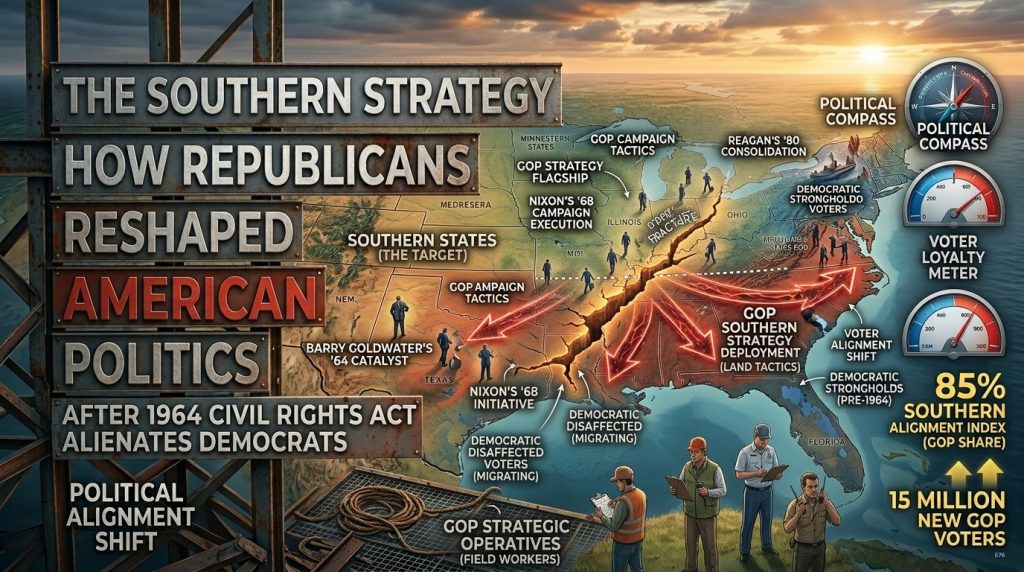
The Southern Strategy remains one of the most debated political maneuvers in American history. It refers to efforts by the Republican Party to gain electoral support in the South by appealing to racial tensions. From Nixon’s 1968 campaign to Reagan’s symbolic speeches, this strategy reshaped the entire political map of the United States.
Background: What Political Party Was the South During the Civil War?
To understand the Southern Strategy, you must go back to the Civil War era. The South was overwhelmingly Democratic during and after the Civil War. The Democratic Party was the party of Southern secession, slavery, and later, segregation.
Republicans, founded in 1854, were the party of Abraham Lincoln and abolition. After the Civil War, Southern whites deeply resented the Republican Party for defeating the Confederacy. This created what historians called the “Solid South” a bloc of Southern states that reliably voted Democratic for nearly a century.
This political alignment held firm through the early 20th century. Southern politicians names like John C. Calhoun, Jefferson Davis, and later Strom Thurmond were all originally Democrats. Understanding this history is essential before discussing how the shift happened.
What Is the Southern Strategy?
The Southern Strategy refers to a calculated Republican political approach primarily associated with the 1960s and 1970s to attract white Southern voters who were unhappy with the Democratic Party’s support for civil rights legislation.
The Civil Rights Act of 1964 and the Voting Rights Act of 1965, signed by Democratic President Lyndon B. Johnson, angered many white Southerners. Republicans saw an opportunity. Rather than directly advocating racial policies, the strategy used coded language focusing on “states’ rights,” “law and order,” and opposition to busing that resonated with racial anxieties without explicitly mentioning race.
Southern Strategy Nixon: The 1968 Blueprint
Richard Nixon is most closely associated with launching the Southern Strategy at the national level. His 1968 presidential campaign deliberately targeted the South using subtle racial messaging. Nixon’s campaign manager Kevin Phillips openly discussed the strategy, saying the GOP could build a majority by winning disaffected white Southern voters.
Nixon used phrases like “law and order” and “silent majority” language that many analysts say was a direct appeal to white voters frustrated by civil rights progress and urban unrest. He carried several Southern states in 1968, a region that had previously been solidly Democratic.
Nixon’s advisor Lee Atwater later gave a candid interview in 1981 explaining the evolution of the strategy. He described how explicit racial language gave way to economic and policy-coded messaging over time. This interview is frequently cited in discussions about the Southern Strategy.
Southern Strategy Reagan: Continuing the Shift
Ronald Reagan took the Southern Strategy to a new level in 1980. His decision to launch his presidential campaign in Philadelphia, Mississippi the site of the 1964 murders of civil rights workers was seen as deeply symbolic by many observers.
Reagan championed “states’ rights” in that speech, a phrase heavily loaded with historical meaning in the South. He also attacked welfare programs in ways that critics argued were racially coded, referring to the controversial “welfare queen” stereotype.
Reagan swept the South in 1980 and 1984, cementing the regional realignment that Nixon had begun. The Southern Strategy Reagan employed was more polished but followed the same underlying framework appealing to cultural conservatism, racial anxiety, and anti-government sentiment.
Southern Strategy Examples: Key Moments
Several clear Southern Strategy examples stand out across decades:
Barry Goldwater (1964) voted against the Civil Rights Act and carried five Deep South states the first Republican to do so in the modern era. His campaign is considered an early prototype of the strategy.
George Wallace (1968), running as a third-party candidate, carried five Southern states on an explicitly segregationist platform. His success showed Republicans the electoral potential of Southern white resentment.
Nixon’s 1972 Landslide saw him win nearly every Southern state by applying the strategic playbook more aggressively. His use of anti-busing rhetoric and appeals to “law and order” were textbook Southern Strategy examples.
The Willie Horton Ad (1988) during George H.W. Bush’s campaign is another widely cited example. The ad featuring a Black convict was accused of deliberately stoking racial fears among white voters.
Southern Democrats Became Republicans: The Great Realignment
One of the most dramatic results of the Southern Strategy was that Southern Democrats became Republicans in large numbers. This realignment happened gradually but decisively over several decades.
Politicians like Strom Thurmond, once a staunch segregationist Democrat, switched to the Republican Party in 1964 after the Civil Rights Act passed. Jesse Helms of North Carolina built his Republican career on conservative cultural messaging. Phil Gramm of Texas switched parties in 1983.
By the 1990s and 2000s, Southern politicians names once associated with the Democratic Party had largely disappeared. The South had flipped completely. States like Alabama, Mississippi, South Carolina, and Georgia once reliably Democratic became the backbone of Republican presidential victories.
This transformation also changed the Democratic Party. As Southern conservatives left, the party became more uniformly liberal, particularly on social issues.
Was the Southern Strategy Successful?
By electoral measurements, the answer is clearly yes. Republicans went from being nearly shut out of the South to dominating it within two decades.
The GOP has won the majority of Southern states in every presidential election since 1972 with few exceptions. The strategy fundamentally restructured the two-party system. Today, the South is the most reliably Republican region in the country a complete reversal from its Civil War-era Democratic stronghold status.
However, success came with long-term consequences. The strategy accelerated racial polarization in American politics. Black voters, who had been shifting toward Democrats since FDR’s New Deal, moved even more decisively into the Democratic column. White Southern voters moved equally decisively Republican. American politics became more racially sorted than at any point in the post-Civil War era.
The Southern Strategy Myth Debate
The Southern Strategy myth debate is fierce among historians and political scientists. Some scholars argue the strategy has been exaggerated or mischaracterized.
Conservative historians like Byron Shafer and Richard Johnston argued in their research that economic development not racial resentment drove Southern realignment. They contend that upwardly mobile white Southerners shifted Republican because of economic conservatism, not coded racism.
Other researchers point out that the South began shifting Republican even before the Civil Rights Act in some states. Dwight Eisenhower won parts of the South in 1952 and 1956 without racial strategy, suggesting economic and cultural factors were also at play.
Those who call elements of the strategy a myth argue that reducing the entire Southern realignment to racial politics oversimplifies a complex historical process. They say millions of Southerners switched parties for legitimate policy reasons lower taxes, strong defense, religious conservatism.
However, most mainstream historians maintain that while multiple factors contributed to realignment, racial politics played a central and documented role. The Lee Atwater interview alone provides significant direct evidence.
Impact: How the Southern Strategy Changed America
The Southern Strategy’s impact on American politics cannot be overstated. It gave Republicans a reliable Electoral College foundation for over 50 years. It pushed the Democratic Party leftward and turned it into a coalition of minorities, urban professionals, and college-educated voters.
The strategy also contributed to deep racial polarization in political identity. Policies became racially coded in ways that made bipartisan cooperation increasingly difficult. Many analysts argue it laid the groundwork for today’s highly polarized political environment.
Internationally, the Southern Strategy is studied as a case study in how democracies can be reshaped through strategic political messaging targeted at demographic anxieties.
Quotes
Lee Atwater (1981): In a now-famous interview, Reagan’s political strategist described how racial language in politics evolved from explicit terms to abstract policy concepts like “forced busing” and “states’ rights.”
Kevin Phillips, Nixon’s strategist, wrote in his 1969 book The Emerging Republican Majority that the GOP’s future lay in winning over Southern whites and suburban conservatives — a prediction that proved remarkably accurate.
President Lyndon B. Johnson, upon signing the Civil Rights Act, reportedly told an aide: “We have lost the South for a generation.” It turned out to be longer than a generation.
Conclusion
The Southern Strategy represents a pivotal chapter in American political history. What began as a tactical effort to win elections fundamentally transformed both major political parties and reshaped the country’s political geography. Southern Democrats became Republicans, the Solid South flipped, and racial identity became more deeply embedded in partisan politics than ever before.
Whether viewed as shrewd politics or cynical manipulation or some combination of both the Southern Strategy’s legacy continues to shape American elections, racial discourse, and political identity today. Understanding it is essential to understanding modern America.
FAQs
Is India an underrepresented country?
In many global institutions and political forums, India has historically been considered underrepresented relative to its population size. Despite being the world’s most populous democracy, India holds limited permanent influence in bodies like the UN Security Council, fueling ongoing debates about global governance reform.
What is the delimitation issue in India?
Delimitation refers to the redrawing of electoral constituency boundaries based on population data. In India, a major controversy surrounds the upcoming delimitation exercise, which critics fear will reduce political representation for southern states that have successfully managed population growth, effectively penalizing them for good governance.
Why is women’s political representation so low in India at present?
Despite recent legislation reserving 33% of parliamentary seats for women, implementation is tied to the next delimitation exercise, delaying real change. Cultural barriers, limited party support, financial constraints, and patriarchal social structures continue to suppress women’s participation in Indian electoral politics at both state and national levels.