
Surah Al-Fil: Arrogance, Ababeel’s Attack, and Divine Protection of the Kaaba
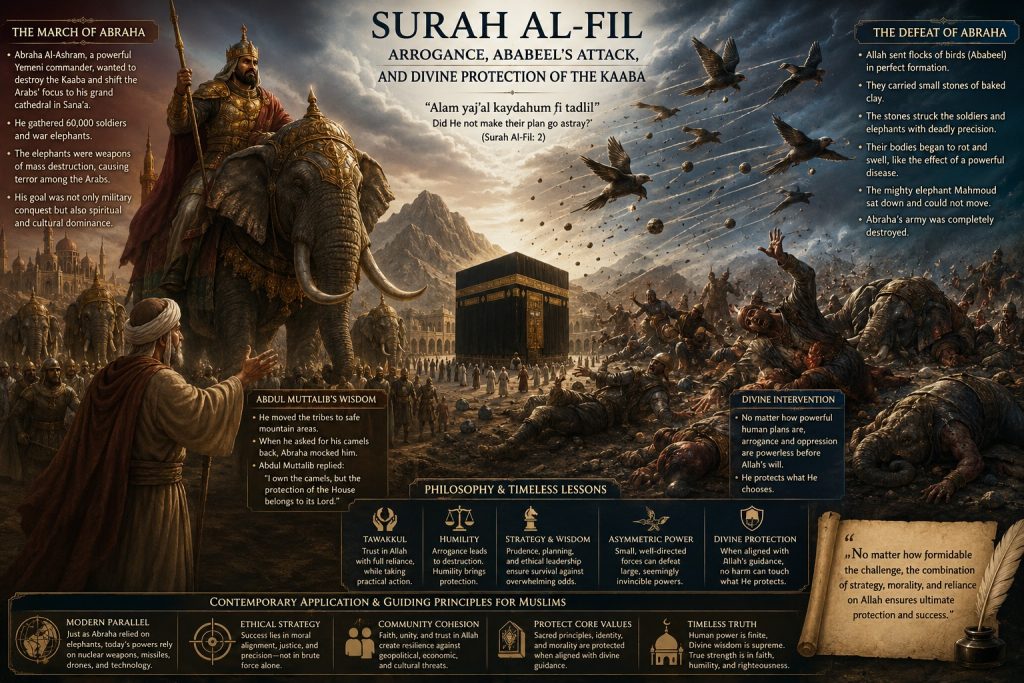
In the sixth century CE, the Arabian Peninsula was situated within a delicate and complex global political landscape, with two major powers vying for supremacy: the Roman Empire and the Persian Empire, both seeking not only religious influence but also commercial and military dominance. The strategic Red Sea trade routes along with the coastal areas of Yemen held paramount importance, for control over these would allow dominance over the economic and cultural heart of Arabia. Abyssinia, an ally of the Romans, had already established a strong foothold in Yemen to curb Persian influence, and its power was embodied in the figure of Abraha Al-Ashram, a commander not only skilled in military strategy but also ambitious in economic and political expansion. Upon realizing the significance of the Kaaba in Mecca as the spiritual and commercial center of the Arabs, he devised a plan to target it, intending to transfer the Arabs’ religious and economic focus to Yemen. In Sana’a, he commissioned the construction of a grand cathedral called Al-Qullays, adorned with gold, silver, and marble, declaring that Arabs would be required to perform circumambulation around this new luxurious structure. The purpose of his project was not only to subdue the Arab tribes materially but also to seize spiritual and cultural authority. To implement this, Abraha mobilized a force of sixty thousand soldiers along with war elephants, the elephants of that era functioning as weapons of mass destruction due to their immense weight, armor, and power, causing psychological terror among the Arab tribes.
This plan demonstrates that in the sixth-century global scenario, power was not determined solely by military strength, economic leverage, or territorial conquest but also by cultural and spiritual influence. Mecca, as the site of the Kaaba and annual fairs, had emerged as a communal center for Arab tribes, and for Abraha, it was unacceptable that Arabs concentrated their devotion on a modest, remote location. Thus he sought both military conquest and the cultural transfer of authority. As the army began its march, the Arabs faced a terrifying spectacle, for the elephants were akin to modern heavy battle tanks, trampling tents and crushing advancing soldiers, while archers struggled against their sheer size. During this period, the Arabs adopted a strategic response, with Abdul Muttalib demonstrating wisdom and patience, relocating people to safe mountainous areas. When requesting the return of the camels seized by Abraha’s soldiers, he was met with derision. Abraha mockingly responded that Abdul Muttalib worried only about a few camels while he intended to destroy the Kaaba. Abdul Muttalib replied that while he owned the camels, the protection of the House belonged to its Lord. This response not only secured the tribes but also illustrated a philosophical and spiritual principle: when human power fails, reliance on God is essential.
Abraha’s campaign constituted a psychological warfare system, combining military forces, elephants, and intimidation. Yet Allah rendered all his schemes futile, demonstrating that arrogance and technological power are powerless before divine will. The elephants, though formidable, could not alter the outcome. This episode also illustrates the intersection of military strategy, cultural ambition, and spiritual authority in historical power dynamics, highlighting that conquest is not merely physical but also involves controlling hearts and minds. The use of elephants as psychological instruments reflects an understanding of terror as a tactical tool, and the Arabs’ reliance on faith alongside tactical relocation demonstrates a blend of strategy and spirituality. Moreover, the event emphasizes that leadership grounded in wisdom, patience, and divine trust can counter even the most overwhelming material threat. Abdul Muttalib’s actions provided both safety and moral guidance, establishing a precedent in Arabian society for valuing divine reliance in the face of superior military might. The plan’s reliance on sheer force and mass psychology failed, revealing the limits of brute strength when confronted with divine orchestration. This sets the stage for what is described in the Qur’an as a decisive and miraculous intervention.
The unfolding events highlight that historical narratives intertwine military, spiritual, and psychological elements, with the Kaaba representing not only a religious center but also the axis of social, economic, and cultural cohesion. Abraha’s failure underscores that any attempt to dominate such a center without acknowledging its divine protector is doomed. Thus the march of Abraha, though meticulously planned, became a cautionary tale demonstrating that human arrogance, no matter how sophisticated or powerful, remains subordinate to divine wisdom. In summary, the first stage of this episode provides insights into historical geopolitics, the interplay of military technology and psychology, the role of spiritual centers in societal cohesion, and the principle that faith and reliance on God can negate even the most intimidating threats. It is a reminder that leadership, strategy, and belief are interwoven, and that true power lies not merely in numbers, wealth, or instruments of war, but in alignment with divine guidance. This part of the narrative lays the foundation for understanding the miraculous events that follow, including the airborne intervention and the symbolic defeat of the elephants, which will be explored in the subsequent sections. By examining the march of Abraha and Abdul Muttalib’s response, one observes the convergence of tactical decision-making, ethical leadership, spiritual reliance, and the limits of material might, making this episode an enduring lesson in the philosophy of history, the ethics of power, and the dynamics of human and divine interaction.
The emphasis on cultural and spiritual authority demonstrates that historical dominance is not only territorial but also moral and symbolic, and that true protection of a community or sacred center transcends the capabilities of conventional military forces. Furthermore, this event reflects principles analogous to modern asymmetric warfare, where smaller, strategically deployed forces can neutralize ostensibly superior adversaries, illustrating that the efficacy of power is measured not merely by physical presence but by wisdom, timing, and divine support. The detailed accounts of this episode serve as both a historical record and a didactic framework, teaching that in situations of extreme threat, the combination of moral leadership, strategic foresight, and spiritual conviction can alter outcomes in ways that defy purely material expectations. Thus the march of Abraha represents a convergence of geopolitical ambition, technological intimidation, and moral resistance, and sets the stage for the miraculous elements that define the narrative in the Qur’an, emphasizing that no matter the sophistication of human planning, the ultimate arbiter remains divine wisdom and providence. The first part concludes with this philosophical insight, preparing for the description of the airborne intervention, the intervention of the small but mighty forces, and the disintegration of the elephants’ power, which together constitute a comprehensive lesson on the limits of arrogance, the role of divine will, and the enduring significance of faith and strategic insight in human history.
**The Defeat of Abraha and the Miraculous Birds:** When Abraha’s army reached the valley of Mahsir and set up camp, a historic and cosmic dialogue unfolded, demonstrating the interplay of human arrogance and divine intervention. Abdul Muttalib, with wisdom and trust in Allah, had already secured the safety of the tribes by moving them to the mountains, and when he requested the return of his camels, Abraha scoffed, dismissing the concern as trivial compared to his goal of destroying the Kaaba. Yet this exchange highlights the principle that worldly power, no matter how formidable, is subordinate to divine protection. The Qur’an emphasizes this intervention, stating that Allah rendered their plans into error, “Alam yaj’al kaydahum fi tadlil,” questioning whether He did not place their schemes into confusion, signaling that what appears invincible to human eyes can be nullified by divine will.
The first manifestation of this defeat was the elephant Mahmoud, the largest and most powerful of the war elephants, who suddenly sat down on the ground, immobilized, and the mahouts’ weapons proved useless. This demonstrates how arrogance grounded in strength and intimidation can crumble when faced with divine authority. Simultaneously, Allah deployed an extraordinary and unprecedented airborne strike, described in the Qur’an as “wa arsala ‘alayhim tayran ababil.” The term Ababil signifies flocks in formation, indicating organized units descending upon the enemy, suggesting that the intervention was systematic, precise, and beyond ordinary perception. These birds carried small stones made of baked clay, which upon impact had lethal effects, striking soldiers and even the elephants with devastating accuracy. Each stone targeted specific individuals, a remarkable parallel to modern precision-guided munitions. The physical and biological consequences on Abraha’s army were severe: soldiers’ bodies began to rot, swell, and discharge pus, resembling the effects of a sophisticated biological weapon. The elephants too suffered similarly, underscoring that divine intervention transcends human comprehension and technological limits.
The seemingly small birds and their stones caused the complete destruction of a massive army, highlighting the principle that magnitude and sophistication do not determine efficacy in the absence of divine sanction. This episode can also be viewed as an early example of asymmetric warfare, where a seemingly minor force achieves disproportionate impact due to strategic deployment and divine support. The philosophical lesson is profound: human arrogance, whether through military, technological, or psychological means, is inherently limited, no matter how advanced, and divine will ultimately dictates outcomes. The aftermath of this airborne assault left the elephants and soldiers incapacitated, and Abraha himself succumbed to gradual decomposition, his organs disintegrating as he was transported back to Yemen. This symbolizes the futility of pride, material power, and technological prowess in defiance of divine authority. The Arab tribes observed firsthand that reliance on human strength alone is insufficient, and that strategic patience, wisdom, and faith in Allah are paramount.
Abdul Muttalib’s role exemplifies ideal leadership, blending pragmatic action with spiritual reliance. His foresight in relocating tribes and entrusting the Kaaba to divine protection ensured survival and moral victory. Moreover, this event illustrates the integration of military, spiritual, and psychological dimensions in historical conflicts. The failure of Abraha’s campaign demonstrates that even meticulously organized and heavily armed forces can be rendered powerless without divine alignment. The destruction by the birds’ stones also implies that small, intelligently applied forces can overcome overwhelming numbers, emphasizing the principle that ultimate efficacy depends on alignment with higher wisdom rather than brute strength. Historically, this event underscores the inseparability of faith and societal cohesion, as the Kaaba’s spiritual and economic centrality required both divine protection and strategic leadership to withstand existential threats.
The airborne strike and the precise effect of the stones reveal that God’s mechanisms may appear subtle or insignificant yet yield decisive outcomes. The similarity to contemporary biological or chemical warfare highlights an advanced understanding of cause and effect, where even minute agents can neutralize massive adversaries. Philosophically, this narrative conveys that arrogance, technological sophistication, and numerical superiority are insufficient against moral, spiritual, and divinely sanctioned forces. It demonstrates that leadership based on faith and foresight can withstand crises that overwhelm conventional strategies. The intervention of the birds and the failure of the elephants’ power illustrate the principle of the weak overcoming the strong when guided by divine providence. This principle resonates across ages, suggesting that asymmetric and spiritual dimensions of power are as decisive as conventional means. The complete annihilation of Abraha’s army also serves as a warning to rulers and empires that excessive pride, expansionist ambitions, and disregard for divine limits invite humiliation and defeat.
The event highlights the interconnection of cosmic, spiritual, and material forces, showing that what appears accidental or trivial in human perspective is an instrument of divine precision. The psychological effect on both the Arabs and surrounding communities was significant, as it reinforced the principle that reliance on God ensures protection even against seemingly insurmountable threats. The narrative underscores that history, when interpreted philosophically, reveals consistent patterns: human overreach is invariably met with corrective forces, whether through natural, technological, or divine mechanisms. This story also provides enduring ethical lessons about humility, foresight, and strategic patience. The Qur’an’s depiction of the Ababil birds and their stones communicates that even small agents, properly aligned, can neutralize large-scale threats, reinforcing the importance of spiritual alignment. The outcome of Abraha’s march illustrates the futility of attempting to undermine sacred institutions or moral centers, regardless of military might. The intervention demonstrates the principle that God’s protection is not contingent on human expectation or conventional calculations. The meticulous targeting of the birds implies an extraordinary system of order and purpose, highlighting the divine orchestration underlying events that surpass human understanding.
Thus, the second part of this story provides insight into the failure of human arrogance, the limitations of technological and military power, the efficacy of asymmetric divine interventions, and the enduring relevance of faith, strategy, and moral leadership. The event serves as a prototype for examining historical and contemporary instances where small forces, guided by strategy and principle, achieve outcomes disproportionate to their apparent strength. The combined philosophical, military, and spiritual lessons inform not only historical analysis but also contemporary understanding of asymmetric threats. The narrative encourages reflection on the role of divine providence in shaping outcomes, suggesting that true security and efficacy emerge from alignment with higher principles rather than reliance solely on material or technological capabilities. The miraculous defeat of Abraha, the impotence of elephants, and the precise efficacy of the Ababil birds collectively illustrate a timeless principle: human power, however advanced, is subordinate to divine wisdom, and small, well-directed means, when guided by providence, can decisively overcome overwhelming forces. Abdul Muttalib’s leadership, the preservation of the Kaaba, and the integration of strategic, spiritual, and cosmic dimensions exemplify the holistic approach required to withstand existential threats. The implications of this episode extend beyond its historical context, offering enduring guidance on the limits of arrogance, the importance of moral and spiritual alignment, and the transformative impact of precise, divinely guided interventions. In sum, the miraculous events surrounding the destruction of Abraha’s army and the airborne intervention of the Ababil birds highlight the interplay of faith, strategy, asymmetric means, and divine authority, offering profound lessons on leadership, power, morality, and the ultimate futility of human arrogance when confronted with higher wisdom.
**The Philosophy of History, Tawakkul, and Timeless Lessons:** The incident of the Elephant, the army of Abraha, and the miraculous intervention of the Ababil birds is not merely a historical narrative but a profound lesson in the philosophy of history, illustrating the limits of human arrogance and the supremacy of divine will. When humans rely solely on material power, technology, or numbers, they often overlook the ultimate determinant of outcomes, which is Allah’s decree. The Qur’an vividly portrays this, emphasizing that every scheme, no matter how sophisticated or powerful in human terms, can be rendered null by divine wisdom. Abdul Muttalib’s trust in Allah exemplifies the principle of Tawakkul, or complete reliance on God. His strategic relocation of the tribes and the subsequent survival of the Kaaba show that practical action combined with spiritual faith is essential for societal protection. The destruction of the massive army, the incapacitation of the mighty elephant Mahmoud, and the targeted impact of the Ababil birds underscore that magnitude and apparent power are irrelevant when divine orchestration is at work.
Philosophically, this teaches that the grandeur of human constructs, whether military, economic, or technological, cannot ensure victory if they contravene higher moral and spiritual principles. The phenomenon of the Ababil birds carrying small stones that destroyed thousands illustrates a concept analogous to asymmetric warfare, showing that subtle, well-directed forces, even if seemingly insignificant, can achieve decisive outcomes when aligned with divine guidance. This parallels modern examples where small innovations, precise interventions, or strategic moral actions have disproportionate effects in history. The narrative also emphasizes that divine power operates through means that may appear trivial to human perception but carry immense efficacy. The effectiveness of the stones, which caused rot, swelling, and death, resembles modern biological or chemical agents in their specificity and lethality, highlighting the precision of divine intervention. The lesson extends to leadership and governance, demonstrating that rulers, generals, and policymakers must recognize the limits of human control and maintain humility before higher principles. The preservation of the Kaaba, despite the technological might and psychological warfare employed by Abraha, exemplifies how faith, foresight, and ethical guidance can protect societies from existential threats.
The historical event further indicates that reliance on brute force, intimidation, or psychological manipulation is insufficient without spiritual alignment. This principle resonates across centuries, suggesting that all human ambition, whether in the sixth century or the modern age, is subject to checks beyond material means. The incident also provides insights into the philosophy of history itself, showing that the outcomes of human conflicts are not solely determined by visible power or numerical strength but by a complex interplay of divine providence, moral integrity, and strategic wisdom. The annihilation of Abraha’s army demonstrates that even meticulously planned and technologically advanced operations are vulnerable to failure if they disregard moral and spiritual boundaries. This aligns with a broader understanding of historical causality where invisible forces, principles, and ethical structures often guide the apparent chaos of events. The role of Abdul Muttalib is emblematic of leadership that harmonizes practical action with faith. His prudence in safeguarding the tribes and entrusting the Kaaba to Allah reflects a multidimensional approach that considers material, moral, and spiritual factors simultaneously.
The episode emphasizes the importance of humility for individuals and nations, showing that pride, arrogance, and overreliance on technology or wealth are insufficient safeguards. Instead, acknowledgment of higher authority and ethical responsibility ensures resilience and survival. From a sociological perspective, the event demonstrates that collective faith and community cohesion, guided by principled leadership, can withstand crises that would overwhelm isolated or materially superior forces. The integration of cosmic, spiritual, and material dimensions in the outcome shows that human understanding is inherently limited and that history often unfolds through mechanisms beyond immediate perception. In modern contexts, this principle can be applied to strategic planning, governance, and defense, where reliance solely on numbers, weapons, or economic dominance is insufficient, and ethical, moral, and spiritual considerations determine long-term success. Philosophically, the story conveys that divine law is the ultimate arbiter, and human power, no matter how advanced or extensive, remains subordinate. The pattern observed with Abraha, his elephants, and the Ababil birds is mirrored in modern history where seemingly insignificant or minor interventions, when aligned with higher principles or timely wisdom, have determined the outcomes of major conflicts.
The story also illustrates the limits of hubris, showing that overconfidence in technology, military might, or wealth leads to vulnerability. The complete collapse of Abraha’s forces despite preparation and intimidation tactics demonstrates the futility of arrogance. The lessons of the Elephant incident extend beyond historical, military, and political realms into moral, ethical, and philosophical domains, highlighting that history is a teacher of humility and a guide to recognizing the primacy of moral and spiritual alignment over brute force. The narrative emphasizes that divine providence operates in subtle, precise, and seemingly minimal ways to achieve maximal results, reminding humanity that no matter how sophisticated, advanced, or confident they may be, the outcomes of their actions are ultimately contingent on higher principles. The event is a template for understanding asymmetric power dynamics, both in historical and contemporary contexts, showing that small, disciplined, and principled forces can defeat larger, seemingly invincible powers when guided by ethical and spiritual alignment. In essence, the incident demonstrates that faith, wisdom, and moral courage are decisive factors in history, often outweighing technology, numbers, or brute strength.
The philosophical dimension of the incident also suggests that history is cyclical and principles remain constant, as human arrogance and the limits of material power recur across ages. The story of the Elephant and the Ababil birds therefore functions as a perennial guide, reinforcing that divine justice and protection govern the ultimate outcomes. Abdul Muttalib’s foresight and strategic action reflect an understanding of the balance between human effort and divine reliance, teaching that practical steps, when combined with moral and spiritual alignment, can secure safety and success against overwhelming odds. The event also provides a lens through which to view modern challenges, whether geopolitical, economic, or technological, indicating that reliance on ethical principles, trust in higher order, and alignment with moral values is the most reliable source of resilience. The narrative encourages reflection on the integration of strategic action and ethical guidance, demonstrating that human ingenuity and planning achieve their fullest potential only when harmonized with higher moral and spiritual principles. Thus the philosophy of history embedded in the incident highlights that arrogance, hubris, and reliance solely on material power lead inevitably to failure, whereas humility, faith, wisdom, and ethical alignment ensure preservation, effectiveness, and moral victory.
The story bridges historical, philosophical, spiritual, and strategic domains, offering timeless lessons relevant for rulers, societies, and individuals, showing that the outcomes of human endeavors are ultimately shaped not merely by material capacity but by the alignment with divine principles and ethical conduct. The incident of the Elephant, the miraculous intervention of the Ababil birds, and the survival of the Kaaba collectively illustrate the enduring truth that human power is limited and divine guidance, faith, and strategic wisdom are paramount. The narrative affirms that history is a living teacher, morality and faith are central to societal resilience, and human arrogance, no matter how sophisticated, is always subject to divine correction. In conclusion, the third part of the story demonstrates that the philosophy of history, the principle of Tawakkul, and the ethical and strategic lessons derived from the event remain applicable across time, reinforcing that the ultimate arbiter of outcomes is divine wisdom, human efforts must be aligned with higher principles, and the enduring lesson is that faith, humility, and moral courage are the most powerful forces in determining the course of events in history and society. This serves as guidance for all generations, illustrating that no matter how formidable a force appears, the combination of strategic wisdom, ethical conduct, and reliance on divine providence ensures ultimate success, while arrogance, pride, and reliance on material or technological power alone inevitably lead to defeat and humiliation. Thus the story of the Elephant and the Ababil birds remains an eternal testament to the supremacy of divine guidance, the power of faith, and the limitations of human arrogance in shaping the course of history and human society.
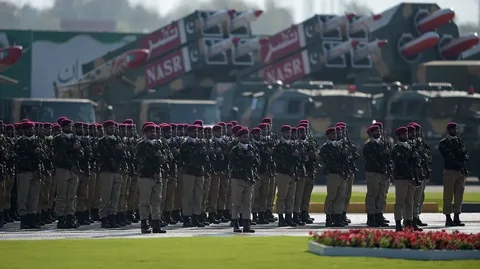
**Contemporary Application, Global Politics, and Guiding Principles for Muslims:** The story of the Elephant, Abraha’s army, and the Ababil birds is not confined to history but offers timeless guidance for contemporary contexts, modern global politics, and the challenges faced by nations and communities. The principles derived from this incident demonstrate that no matter how advanced or powerful a nation or military might be, divine wisdom, ethical conduct, and strategic prudence remain decisive. The arrogance of Abraha, his reliance on elephants as instruments of mass destruction, and his sophisticated military strategies parallel the modern world where nuclear arsenals, ballistic missiles, drones, and cyber warfare are deployed by powerful states. Yet the Qur’anic account reminds us that reliance solely on material power or technology is insufficient. Without moral alignment, ethical guidance, and awareness of higher principles, these resources can lead to self-destruction. The intervention of the Ababil birds carrying stones is a metaphor for asymmetric challenges that can nullify overwhelming power. In contemporary terms, small, disciplined, and ethically aligned forces or strategies can overcome formidable opponents.
This principle is evident in modern conflicts where insurgencies, non-state actors, and strategic innovations challenge superpowers. The lesson for Muslim societies is clear: reliance on God, ethical strategy, community cohesion, and moral courage can safeguard against threats that appear insurmountable. The survival of the Kaaba despite the technological and psychological warfare of Abraha emphasizes that sacred and essential principles, whether spiritual, cultural, or societal, are protected when aligned with divine guidance and ethical responsibility. In global politics, this principle translates into the understanding that power projection, economic pressure, or military might alone cannot guarantee long-term security or success. Nations that ignore moral and ethical considerations, and neglect spiritual or cultural integrity, risk collapse regardless of material superiority. The Qur’anic narrative also demonstrates the importance of foresight, planning, and prudence, as Abdul Muttalib’s actions show that practical measures combined with trust in God yield resilience. The evacuation of the tribes, safeguarding resources, and strategic negotiation highlight how leadership must balance action and reliance on higher guidance.
The ethical and philosophical dimension reinforces that arrogance, pride, and overconfidence in technology or military assets lead to vulnerability. Just as Abraha’s elephants, despite their size and strength, became ineffective against divine intervention, this teaches modern leaders that unchecked ambition and hubris, whether in politics, economics, or defense, ultimately result in failure. The event serves as a cautionary tale that advanced weaponry, economic sanctions, and technological dominance do not ensure victory if not tempered with moral and ethical responsibility. From a strategic perspective, the Ababil birds demonstrate the principle of precise targeting and proportionality, where small yet well-directed interventions can have decisive outcomes. In modern warfare, this aligns with precision-guided munitions, cyber attacks, and surgical operations where the quality and alignment of action outweigh sheer volume or force. The broader societal lesson is that faith, trust, and ethical cohesion within a community safeguard against overwhelming external pressures. Muslim societies can draw from this narrative that reliance on divine guidance, moral governance, and communal solidarity is essential in facing modern challenges such as geopolitical pressure, economic manipulation, and cultural threats.
The philosophy of history embedded in the incident teaches that the patterns of human arrogance, reliance on material power, and eventual divine correction recur across ages. Contemporary superpowers, regardless of nuclear capability, economic dominance, or advanced technology, remain subject to unforeseen constraints, ethical checks, and the limits of human perception. The event also highlights that small, morally aligned forces can produce transformative outcomes, a principle visible in contemporary political, economic, and social movements where disciplined, principled, and ethical actors can influence or constrain far larger powers. The Qur’anic account emphasizes that reliance on God is not passive, but a combination of action, prudence, and faith. Abdul Muttalib’s foresight demonstrates proactive measures alongside trust, teaching that strategic planning, ethical conduct, and faith work synergistically to achieve protection and success. The narrative also serves as a spiritual guide, reminding that central sacred principles, such as the Kaaba, justice, and moral integrity, remain protected when aligned with divine will. This is applicable today for individuals, leaders, and nations, suggesting that protection of values, culture, and ethical governance depends on conscious alignment with higher principles.
The historical lesson translates into a contemporary directive that Muslims should navigate modern challenges by combining knowledge, strategy, ethical awareness, and faith in God. Global powers that rely solely on brute force, technological superiority, or economic pressure, while neglecting moral and spiritual dimensions, are historically and philosophically vulnerable. The story of the Elephant provides a model for understanding asymmetric conflict, where smaller, well-directed, and ethically guided forces can neutralize larger, seemingly invincible threats. In the contemporary world, this applies to governance, activism, defense strategy, and societal organization. The principles embedded in the Qur’anic narrative encourage Muslims to cultivate resilience, prudence, moral courage, and faith, emphasizing that external challenges are ultimately secondary to internal alignment with divine guidance and ethical principles. The outcome of Abraha’s campaign and the miraculous intervention illustrate that divine providence manifests through means that may seem trivial or ordinary to human perception, yet carry decisive efficacy. This reinforces that ethical conduct, foresight, and faith magnify human efforts beyond mere material capacity.
The story further affirms that arrogance, hubris, and overreliance on technological or numerical superiority invite inevitable collapse. The Ababil birds’ impact demonstrates that precision, timing, and alignment with higher principles outperform raw strength. The incident also teaches that history is a living repository of guidance, where recurring patterns of arrogance, correction, and ethical consequence provide continuous lessons for societies, modern states, and leadership. The narrative shows that both human and technological power are inherently limited and subordinate to divine wisdom. Muslim societies today can apply these lessons to geopolitics, economic resilience, defense policy, and cultural preservation, ensuring that reliance on God, ethical governance, and strategic foresight remain central to survival and success. The story of the Elephant, the Ababil birds, and the protection of the Kaaba thus remains a universal paradigm, guiding contemporary action, policy formulation, leadership, and societal resilience. It teaches that while material power is transient, alignment with divine guidance, ethical conduct, and faith is enduring and decisive. The narrative demonstrates the integration of historical, philosophical, spiritual, and strategic dimensions, underscoring that true power lies not in numbers, technology, or wealth, but in wisdom, ethical alignment, and divine support.
Muslims can derive actionable principles from this story: combine prudence with faith, safeguard core values, act with moral courage, and recognize that the ultimate arbiter of outcomes transcends material capabilities. Finally, the Elephant incident and the Ababil birds reinforce that history is guided by divine principles, that faith and ethical alignment are paramount, and that no matter how formidable the challenge, the combination of strategy, morality, and reliance on God ensures ultimate protection and success. The narrative is a timeless guide for generations, a reminder that arrogance and reliance solely on power leads to destruction, and that true strength lies in faith, humility, ethical action, and alignment with divine providence. This story of the Elephant remains a living, practical lesson for leadership, strategy, society, and personal conduct, demonstrating that divine guidance, moral courage, and faith surpass all material and technological power, ensuring that the Kaaba, symbolic of spiritual and ethical centrality, remains protected across time, just as ethical and spiritually guided action ensures resilience, protection, and ultimate victory in every era. The lesson is clear: human power is finite, divine guidance is supreme, and true success is attained through faith, prudence, and alignment with eternal principles.