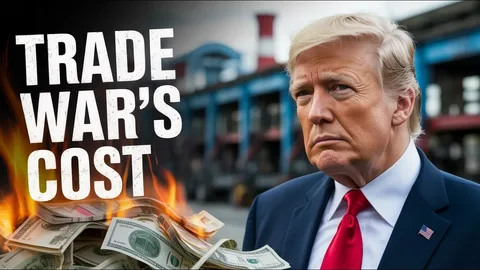
Trump war economic repercussions are now unfolding on two simultaneous fronts — a sweeping global trade war driven by aggressive tariffs, and a shooting war with Iran that has shut the world’s most critical oil corridor and pushed crude prices above $100 a barrel for the first time since 2022.
President Trump’s second-term tariff policies have upended long-standing global trade arrangements, caused market volatility, and accelerated trends towards economic regionalism — with traditional trading partners now reassessing their economic and security relationships with the United States.
And now, layered on top of the tariff shock, the spike in energy prices caused by the war in the Middle East has thrown into doubt the general view that 2026 will be an acceptable year for the US economy — with past energy shocks of comparable scale having plunged the country into economic turmoil.
Background: Two Wars Running at Once
The Tariffs Timeline
Trump’s tariffs timeline began the moment he returned to the White House. The Trump tariffs are the largest US tax increase as a percent of GDP since 1993 and amount to an average tax increase per US household of $1,500 in 2026.
He launched his second trade war soon after taking office in January 2025 and raised tariffs on China by 145 percentage points by April. By June 2025, US imports from China were roughly half their levels of a year earlier, falling to depths not seen since the financial crisis of 2009.
The legal architecture of the tariff campaign then collapsed. On February 20, 2026, the Supreme Court ruled 6-3 that IEEPA does not authorize tariffs, leaving only the new Section 232 tariffs in place. Trump responded by imposing a 10 percent tariff under Section 122 of the Trade Act of 1974.
In March 2026, the Trump administration announced new investigations into allegedly unfair trading practices by China, Vietnam, Taiwan, Mexico, Japan, the European Union, and dozens of other economies under Section 301 of the Trade Act of 1974 — with new tariffs a likely outcome of these investigations.
The Iran War
Then came the second front. The United States and Israel attacked Iran on February 28, 2026. The war has sent oil prices soaring — with Iran threatening to attack ships traversing through the Strait of Hormuz, putting the route at severe risk for about one-fifth of the world’s oil supply.
The war will cut the global supply of oil by about 8 million barrels a day in March, the International Energy Agency estimated — and the economic math is uncompromising.
Details: Trump’s Tariffs Economic Impact on the US Economy
GDP, Jobs, and Household Costs
Trump’s tariffs economic impact is already visible in the headline economic data. GDP increased just 2.2 percent last year — the slowest economic growth since COVID-19 caused a recession in 2020. And excluding the pandemic, 2025 was the worst year for the US economy since 2016, with artificial intelligence spending accounting for more than one-third of GDP growth.
Meanwhile, businesses navigated uncertainty created by Trump’s tariffs by hiring fewer employees. The US economy added 181,000 jobs in 2025, down from 1.5 million the previous year — the worst year for jobs growth outside the pandemic since 2009.
The US economy grew just 0.7 percent last quarter, ahead of a potentially destabilizing war with Iran — a figure that has alarmed economists and investors alike.
Global Trade Fragmentation
The world has shifted from a unipolar system under American guidance to a fragmented system in which the US no longer plays a leadership role. Long-loyal trading partners such as Canada and the EU have strengthened their relationships with each other and fostered their own internal markets — with Trump’s tariffs breeding resentment toward the US and weakening its strategic impact as other countries replace its markets and its leadership.
Without Trump’s trade wars since 2017, US exports to China would have been nearly 60 percent higher in 2025, or roughly $90 billion annually.
The Iran War’s Economic Blow
Oil and Gas Prices
Gas prices in the United States rose to just under $3.72 a gallon on average — the highest price for regular gas since October 2023. Since the start of the war with Iran, gas prices have surged 74 cents a gallon. Diesel has gained even more, rising by $1.24 to average $4.99 a gallon, coming close to hitting $5 for the first time since December 2022.
Every sustained $10-per-barrel increase in oil costs an average US household close to an extra $450 each year. Higher jet fuel prices could push airline tickets higher. Rising transportation costs could do the same for grocery prices. And if high prices persist, petroleum-based products like plastics could become more expensive, spilling over across the economy for a long time.
The Strait of Hormuz: A Chokepoint for the World
Brent crude, the global oil benchmark, surged above $100 a barrel — crossing that mark for the first time since Russia’s 2022 invasion of Ukraine. Brent neared $120 a barrel at one point before falling back after Trump suggested the war could end soon.
Saudi Aramco CEO Amin Nasser warned of catastrophic consequences for the world’s oil markets the longer the disruption goes on — noting that global inventories of oil were at a five-year low.
The Philippines, Thailand, Malaysia, and Brunei rely on imports for 60 to 95 percent of their crude supply. Around 80 percent of Qatar’s LNG exports are shipped to Asia through Hormuz — and smaller energy-importing economies, including the Philippines, Pakistan, and Sri Lanka, are likely to experience comparatively stronger macroeconomic effects, with higher oil prices transmitting rapidly into inflation and exchange rate pressures.
Quotes
Goldman Sachs economists warned clients that inflation could snap back to 3 percent this year if the war drags on and oil prices keep rising — a sharp reversal from their earlier prediction that inflation would ease to 2 percent by year end.
Defense Secretary Pete Hegseth said: “The only thing prohibiting transit in the straits is Iran shooting at shipping.” He added that the war would not end until the enemy is totally and decisively defeated.
Bernd Lange, head of the European Parliament’s trade committee, described the current tariff environment as “pure tariff chaos,” saying no one can make sense of it anymore — with only open questions and growing uncertainty for the EU and other US trading partners.
The US economy has proven remarkably resilient since the pandemic — but analysts warn that Iran is bent on creating maximum economic disruption, and the US economy was more fragile heading into the conflict than anyone realized, leaving it ill-equipped to absorb soaring energy prices.
Impact: What the Stock Market Is Saying
The S&P 500 is currently 5 percent below its record high after falling in three straight weeks. Several factors have contributed to the drawdown: Trump’s tariffs have coincided with weak GDP and jobs growth, oil prices have skyrocketed to their highest levels in nearly four years, and midterm election years are fraught with policy uncertainty.
Analysts at major investment firms have begun modeling bear market scenarios, with some predicting the S&P 500 could fall at least 20 percent from its record high during 2026 — a decline that would officially end the bull market that has delivered impressive returns since the pandemic recovery.
The dollar index dropped 8 percent last year, eroding the US stock market’s gains relative to other currencies — with analysts generally blaming this trend on Trump’s trade policy.
Conclusion
Trump war economic repercussions are no longer a forecast — they are a reality playing out in petrol stations, supermarkets, stock exchanges, and shipping lanes from Houston to Hong Kong. The combination of the world’s largest tariff increase since 1993 and the biggest oil supply disruption in history has placed the US and global economy at a dangerous crossroads. Whether the Iran war ends quickly or drags on for months will determine whether the economic damage is contained or compounded — but in either scenario, the march of folly has already left deep footprints on the world economy.
FAQs
What happens to the economy if the US goes to war?
Wars typically drive up government spending, boost defense sector output, and push energy prices higher — especially when the conflict disrupts major oil supply routes. Past energy shocks triggered by conflict, such as OPEC’s oil embargo in 1973 and the start of the Iran-Iraq War in 1980, triggered recessions in the United States. Russia’s invasion of Ukraine in 2022 did not — but the current war in Iran has already caused the biggest oil supply disruption in history, and the US economy was more fragile heading into this conflict than many realized.
How will Trump’s trade war affect the stock market?
In 2025, Trump’s tariff announcements and shifting trade rules triggered a sharp selloff, with the S&P 500 falling nearly 20 percent in seven weeks around the April 2 Liberation Day announcement. The rebound that followed was equally powerful, with the index rising nearly 40 percent from its April low. However, the economic fallout from Trump’s tariffs, coupled with high valuations and midterm elections, could cause the stock market to decline sharply or even crash in 2026 — with the S&P 500 historically suffering a median intra-year drawdown of 19 percent during midterm election years.
What were the economic consequences of the war?
The US-Israel war on Iran has produced swift and severe economic consequences. US gas prices have surged 74 cents a gallon since the start of the war, with diesel approaching $5 a gallon for the first time since December 2022. Higher transportation costs are beginning to filter through the economy, leading to price increases on airfares, groceries, and consumer goods such as appliances and building supplies. Globally, governments across Asia have closed schools, told workers to stay home, and adopted fuel-saving measures as surging oil prices push up the prices of nearly everything from food to transport to electricity.