
The US-China trade war, one of the most consequential economic conflicts in modern history, has entered a new chapter. President Trump said he and Chinese President Xi Jinping made “fantastic trade deals” following their historic May 2026 summit in Beijing, as both countries look to stabilize their relationship after last year’s bitter trade war. The two superpowers are now attempting to reset US-China relations after years of punishing tariffs, rare earth restrictions, and technology bans that shook global markets.
Background: How the US-China Trade War Began
The roots of the US-China trade war stretch back nearly a decade. Trade tensions between the United States and China sharply worsened during President Donald Trump’s first term in 2018, when tariffs triggered a major trade war. Although both sides later signed the Phase One trade deal, many tariffs remained. President Joe Biden retained and expanded several restrictions, particularly on semiconductor exports.
In 2018, with the trade deficit hitting a record $377 billion, Trump imposed tariffs on hundreds of billions of dollars worth of goods, including 25 percent on steel. China retaliated with duties on 128 products, including pork and aluminium. This marked the opening salvo of a conflict that would reshape global supply chains for years to come.
Before Trump’s first trade war started in 2018, the average US tariff on China stood at just 3.1 percent. That number would balloon dramatically in the years that followed under both US-China trade relations and broader geopolitical pressure.
The Trade War Escalates Again
When Trump returned to the White House in January 2025, the US-China trade war reignited with full force. Trump launched his second trade war soon after taking office in January and raised tariffs on China by 145 percentage points by April. By June, US imports from China were roughly half their levels of a year earlier, falling to depths not seen since the financial crisis of 2009.
Xi responded by restricting Chinese exports. Twice in 2025, he nearly brought the US automobile industry to a screeching halt by cutting off companies’ access to essential Chinese inputs. The tit-for-tat nature of US-China trade relations reached a dangerous new peak.
China responded immediately, targeting key American exports such as coal, liquefied natural gas and agricultural equipment, and escalating with additional tariffs on US agricultural products and restrictions on American firms. The escalation sent shockwaves through global financial markets and disrupted supply chains worldwide.
Rare Earths and Technology: The Silent Weapons
Beyond tariffs on US-China trade, the conflict extended into a deeper technological and resource battle. The United States blocked shipments of the most advanced computer chips to China, and the Chinese blasted back by periodically cutting off supplies of rare earth minerals crucial for electronics. China controls about 80 percent of the world’s tungsten.
China’s so-called rare earth chokehold, which made it able to entirely cut off the United States and Europe from several critical minerals, makes the rest of the world more vulnerable to geopolitical tensions between the United States and China. These non-tariff barriers became as powerful as any formal trade restriction.
China also stopped buying US soybeans, delivering a well-aimed blow at Trump’s supporters in rural America. US soybean exports to China dropped 75% in 2025. The move demonstrated how deeply intertwined US-China trade statistics truly are and how painful a full decoupling could be for both sides.
US-China Trade Statistics: The Numbers Tell the Story
The impact on US-China trade statistics over this period has been dramatic. Before Trump’s first trade war started in 2018, 22 percent of US goods imports were from China. By the end of 2025, China’s share had fallen to 9 percent, down 4 percentage points from the beginning of the year alone.
Now, even after coming down from the triple-digit levels they briefly hit last year, tariffs on US-China trade are still at almost 48 percent, according to Chad Bown of the Peterson Institute for International Economics. These figures represent a seismic shift in the structure of global commerce.
Many American firms responded by moving production. Apple has moved some of its production of iPhones to India. Nike has stepped up production in Vietnam. Dell and Apple turned to Vietnam for laptop assembly. Sony, Nintendo, and Microsoft set up contractors in the country to manufacture the PlayStation, Switch, and Xbox.
The Geneva Truce and the Busan Agreement
Diplomatic efforts eventually brought both sides to the negotiating table in Geneva, where a partial rollback of tariffs was agreed upon. This provided temporary relief but did not resolve the underlying tensions in US-China trade relations.
Trump and Xi met in South Korea in October 2025 for the first time since Trump’s second term. Though there was no formal agreement, the two sides extended a trade truce reached in Geneva in May 2025 by another year. China committed to purchasing US soybeans after halting imports earlier that May, and also agreed to postpone by a year its proposed export controls on rare-earth minerals.
The United States and China took further steps to defuse their trade war by the end of November 2025, reducing their tariff rates to 30 percent and 10 percent respectively. The gradual de-escalation reflected both sides’ recognition of mutual economic damage.
The May 2026 Beijing Summit: A New Chapter?
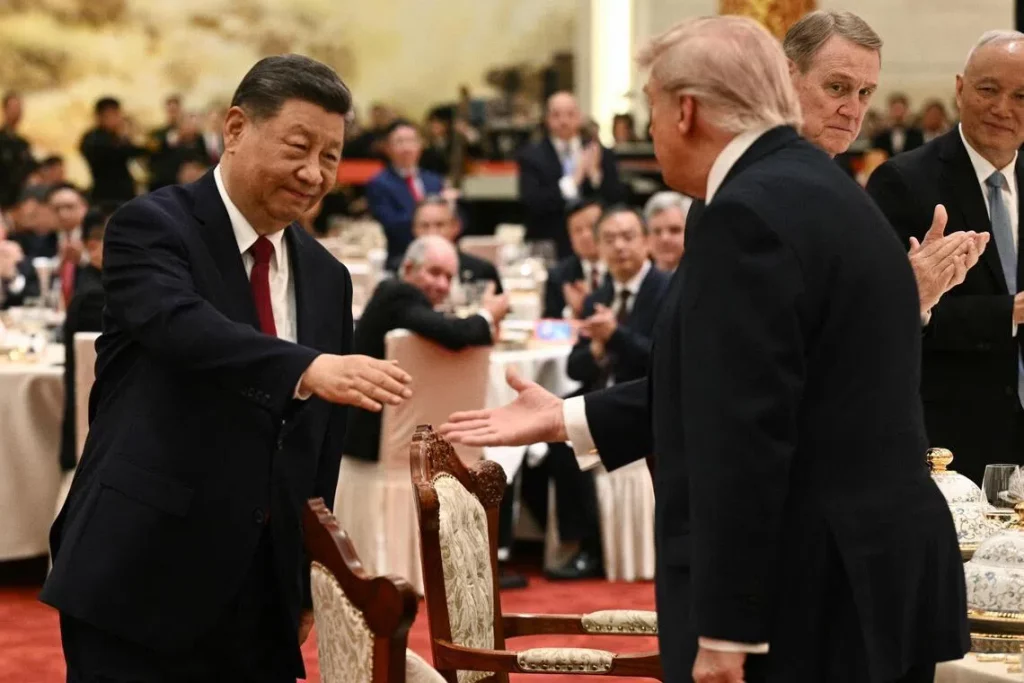
The most significant recent development in the US-China relationship is the landmark Beijing summit held on May 14–15, 2026. As the world watched Trump and Xi Jinping’s historic summit, analysts suggest it could mark a reset in ties between the world’s top two economies.Xi called their meetings “historic” and a “landmark” and said they “reached important common understandings on maintaining stable economic and trade ties, expanding practical cooperation in various fields, and properly addressing each other’s concerns.”
The Trump administration indicated ahead of the trip that it planned to press for greater Chinese purchases of American soybeans, Boeing aircraft, and other goods, while Beijing made it clear that the Taiwan issue would be front and center on its agenda.
Xi warned Trump in Thursday’s meeting of possible “clashes and even conflicts” if the Taiwan issue isn’t handled properly. Taiwan remains the most sensitive flashpoint in the broader US-China relationship, sitting at the intersection of trade, security, and sovereignty.
Expert Quotes and Analysis
Experts and business leaders have weighed in heavily on the state of US-China trade relations.
“The idea of somehow China being totally independent of us and us being totally independent of China, I think, is a fiction,” said financier Wilbur Ross, who served as US Commerce Secretary.
“It makes no sense for the two countries to engage in trade wars or tit for tat,” said James Zimmerman, AmCham China chairman.
“The big word will be stabilization. The truce that the two parties negotiated will, I suspect, become a formal agreement,” said Graham Allison, Harvard professor and former assistant secretary of defense.
“Trade tensions can flare up quite quickly, and that makes US firms hesitant to rely too heavily on Chinese supply,” said Sarah Tan, a Singapore-based economist at Moody’s Analytics.
Global and Regional Impact
The US-China trade war has had ripple effects far beyond the two countries. A few years ago Europe overtook the US as the largest export market for China, and nowadays it is ASEAN that’s the largest export market, with Latin America and the Caribbean being the fastest growing. China has successfully diversified its trade relationships.
The US Trade Representative has launched two Section 301 investigations into excess capacity and forced labor targeting China and other trade partners, in a move to find alternative means of imposing import duties following the Supreme Court’s decision. This signals that the trade conflict is far from over, even as diplomacy advances.
Justin Feng, Asia economist at HSBC, pointed out that the US, China, and European Union now account for 60 percent of global GDP meaning the outcome of their trade dispute has enormous consequences for every nation on earth.
Conclusion: What Comes Next?
The two countries eventually called a truce and some trade resumed. US auto production that had been paused was able to restart. But the direction of travel is clear: trade between the two countries is unwinding faster than ever.
Experts say complete decoupling of the world’s two biggest economies is still unlikely, and high tariffs, rare earth restrictions, and tech export controls remain major sticking points. The relationship is likely to remain competitive, complex, and consequential for years to come.
Whether the Beijing summit leads to a lasting agreement or simply another temporary truce, the US-China relationship will define global economics and geopolitics for the foreseeable future. The world is watching closely.
FAQs
Who is China’s biggest trading partner?
China’s largest trading partner has shifted in recent years. ASEAN is now China’s largest export market, having overtaken both Europe and the United States, while Latin America and the Caribbean have been its fastest-growing export destination. The US-China trade war directly accelerated this geographic diversification.
Did China put 75% tariffs on the US?
China retaliated against US tariffs with a 125 percent tariff on American goods at the peak of the 2025 escalation, essentially halting US agricultural exports. While those extreme levels have since been reduced through negotiations, tariffs on US-China trade remain significantly elevated on both sides.
Is there a trade conflict between the US and China?
Yes, the US-China trade conflict remains active, though it is in a phase of diplomatic management. The United States and China face considerable trade tensions, with implications for the global economy, supply chains, and the broader trading system. The May 2026 Beijing summit represents an effort to stabilize but not fully resolve this ongoing dispute.