

Pakistan is making a bold attempt at financial self-repositioning. Finance Minister Muhammad Aurangzeb has formally proposed a $10 billion Bilateral Exchange Stabilization Support Facility to the United States, submitting the request directly to US Treasury Secretary Scott Bessent. The proposal calls for a facility with a maturity of up to five years, which Pakistani officials believe would help stabilize the country’s external finances, ease pressure on the Pakistani rupee, and reduce dependence on multilateral lenders.
This move is widely seen as part of a deliberate strategy of “offloading” reducing Pakistan’s suffocating reliance on IMF rollovers and emergency bailouts by locking in a direct, bilateral financial cushion from the world’s largest economy. If successful, it would be a watershed moment for Islamabad’s monetary policy standing.
Background: A Country That Barely Avoided Default
To understand why this request matters, you have to look at where Pakistan was just a few years ago. Pakistan narrowly avoided a sovereign default in 2023 after securing a $3 billion IMF standby arrangement. It later received a $7 billion Extended Fund Facility, along with an additional $1.3 billion loan aimed at improving resilience against climate change and natural disasters.
Despite those packages, Pakistan’s forex reserves remained dangerously thin and its currency under constant attack. The government has since been walking a tightrope fulfilling painful IMF conditions while trying to protect ordinary citizens from the full brunt of austerity. Pakistan remains under $7 billion IMF discipline that has required politically unpopular tax increases, spending restraint and reforms.
The $10 billion US facility, if approved, would sit alongside not replace the IMF program, giving Islamabad a critical financial buffer that multilateral borrowing alone cannot provide.
State Bank of Pakistan Interest Rate: The Policy Rate Story
Central to Pakistan’s monetary policy is the question of its policy rate in Pakistan and 2026 has already been a rollercoaster.
The State Bank of Pakistan raised its benchmark policy rate by 100 basis points to 11.5% on April 27, 2026, surprising analysts who expected it to remain steady at 10.5%. This marked the first rate hike since June 2023, amid heightened economic uncertainty, with volatile oil prices from Middle East tensions driving the decision.
The State Bank of Pakistan then left its benchmark policy rate unchanged at 11.5% on June 15, 2026. While recent geopolitical developments have been broadly positive, concerns over global oil prices continue to pose risks to the inflation outlook. Headline inflation accelerated to 11.7% in May 2026, exceeding the central bank’s 5% to 7% target range.
This policy rate decision reflects a difficult balancing act. Economic growth has been picking up economic growth rose to 3.7% in FY26, supported primarily by the services and industrial sectors but inflation is threatening to undo the gains made over the past year of aggressive rate cuts. A US stabilization facility would directly support the rupee and give the SBP more room to manage monetary policy without external shocks forcing its hand.
Rethinking Pakistan’s Higher Defence Spending
Any serious conversation about Pakistan’s monetary policy must also confront the uncomfortable truth about its defence budget. Rethinking Pakistan’s higher defence spending has become a genuine economic debate, not just a strategic one.
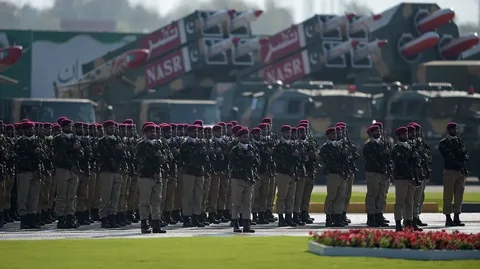
Pakistan has announced a defence budget of PKR 3.01 trillion (USD $10.8 billion) for 2026–27, representing an increase of about 16% over the revised 2025–26 defence budget of PKR 2.59 trillion. The previous year had already seen a dramatic escalation Pakistan increased defense spending by more than 20% in the 2025–26 fiscal year to Rs 2.55 trillion ($9.04 billion) as it sought to bolster military capabilities following the country’s worst confrontation with India in nearly three decades.
Finance Minister Aurangzeb acknowledged the pressure directly when presenting last year’s budget. “National defense is the most important priority of the government,” he said. But critics argue that Pakistan simply cannot afford to let defence consume an ever-larger share of a shrinking fiscal space.
Pakistan’s defence expenditure, together with debt servicing, consumes almost the entire revenue earned by its government. This means the fiscal situation is becoming untenable, as virtually every other expenditure is being made from borrowed funds.
This is the core tension in Pakistan’s economic management. The US stabilization facility could provide breathing room precisely because it would reduce the pressure on reserves without requiring further domestic spending cuts.
Pakistan’s Reaction on Dhurandhar: When Cinema Meets Geopolitics
It would be incomplete to discuss Pakistan’s place in the world right now without noting the extraordinary cultural dimension of its current moment specifically, Pakistan’s reaction on Dhurandhar, the Bollywood spy thriller that has become one of the most talked-about films of 2025.
Dhurandhar, released in December 2025, is a 3.5-hour-long cross-border political spy drama that takes cinemagoers on a violent and bloody journey through a world of gangsters and intelligence agents set against the backdrop of India-Pakistan tensions. It comes just months after hostilities broke out between the two countries in May, following a rebel attack on a popular tourist spot in Pahalgam, in Indian-administered Kashmir.
What surprised many observers was the nuance of Pakistan’s reaction. Several Pakistani viewers publicly appreciated the movie. Multiple videos and posts circulating online show Pakistani men and women many of them based overseas praising the film’s storytelling, performances, and technical finesse. Some viewers described the movie as fact-based rather than propaganda-driven, urging others to watch it with an open mind.
Pakistan’s reaction on Dhurandhar reflects a society caught between genuine grievances over how it is portrayed internationally and a growing openness, particularly among younger and diaspora communities, to engaging honestly with difficult narratives. It is a small but telling window into the complexities of Pakistani public opinion today.
Pakistan and Australia: A Relationship Quietly Expanding
While much attention focuses on Pakistan’s relationship with the US and China, the Pakistan–Australia relationship has been quietly deepening and Sydney is at the heart of it.
Australia and Pakistan are expanding cooperation in trade, education and development. Bilateral trade has surpassed US $2.6 billion, with Australian exports like dairy cattle supporting Pakistan’s food security and dairy sector. More than 21,000 Pakistani students are currently enrolled in Australian institutions.
More than 145,000 Australians of Pakistani origin are living in Australia today. Sydney has the largest Pakistani community in Oceania, with western suburbs of Sydney home to the biggest Pakistani community in Australia. Suburbs like Auburn, Lakemba, and Wiley Park have become cultural hubs where Pakistani identity, commerce, and community life thrive and where developments back home, from monetary policy shifts to military budgets, are followed closely.
The Pakistan–Australia relationship extends beyond trade and diaspora ties. Australia hosted Pakistan’s cricket team earlier this year and received Australia’s squad for a landmark ODI series in Pakistan the first Australian ODI tour to Pakistan since 2022, with matches played between May 30 and June 4, 2026.
Impact: Why This $10 Billion Matters Beyond Pakistan
If the US agrees to the $10 billion backstop facility, the regional and global implications would be significant.
First, it would represent an unusual and substantial American financial commitment to Pakistan a country that has often been a difficult partner for Washington. Exchange stabilization facilities are rare US Treasury backstops, usually routed via the Exchange Stabilization Fund, that provide dollars, swaps or guarantees to support reserves and steady currencies. These facilities are different from the permanent standing dollar swap lines that the US Federal Reserve has with some major central banks.
Second, it would strengthen Pakistan’s hand in its ongoing IMF program by reducing the pressure on its reserves and giving the government more flexibility on the policy rate in Pakistan without triggering a currency crisis. The State Bank of Pakistan could then make monetary policy decisions based on domestic economic conditions rather than external reserve pressures.
Third, it would send a clear geopolitical signal that the United States remains strategically invested in Pakistan’s stability, even amid tensions and realignments across the region. For Islamabad, that signal may be as valuable as the dollars themselves.
What Officials Are Saying
Pakistan’s Finance Ministry did not issue an immediate public statement on the specifics of the backstop request. The US Treasury also declined to comment immediately when approached by wire services. However, sources familiar with the matter confirmed that the proposal has been formally submitted and is under review by American officials.
Finance Minister Aurangzeb, who has staked his tenure on restoring Pakistan’s financial credibility, is understood to be personally driving the initiative. His track record so far navigating the IMF program, managing a dramatic turnaround in reserves, and executing two years of aggressive monetary tightening gives him credibility with international financial institutions that previous finance ministers lacked.
Conclusion: Pakistan at a Monetary Crossroads
Pakistan stands at a pivotal moment in its economic history. The $10 billion US facility request, the debate around rethinking Pakistan’s higher defence spending, the State Bank of Pakistan’s policy rate balancing act at 11.5%, and the deepening ties with Australia all reflect a country trying to break out of a cycle of crisis and into something more durable.
Monetary policy in Pakistan latest news tells a story of cautious optimism tempered by real risk. If the US facility comes through, Pakistan will have more than just reserves it will have a new kind of credibility. If it does not, Islamabad will face the familiar pressure of managing a fragile economy with limited tools and rising costs.
The next few months will determine which of those paths Pakistan walks down.
Frequently Asked Questions
How much money does the US give Pakistan?
The United States has historically been one of Pakistan’s largest sources of financial assistance, though the nature of that support has varied significantly over the decades. Over the past two decades, the US has provided Pakistan with tens of billions of dollars in combined military aid, economic assistance, and development funding, particularly during the post-9/11 period when Pakistan was a frontline partner in counter-terrorism operations in Afghanistan. In more recent years, direct aid flows have decreased substantially as the relationship has shifted and conditions imposed by the US Congress on military aid have become more stringent. The current request for a $10 billion exchange stabilization facility is not traditional aid it would be a structured financial backstop routed through the US Exchange Stabilization Fund, closer in nature to a currency support mechanism than a grant or development package.
How much loan has Pakistan taken from the USA?
Pakistan has received a substantial amount of financing from US-led or US-backed institutions over the years, but direct government-to-government loans from the United States to Pakistan have been less common than people assume. Much of what is described as US financial support has come through reimbursements under military cooperation programs, Coalition Support Funds, and development grants rather than formal loans. However, the IMF where the United States holds the largest voting share and exercises significant influence has extended multiple loan programs to Pakistan, including the current $7 billion Extended Fund Facility. The proposed $10 billion stabilization facility being sought from Washington would constitute a direct bilateral financial arrangement and would be among the largest such deals Pakistan has ever pursued with the United States.
Who is the largest donor of aid to Pakistan?
Historically, the United States has been one of Pakistan’s largest bilateral donors, providing billions in both military and civilian assistance across several decades. However, in more recent years, China has emerged as Pakistan’s most significant financial partner in terms of investment and project financing, primarily through the China-Pakistan Economic Corridor. In terms of development assistance and institutional lending, the World Bank and the Asian Development Bank are among the largest sources of concessional loans and grants that Pakistan relies on. The IMF, while not technically a donor, has been the most critical emergency financial institution for Pakistan during periods of economic crisis.