
Iran war Gulf wildlife is now facing an environmental emergency.
From sea turtles to birds and the gentle dugong, the Persian Gulf’s diverse but fragile marine life is threatened by the bombs and oil of the war in the Middle East. The ecosystem was already under pressure from climate change and maritime traffic before the United States and Israel launched their war on Iran at the end of February.
More than 300 incidents involving environmental risks — including attacks on oil tankers — have been recorded in the region since the conflict broke out, according to a report by the Conflict and Environment Observatory, a UK non-governmental organisation.
The Iran war Gulf wildlife crisis threatens species that were already classified as vulnerable before the first missile was fired.
Background
The Iran war Gulf wildlife threat did not emerge from nowhere. The Persian Gulf’s ecosystem was already one of the most ecologically stressed bodies of water on earth.
The geography of the Gulf makes its ecosystem particularly vulnerable. A semi-enclosed and shallow sea about 50 metres deep on average, it is connected to the Indian Ocean through the Strait of Hormuz.
The wildlife of the Persian Gulf is entirely unique because of the Gulf’s geographic distribution and its isolation from international waters, breached only by the narrow Strait of Hormuz. The Persian Gulf has hosted some of the most magnificent marine fauna and flora, some of which are near extirpation or at serious environmental risk.
The Iran war Gulf wildlife emergency has now delivered the additional shock that conservationists had long feared — an active military conflict inside one of the world’s most fragile semi-enclosed seas.
Iran War Gulf Wildlife — What Is at Risk
The Iran war Gulf wildlife threat spans marine mammals, reptiles, fish, and birds across the entire Persian Gulf ecosystem.
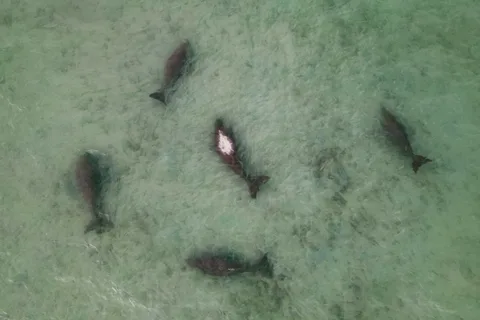
The world’s second-largest population of dugongs, herbivorous marine mammals, along with hundreds of fish and turtle species, live in the Gulf, where attacks on oil tankers threaten to create multiple oil spills, jeopardising their survival. The Persian Gulf is home to unique marine flora and fauna of great biological richness, some of which are already threatened, and the conflict could deliver a fatal blow.
About a dozen species of marine mammals are found in the Gulf, including humpback whales and whale sharks. In total, more than 2,000 marine species have been recorded in the warm Gulf waters, including over 500 fish species and five types of sea turtles, among them the critically endangered hawksbill sea turtle. There are also about 100 species of corals, which together with mangroves and seagrass beds form essential breeding and nursery grounds for fish and crustaceans.
Greenpeace has warned that dozens of tankers carrying around 21 billion litres of oil are trapped in the Persian Gulf. “This is an ecological ticking time bomb,” said Nina Noelle of Greenpeace Germany, who has been mapping oil tankers in the region.
Wildlife of Iran — Beyond the Gulf
The Iran war Gulf wildlife crisis is only part of a broader picture. The wildlife of Iran extends far beyond the Persian Gulf into one of the most biodiverse landscapes on earth.
In total, 1,168 species are listed within Iran’s wildlife. The country boasts a diverse range of ecosystems, from vast deserts and lush forests to the Caspian Sea and the Persian Gulf. Iranian mammals include at least 194 species.
The most notable animals found in the wildlife of Iran include the Persian leopard, Asiatic cheetah, brown bear, striped hyena, golden jackal, Eurasian lynx, wild goat, and Persian gazelle among mammals. Bird species include the flamingo, bearded vulture, Eurasian eagle-owl, great bustard, and pheasant. Marine life in the wildlife of Iran includes the Caspian seal, Persian Gulf green sea turtle, and bottlenose dolphin.
The Iran war Gulf wildlife emergency now threatens the southern portion of this broader ecological network — a coastline Iran shares with the Persian Gulf stretching over 2,000 kilometres.
The Oil Tanker Threat
The most immediate Iran war Gulf wildlife danger comes not from bombs directly but from the oil they release.
Sea mines and other explosive devices can cause acoustic disturbance impacting sea mammals and other animals, and blast damage to natural undersea structures such as reefs. Studies published in Nature and in a journal of the Royal Society found links between the use of mid-frequency military sonar and whale strandings.
On land, Iranian officials described Israeli strikes on Tehran fuel depots as ecocide, contaminating soil and groundwater and causing long-term risks to human health and the wider environment.
The Persian Gulf ecosystem faces serious threats from oil and gas extraction, coastal development, and pollution. These factors alongside climate change pose risks to the delicate balance of marine life, potentially leading to food shortages and economic challenges for local communities that rely on fishing.
The Iran war Gulf wildlife crisis compounds all of these existing pressures simultaneously.
Is the Persian Gulf War Still Ongoing
The question of whether the Persian Gulf war is still ongoing requires separating two distinct conflicts.
The original Persian Gulf War of 1990 to 1991 ended with a ceasefire in February 1991 after a US-led coalition drove Iraqi forces out of Kuwait. That conflict officially ended over three decades ago.
The current conflict — the Iran war of 2026 — is an entirely separate war triggered by US-Israeli strikes on Iran beginning at the end of February 2026. This conflict is ongoing. The Persian Gulf is now an active theatre of military operations for the first time since 1991, which is precisely why the Iran war Gulf wildlife emergency has become so acute.
So the Persian Gulf war is not still ongoing in its original form — but an active and arguably more dangerous conflict is now being fought in and around the same waters.
Was Iran Involved in the Gulf War
Iran was not a participant in the Gulf War of 1990 to 1991, but it was directly affected by it.
The Gulf War was fought between Iraq and a US-led international coalition following Iraq’s invasion of Kuwait. Iran had recently concluded its own devastating eight-year war with Iraq — the Iran-Iraq War of 1980 to 1988 — and maintained a position of official neutrality during the Gulf War that followed.
Iran did benefit strategically from Iraq’s defeat and weakening in 1991. However, Iran was not a combatant in that conflict and did not contribute forces to either side. The current 2026 conflict is the first time Iran has been directly at war involving the Persian Gulf since the Iran-Iraq War ended.
Quotes
“The wars in the 1980s and 1990s demonstrate how exposed the ecosystems of the Persian Gulf are to conflict pollution, whether this is from damage to on- or offshore oil facilities or through spills from attacks on shipping.” — Doug Weir, Director, Conflict and Environment Observatory
“This is an ecological ticking time bomb.” — Nina Noelle, Greenpeace Germany
“Israeli strikes on Tehran fuel depots constituted ecocide, contaminating soil and groundwater and causing long-term risks to people’s health.” — Abbas Araghchi, Iranian Foreign Minister
Impact
For the dugong, the Iran war Gulf wildlife crisis arrives at the worst possible moment. The world’s second-largest dugong population was already classified as vulnerable before the conflict began. Oil contamination of seagrass beds — the dugong’s only food source — could drive local population collapse within a single breeding cycle.
For sea turtles, five species use the Persian Gulf for nesting and feeding. The critically endangered hawksbill sea turtle has nesting beaches along Iranian, Emirati, and Saudi coastlines that are now within the zone of active military operations and potential oil contamination.
For birds, a 2009 study recorded more than 100,000 breeding pairs of waterbirds across Iranian Gulf islands. Oil spills reaching these nesting sites during breeding season could devastate multiple seabird populations simultaneously.
For the broader wildlife of Iran, the conflict adds a new layer of environmental stress to an already pressured natural heritage that includes the last wild Asiatic cheetah population on earth.
FAQs
Did Iran help in the Gulf War?
No. Iran was officially neutral during the Gulf War of 1990 to 1991. Iran had just ended its own eight-year war with Iraq and did not contribute forces to either the Iraqi side or the US-led coalition. Iran benefited indirectly from Iraq’s military defeat and subsequent weakening.
Does the Persian Gulf have sharks?
Yes. Iranian fishermen have documented sharks, guitarfishes, wedgefishes, and rays along the southern Iranian coast. A third of fishermen interviewed said that with current overfishing, sharks will disappear, and most believed having these species around is very important and that sharks and rays should be protected. Whale sharks are also among the marine species recorded in the Persian Gulf.
What were the environmental impacts of the Persian Gulf War?
The Gulf War in 1991 triggered one of the largest marine oil spills linked to armed conflict, when retreating Iraqi forces deliberately opened oil valves in Kuwait and destroyed oil infrastructure. Up to 11 million barrels of oil were released, contaminating 640 kilometres of Saudi coastline and killing more than 30,000 seabirds. It took decades to recover.The Iran war Gulf wildlife threat today echoes those same risks in a Gulf that has never fully healed from that earlier environmental catastrophe.
Conclusion
Iran war Gulf wildlife is under threat from a conflict that was not designed with nature in mind — but nature has no exemption from its consequences.
The combination of direct military activity, oil tanker attacks, and the broader disruption to the marine environment has created what experts describe as an unprecedented threat to the Gulf’s biodiversity. The more than 300 recorded environmental risk incidents since the war began underscore the scale of the danger facing the region’s wildlife.
The wildlife of Iran — from Persian leopards in the north to dugongs in the south — existed long before this conflict and deserves the chance to exist after it ends.
Whether the Persian Gulf recovers from the Iran war Gulf wildlife emergency as slowly as it recovered from 1991, or faster, will depend on how long the conflict lasts and how much oil reaches the water before it stops.