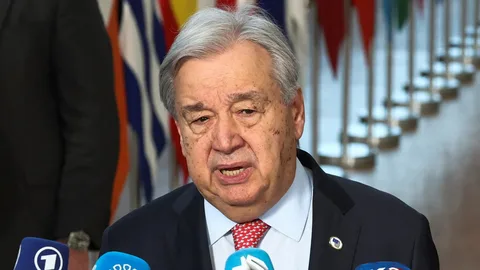

Guterres end war US Israel Iran call has been issued in the strongest terms yet by the UN Secretary-General — with Antonio Guterres stating that it is high time to end the war while simultaneously urging Iran to stop attacking its neighbours in a carefully balanced UN statement on Iran war that attempts to hold all parties accountable without aligning the United Nations with any single side in the conflict.
Guterres end war US Israel Iran statement represents the most direct and forceful UN on Iran war intervention since hostilities began on February 28 2026 — with the Secretary-General departing from the diplomatic language that has characterised previous UN statements on Iran to deliver an unambiguous demand that all parties pursue an immediate ceasefire and political settlement.
The UN statement on Iran war dual accountability framing — telling the US and Israel it is high time to end the war while simultaneously telling Iran to stop attacking its neighbours — reflects Guterres’s attempt to preserve the United Nations’ credibility as an impartial international institution while making clear that the human and economic cost of the Iran US war has reached a threshold that demands immediate action from every party responsible for continuing it.
Background: Guterres End War US Israel Iran — Why Now
The UN’s Difficult Position
Guterres end war US Israel Iran statement comes at a moment when the United Nations has been largely sidelined by a conflict whose primary parties have either ignored or actively circumvented UN institutional mechanisms designed to manage exactly this kind of international security crisis.
UN on Iran war institutional response has been hampered since day one by the Security Council dynamics that make meaningful collective action impossible — with the United States as a permanent member and direct party to the Iran US war having the ability to veto any Security Council resolution that would impose binding constraints on US military operations, and Russia and China using their veto power to block resolutions that would impose costs on Iran without equally condemning the US-Israel strikes.
UN statement on Iran war previous iterations have been progressively stronger as the conflict has continued — with Guterres moving from initial calls for restraint through expressions of concern to the current it is high time language that represents the most direct demand the Secretary-General has yet made. The escalation in Guterres end war language mirrors the escalation in the conflict itself — with the Sejjil missile Iran deployment on day 18 the partial Strait of Hormuz ships Iran opening and the accumulation of over 1,760 confirmed deaths across all parties creating the conditions for a more forceful UN on Iran war intervention than Guterres had previously felt diplomatically justified in making.
What Has Changed Since Previous UN Statements
Guterres end war US Israel Iran statement timing reflects several specific developments that have pushed the Secretary-General to speak more forcefully than at any previous point in the conflict.
The Sejjil missile Iran deployment and the resulting highest single-night Israeli casualty toll of the conflict — 6 killed and over 40 injured — demonstrated to Guterres that the conflict’s military escalation was accelerating rather than plateauing in ways that made continued diplomatic caution irresponsible.
The Strait of Hormuz ships Iran partial opening created what Guterres assessed as a genuine diplomatic window — with Iran’s partial concession providing a foundation for the UN on Iran war ceasefire diplomacy that previous complete closure had made nearly impossible to structure.
The Goldman Sachs recessionary risk warning shifting from possible to probable provided economic urgency — with the UN’s development agencies and humanitarian organisations communicating to Guterres that the global economic damage of the Iran US war was beginning to produce human development consequences in developing nations far removed from the conflict that the UN had a direct institutional responsibility to address.
Guterres End War Statement — What He Said
The High Time Statement
Guterres end war US Israel Iran high time statement was delivered in a formal address to the UN General Assembly emergency special session convened under the Uniting for Peace procedure — with Guterres speaking directly and without diplomatic qualification in a manner that his aides described as deliberately designed to break through the political noise surrounding the Iran US war.
Guterres end war statement directed at the United States and Israel stated that it was high time to end the war — adding that the military objectives of the US-Israel campaign had been substantially achieved with Iran’s nuclear programme destroyed and its military infrastructure severely degraded and that continuing the conflict beyond the point where its stated objectives had been largely met was producing costs including American service member deaths Israeli civilian casualties and global economic damage that no longer served any strategic objective commensurate with their scale.
Guterres end war message to the US and Israel was accompanied by specific demands that the UN statement on Iran translated into operational terms — an immediate halt to offensive strikes on Iranian territory a commitment to UN-mediated ceasefire negotiations and a guarantee of humanitarian access to Iranian civilian populations affected by the strike campaign.
The Iran Statement
Guterres end war dual message included an equally direct UN statement on Iran war calling on Tehran to stop attacking its neighbours — a formulation that held Iran accountable for the missile and drone attacks on Gulf nations Israeli cities and US military bases that have collectively produced hundreds of casualties across the region.
UN on Iran war accountability for Iranian retaliation was framed by Guterres with careful balance — acknowledging that Iran was responding to US-Israeli military strikes on its territory while making clear that the UN considered the scale and indiscriminate nature of Iranian attacks on Gulf civilian infrastructure and Israeli population centres to constitute violations of international humanitarian law that the UN could not endorse or excuse regardless of the political context.
Guterres end war Iran demand included 3 specific calls — an immediate halt to ballistic missile and drone attacks on Gulf nations and Israel a withdrawal of IRGC naval threats from the Strait of Hormuz shipping lanes and a commitment to engage with UN-mediated ceasefire negotiations alongside the US and Israel.
UN Statement on Iran — Full Analysis
UN Statement on Iran — Institutional Significance
UN statement on Iran war from Guterres carries institutional significance that exceeds the diplomatic impact of any individual national government’s ceasefire call — with the Secretary-General speaking in his unique capacity as the representative of the international community’s collective interest in peace and security.
UN statement on Iran institutional authority derives from the UN Charter obligations that bind all 193 member states including the US Israel and Iran to cooperate with UN efforts to maintain international peace and security. While the Security Council’s veto-paralysed inability to pass binding resolutions has reduced the UN’s enforcement capacity in the Iran US war the Secretary-General’s moral authority and his ability to mobilise diplomatic pressure through the General Assembly and through bilateral engagement with key member states gives the UN statement on Iran genuine practical weight.
UN statement on Iran war Guterres credibility is enhanced by the dual accountability framing — with the Secretary-General’s willingness to criticise Iran as well as the US and Israel making his ceasefire call harder to dismiss as one-sided advocacy for any particular party’s position. Previous UN on Iran war statements that focused primarily on US-Israeli strike accountability had been dismissed by Washington and Tel Aviv as politically motivated — the Guterres end war balanced framing makes this dismissal harder to sustain.
UN Statement on Iran — What It Proposes
UN statement on Iran war Guterres has moved beyond general ceasefire calls to propose a specific UN-mediated diplomatic framework — the most concrete UN on Iran war intervention since hostilities began.
UN statement on Iran specific proposals include the appointment of a UN Special Envoy for the Iran US war ceasefire — a dedicated diplomatic interlocutor with access to all parties who can maintain continuous engagement rather than the episodic interventions that have characterised previous UN on Iran war diplomacy.
UN statement on Iran ceasefire framework proposal involves a phased approach — an initial 72-hour humanitarian ceasefire during which no offensive strikes would be conducted and no ballistic missiles launched creating space for the diplomatic engagement that the Qatar back-channel has been attempting to structure without UN institutional support.
UN statement on Iran longer-term framework proposes a UN-hosted multilateral conference involving all parties including Iran the US Israel the Gulf states Lebanon and key international stakeholders including China Russia the EU and the Arab League to negotiate the political framework for a sustainable end to the Iran US war.
UN on Iran War — Institutional Response
General Assembly Emergency Session
UN on Iran war General Assembly emergency session convened under the Uniting for Peace procedure — the mechanism that allows the General Assembly to act when the Security Council is blocked by veto — has provided the institutional forum for Guterres end war US Israel Iran address that the Security Council’s paralysis had prevented.
UN on Iran war General Assembly resolution passed with 142 votes in favour 8 against and 35 abstentions — calling for an immediate ceasefire in terms that broadly endorsed the Guterres end war framework while reflecting the significant international consensus that has built against the continuation of the Iran US war beyond the point where its objectives have been largely achieved.
UN on Iran war General Assembly resolution is not legally binding — only Security Council resolutions carry binding force under the UN Charter. But the 142-8 vote margin provides moral and political weight that the Guterres end war call can leverage in bilateral diplomatic engagement with parties less responsive to institutional processes than to the evidence of broad international isolation.
UN Humanitarian Agencies
UN on Iran war humanitarian agency response has provided the human development data that underpins the Guterres end war urgency — with UNHCR WFP UNICEF and WHO collectively documenting a humanitarian situation that has deteriorated beyond the immediate conflict zone to produce global food security and health system impacts that the Secretary-General cannot ignore.
UN on Iran war humanitarian cost documentation includes over 1760 confirmed deaths across all parties the displacement of hundreds of thousands of Lebanese civilians the near-complete disruption of Gulf humanitarian supply chains and the global food price increases driven by oil market disruption that are producing malnutrition increases in developing nations far from the conflict zone.
Iran US War — The Conflict Guterres Is Addressing
Iran US War — Current Status
Iran US war status at the time of the Guterres end war statement is a conflict that has achieved significant military objectives on the US-Israeli side while failing to produce the political outcomes that would constitute strategic victory — creating the conditions for the kind of negotiated settlement that the Guterres end war framework is designed to facilitate.
Iran US war military balance shows US-Israel coalition having struck over 3400 Iranian military targets destroyed Iran’s nuclear programme killed Supreme Leader Ali Khamenei and degraded IRGC military capacity across multiple domains. Iran US war Iranian retaliation has produced 8 American deaths 19 or more Israeli deaths over 400 Lebanese deaths and casualties across all Gulf nations while sustaining effective Strait of Hormuz disruption for 18 consecutive days.
Iran US war diplomatic stalemate has been the defining political feature of the conflict — with Iran’s 3 conditions for ending the war remaining incompatible with US demands for unconditional surrender and no mediating framework having yet bridged the gap between the 2 positions.
Iran US War — The Guterres Assessment
Iran US war Guterres assessment — implicit in the high time to end the war framing — is that the conflict has reached the point at which its costs to all parties and to the global community exceed any remaining strategic benefits that continued military operations could plausibly deliver.
Iran US war Guterres assessment of US-Israeli position acknowledges that the nuclear objective has been largely achieved while arguing that the political objectives of regime behaviour change and unconditional Iranian capitulation are not achievable through continued military pressure at acceptable cost given the mounting American casualties economic damage and international isolation that the conflict is producing.
Iran US war Guterres assessment of Iranian position acknowledges Iran’s right to respond to military attack on its territory while arguing that the indiscriminate nature of Iranian missile attacks on Gulf civilians and Israeli population centres and the Strait of Hormuz economic weapon are producing humanitarian and economic costs that Iran cannot sustain indefinitely and that a negotiated settlement offers Iran better terms than military exhaustion.
Did Iran Agree to End the War
Did Iran Agree to End the War — Current Status
Did Iran agree to end the war is the most consequential question raised by the Guterres end war US Israel Iran intervention — and the answer as of the current moment is no but with meaningful qualification.
Did Iran agree to end the war through a formal acceptance of the Guterres ceasefire framework — No. Iran has not issued a formal statement accepting the Guterres end war proposal or the UN statement on Iran war ceasefire framework. Iranian Foreign Minister Abbas Araghchi’s response to the Guterres statement welcomed the Secretary-General’s acknowledgment that the US-Israel strikes were the root cause of the conflict while stopping short of the formal ceasefire commitment that the UN on Iran war framework requires.
Did Iran agree to end the war through the Strait of Hormuz partial opening — arguably yes in a limited and qualified sense. The Strait of Hormuz ships Iran partial opening that maritime tracking data has confirmed represents Iran’s most significant de-escalation gesture since the conflict began — a unilateral concession that the Guterres end war team is attempting to translate into a formal ceasefire framework through the Qatar back-channel.
Did Iran agree to end the war through back-channel communications — according to Qatari mediation sources yes in the sense that Iran has indicated willingness to engage with a UN-mediated ceasefire process if the US demonstrates reciprocal flexibility on the terms it is demanding. This qualified Iranian openness to engagement is the most positive diplomatic signal since the conflict began and provides the foundation on which the Guterres end war initiative is attempting to build.
Quotes on Guterres End War US Israel Iran
UN Secretary-General Antonio Guterres stated in his General Assembly address that it was high time to end the war — adding that the military campaign had achieved its primary stated objective of destroying Iran’s nuclear weapons programme and that continuing beyond that point was producing American deaths Israeli civilian casualties global economic damage and a humanitarian catastrophe in Lebanon that no strategic objective could justify.
Guterres directed at Iran stated that Iran must stop attacking its neighbours — adding that whatever the injustice of the original US-Israeli strikes the Iranian response targeting Gulf civilian infrastructure Israeli population centres and international shipping lanes was producing consequences that the international community could not accept regardless of the political context that motivated them.
US Ambassador to the UN Linda Thomas-Greenfield stated that the United States welcomed the Secretary-General’s call on Iran to stop attacking its neighbours while rejecting the equivalence implied by telling the US and Israel to end the war — adding that the US would end its military operations when Iran accepted the terms required to guarantee it would never threaten American allies with nuclear weapons again.
Israeli UN Ambassador Danny Danon described the Guterres end war statement as well-intentioned but fundamentally misaligned with the strategic reality — stating that Israel could not accept a ceasefire framework that left Hezbollah armed on its northern border and Iran with the capacity to rearm reconstitute and repeat its aggression within years.
Iranian Foreign Minister Abbas Araghchi welcomed Guterres’s acknowledgment of the US-Israeli aggression that started the conflict — stating that Iran had always been open to diplomatic solutions based on respect for Iranian sovereignty and that the Guterres framework contained elements Iran was willing to discuss through the appropriate diplomatic channels.
Chinese Foreign Minister Wang Yi expressed strong support for the Guterres end war initiative — stating that China had consistently called for a diplomatic solution and that the Secretary-General’s balanced framework provided the foundation for the negotiations that China had been urging since day one of the Iran US war.
Impact: What Guterres End War US Israel Iran Means
For Diplomatic Prospects
Guterres end war US Israel Iran intervention is the most significant potential diplomatic turning point since the conflict began — combining the institutional authority of the UN Secretary-General with the concrete policy proposals of a specific ceasefire framework and the diplomatic opening created by Iran’s Strait of Hormuz partial concession.
UN statement on Iran war ceasefire framework — if adopted as the basis for negotiations — would provide the multilateral diplomatic cover that all parties need to move from their maximalist public positions toward the compromise that a negotiated settlement requires. The US needs a framework that allows it to claim mission accomplished on the nuclear objective. Iran needs a framework that allows it to claim it defended its sovereignty without surrendering. The UN on Iran war multilateral framework provides the face-saving architecture that bilateral negotiations between the parties themselves cannot.
For UN Credibility
Guterres end war dual accountability statement has strengthened rather than compromised UN institutional credibility — with the Secretary-General’s balanced call demonstrating that the UN can speak truth to all parties simultaneously rather than merely reflecting the positions of whichever great powers currently dominate the Security Council.
UN on Iran war institutional response has been hampered by Security Council paralysis throughout the conflict — making the General Assembly emergency session and the Guterres end war address through that forum a significant precedent for how the UN manages conflicts where veto power prevents Security Council action.
For Global Economy
Guterres end war initiative combined with the Strait of Hormuz ships Iran partial opening has produced the most positive economic market signal since the Iran US war began — with oil prices falling commodity markets partially stabilising and shipping insurance premiums declining from their peaks in response to the dual de-escalation signals.
UN statement on Iran war diplomatic framework if it produces even a preliminary ceasefire would allow Strait of Hormuz full restoration — the single development that would most rapidly normalise global energy markets and reduce the recessionary risk that Goldman Sachs has identified as the most acute economic consequence of continued conflict.
Frequently Asked Questions
What Was the Secretary General’s Statement on Iran?
The UN Secretary-General Antonio Guterres made his most direct and forceful statement on the Iran US war in a General Assembly address calling it high time to end the war while simultaneously urging Iran to stop attacking its neighbours. The UN statement on Iran war was deliberately balanced — holding all parties accountable rather than aligning with any single side. Guterres proposed a specific UN-mediated ceasefire framework including the appointment of a Special Envoy an initial 72-hour humanitarian ceasefire and a UN-hosted multilateral conference to negotiate a sustainable political settlement. The UN statement on Iran acknowledged that the conflict’s primary stated objective of destroying Iran’s nuclear programme had been substantially achieved while arguing that continued military operations were producing costs in American lives Israeli civilian casualties global economic damage and Lebanese humanitarian catastrophe that no remaining strategic objective could justify.
Did Iran Agree to End the War With Israel?
Iran has not formally accepted a ceasefire agreement as of the current date. Iran’s response to the Guterres end war initiative has been cautiously positive — welcoming the UN statement on Iran acknowledgment of US-Israeli aggression as the root cause of the conflict while stopping short of a formal ceasefire commitment. Iran’s most significant de-escalation gesture has been the Strait of Hormuz ships Iran partial opening — allowing humanitarian cargo Chinese vessels and Qatari LNG tankers to transit the waterway that had been effectively closed since day one. Qatari mediation sources describe Iran as willing to engage with UN-mediated ceasefire negotiations if the US demonstrates reciprocal flexibility on its unconditional surrender demands. The gap between Iran’s qualified openness to engagement and a concluded ceasefire agreement remains significant — but the Guterres end war initiative and Iran’s Strait of Hormuz partial opening together represent the most positive diplomatic conditions of the entire conflict.
What Is the Reason for the Iran and Israel War in Simple Words?
The Iran and Israel war in simple words has 3 primary causes. First — Iran’s nuclear programme. Iran was enriching uranium to levels close to weapons-grade — meaning it was approaching the ability to build nuclear bombs. Israel and the US considered this an existential threat that could not be allowed to happen and decided military action was the only remaining option after years of sanctions and diplomacy failed to permanently stop Iran’s nuclear progress. Second — decades of declared hostility. Iran has never recognised Israel’s right to exist and has repeatedly called for its elimination since the 1979 Islamic Revolution. Iran has funded and armed Hezbollah Hamas and other groups that have attacked Israel for decades. Israel has conducted covert operations against Iran’s nuclear scientists and facilities for years. The two countries have been in a shadow war for a long time that the current conflict has made direct and open. Third — the United States involvement. The US joined Israel in the military strikes because Iran’s nuclear programme and its support for groups that have killed American soldiers and threatened US allies made Iran the primary US adversary in the Middle East whose nuclear capability the Trump administration decided had to be eliminated by force when diplomacy failed.
Conclusion
Guterres end war US Israel Iran call — delivered with unprecedented directness and backed by a specific diplomatic framework — represents the most significant international intervention in a conflict that has killed over 1760 people displaced hundreds of thousands and pushed the global economy toward recession in just 18 days.
UN statement on Iran war balanced accountability — telling the US and Israel it is high time to end the war while urging Iran to stop attacking its neighbours — is diplomatically sophisticated and morally honest. It does not let any party escape responsibility. It does not pretend that the conflict’s origins or conduct are equivalent on all sides. It acknowledges military reality while demanding political imagination.
Iran US war cannot end through military victory of the kind that either side is capable of achieving at acceptable cost. It can only end through the kind of negotiated settlement that the Guterres end war framework is designed to facilitate — one that gives the US and Israel the security guarantees they need the nuclear problem solved and Iran the sovereignty respect and sanctions relief that makes peaceful coexistence preferable to continued resistance.
Whether the parties choose to use the Guterres end war diplomatic opening or allow it to pass unused while the missiles continue to fly is the question on which millions of lives and the global economy now depend.