
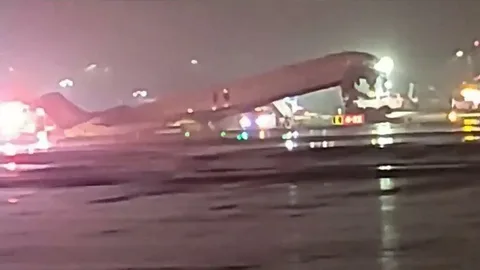
LaGuardia airport runway collision has killed a pilot and co-pilot in one of the most serious aviation incidents at a major American airport in recent years — with the collision between 2 aircraft on LaGuardia’s runway system triggering an immediate airport shutdown that has stranded thousands of passengers and diverted dozens of flights to alternative New York area airports.
LaGuardia airport runway collision occurred during what aviation authorities are describing as a critical phase of ground operations — with initial reports indicating that a communication breakdown or air traffic control instruction confusion may have contributed to 2 aircraft occupying the same runway space simultaneously in the circumstances that produced the fatal LaGuardia airport runway collision.
Air Canada LaGuardia connection has emerged as central to the LaGuardia airport runway collision incident — with an Air Canada aircraft reported to be among the aircraft involved in the collision that has prompted the Air Canada crash investigation and the immediate activation of the National Transportation Safety Board’s go team that is the standard US federal response to major aviation accidents.
Background: LaGuardia Airport — New York’s Challenging Hub
Why LaGuardia Airport Runway Collision Risk Is Elevated
LaGuardia airport runway collision risk context requires understanding the specific characteristics of LaGuardia that make it one of the most operationally challenging airports in the United States — and one of the most studied airports in the world for the cumulative safety pressures that its geography traffic density and runway configuration create.
LaGuardia airport is located in Queens New York on a peninsula jutting into Flushing Bay and Bowery Bay — a geographic constraint that has defined and limited the airport’s physical layout since its construction in the 1930s and that continues to make expansion essentially impossible within the airport’s current footprint. This geographic constraint is the root cause of the runway configuration that makes LaGuardia airport runway collision scenarios more technically complex to prevent than at airports with more generous physical space.
LaGuardia airport handles approximately 30 million passengers annually — making it the 19th busiest airport in the United States and one of the most heavily used airports per square foot of airport area in the world. This traffic density combined with the constrained runway system creates an operational environment where air traffic controllers must manage aircraft movements with minimal margin for error and where the consequences of communication failures are more severe than at airports with more runway separation and space.
LaGuardia airport runway collision history includes several previous serious runway incursion incidents — with the airport having been identified by aviation safety analysts as having above-average runway incursion risk given its specific operational characteristics. The current LaGuardia airport runway collision is the most serious in the airport’s history in terms of confirmed fatalities.
LaGuardia Airport Runway Collision — What Happened
The Sequence of Events
LaGuardia airport runway collision sequence of events as reconstructed from initial air traffic control communications recordings flight data recorder preliminary data and witness accounts presents a picture of the circumstances that produced the fatal collision — though the NTSB investigation will ultimately determine the definitive causal sequence.
LaGuardia airport runway collision occurred during what is described as a period of normal operational tempo — with no declared weather emergency fog advisory or visibility warning in place at the time of the incident that would have indicated to air traffic control or flight crews an elevated collision risk beyond the standard operational challenges that LaGuardia presents daily.
LaGuardia airport runway collision initial reports indicate that one aircraft had been cleared to take off while a second aircraft was either cleared for a runway crossing or misunderstood its clearance instructions in a way that brought it onto the active runway as the first aircraft was beginning its takeoff roll. The collision occurred during the takeoff roll when the departing aircraft was travelling at a speed that made evasive action impossible given the distance available.
LaGuardia airport runway collision impact killed the pilot and co-pilot of one aircraft — believed to be the smaller of the 2 aircraft involved — with the cockpit section of the smaller aircraft bearing the primary impact force of the collision. Passengers aboard both aircraft and cabin crew members experienced varying degrees of injury from the collision impact and the emergency evacuation that followed.
Air Canada Crash — What Is Known
Air Canada crash at LaGuardia involves an Air Canada regional aircraft operating under the Air Canada Express banner — one of the regional carrier partnerships through which Air Canada operates shorter-haul routes throughout North America using aircraft smaller than Air Canada’s mainline Airbus and Boeing fleet.
Air Canada LaGuardia operations are a regular component of Air Canada’s New York area network — with Air Canada Express services connecting LaGuardia to Canadian destinations including Toronto Montreal and Ottawa through the bilateral aviation arrangement that makes Air Canada LaGuardia one of the most frequently served cross-border routes in North American aviation.
Air Canada crash investigation involvement means that Transport Canada — Canada’s equivalent of the FAA — has been notified and is cooperating with the NTSB-led investigation into the LaGuardia airport runway collision given Air Canada’s status as a Canadian carrier operating under Canadian air operator certification.
Air Canada LaGuardia flight involved in the collision was operating with a full passenger load — with Air Canada confirming that the aircraft had departed from a Canadian point of origin and was conducting the standard approach and landing sequence when the LaGuardia airport runway collision occurred.
LaGuardia Airport Closed — Shutdown Details
LaGuardia Airport Closed — Immediate Response
LaGuardia airport closed declaration was made by the Port Authority of New York and New Jersey within minutes of the LaGuardia airport runway collision — with all departures and arrivals immediately suspended as emergency response teams including the Port Authority Police Department the New York City Fire Department and airport emergency medical services responded to the collision site.
LaGuardia airport closed status triggered the diversion of all aircraft in approach sequences to John F Kennedy International Airport and Newark Liberty International Airport — the 2 alternative New York area airports that absorbed the LaGuardia airport closed traffic in a coordinated FAA ground stop that affected hundreds of flights across the entire New York terminal control area.
LaGuardia airport closed duration has been initially assessed as extending through multiple days — with the runway system requiring comprehensive forensic documentation by NTSB investigators the removal of the collision-damaged aircraft the structural assessment of runway surface damage and the review and certification of air traffic control procedures before LaGuardia airport closed status can be lifted.
LaGuardia airport closed passenger impact has affected thousands of travellers — with passengers already aboard aircraft at gates deplaning passengers in transit through the terminal redirected to ground transportation and passengers whose flights were diverted to JFK and Newark facing the significant logistical challenges of reaching their intended LaGuardia destinations from alternative airports.
Passenger Evacuation and Emergency Response
LaGuardia airport runway collision passenger evacuation from the Air Canada crash aircraft and the second aircraft involved was conducted through emergency exit slides — with cabin crew following standard emergency evacuation procedures that prioritised passenger egress from both aircraft before emergency services could reach the collision site.
LaGuardia airport runway collision emergency medical response involved multiple New York City and Port Authority emergency medical teams — with injured passengers and surviving crew members transported to area hospitals including NYU Langone Medical Center and NewYork-Presbyterian Hospital Weill Cornell Medical Center.
LaGuardia airport runway collision confirmed fatalities — the pilot and co-pilot of the smaller aircraft — were pronounced dead at the scene by emergency medical personnel. Additional serious injuries among passengers and crew of both aircraft are being assessed at receiving hospitals with the full injury toll expected to be confirmed in the hours following the initial emergency response.
Investigation — NTSB Response
NTSB Go Team Activation
LaGuardia airport runway collision NTSB response has been immediate — with the National Transportation Safety Board activating its go team within minutes of the collision notification and dispatching investigators from Washington DC to LaGuardia to begin the on-site investigation that will ultimately determine the causal factors of the LaGuardia airport runway collision.
LaGuardia airport runway collision NTSB investigation will focus on several primary areas — air traffic control communications and the specific clearances issued to both aircraft in the minutes before the collision, flight crew responses to ATC instructions and any communication ambiguity that may have contributed to the runway incursion, airport surface detection equipment performance and whether any technological warning of the impending LaGuardia airport runway collision was available to controllers or crews, and the mechanical condition of both aircraft to exclude any pre-existing mechanical factors as contributors.
LaGuardia airport runway collision flight data recorders and cockpit voice recorders from both aircraft will be recovered and transported to the NTSB’s laboratory in Washington DC — with preliminary data from these devices expected to be available within days and providing the factual foundation for the causal analysis that will take 12 to 18 months to complete in final form.
Quotes on LaGuardia Airport Runway Collision
NTSB Chair Jennifer Homendy confirmed the LaGuardia airport runway collision investigation activation — stating that an NTSB go team was on site at LaGuardia and that the Board would conduct a thorough independent investigation of all factors contributing to the collision adding that preliminary findings would be released as soon as the factual record was sufficiently established to support responsible public communication.
FAA Administrator Mike Whitaker stated that the LaGuardia airport closed status would remain in effect until the FAA was satisfied that all safety requirements had been met for resumption of operations — adding that the FAA was cooperating fully with the NTSB investigation and that the agency would implement any safety measures identified as necessary before LaGuardia airport closed restrictions were lifted.
Air Canada President and CEO Michael Rousseau issued a statement expressing deep condolences for the fatalities in the LaGuardia airport runway collision — stating that Air Canada was cooperating fully with the NTSB and Transport Canada investigations and that the company’s immediate priority was providing support to passengers crew members and families affected by the Air Canada crash.
Port Authority of New York and New Jersey Executive Director Rick Cotton confirmed the LaGuardia airport closed status — stating that the Port Authority’s emergency response teams had performed professionally in managing the immediate consequences of the LaGuardia airport runway collision and that the authority was committed to cooperating fully with the NTSB investigation.
New York Mayor Eric Adams expressed condolences to the families of the pilot and co-pilot killed in the LaGuardia airport runway collision — stating that the city’s emergency services had responded with professionalism and that the city would provide whatever support was needed for affected passengers crew members and their families.
Aviation safety analyst Mary Schiavo — a former Department of Transportation Inspector General — told CNN that the LaGuardia airport runway collision was a reminder of the persistent safety challenges at constrained urban airports operating at high traffic density and that the NTSB investigation would need to examine not only the immediate causal factors but the systemic runway incursion risk at LaGuardia that previous safety studies had identified.
Impact: LaGuardia Airport Runway Collision Consequences
For Air Travel in New York
LaGuardia airport closed impact on New York air travel is immediately severe — with LaGuardia handling approximately 370 daily flight operations whose suspension has created cascading delays and cancellations across the entire US national airspace system given LaGuardia’s position as one of the primary arrival points for domestic flights into the New York metropolitan area.
LaGuardia airport closed diversion of traffic to JFK and Newark has created capacity pressure at both alternative airports — with ground stops implemented at both facilities to manage the additional traffic burden and passengers facing extended delays as the diverted flight volume exceeds the smooth absorption capacity of the alternative airports.
LaGuardia airport closed economic impact on the New York metropolitan area is significant — with business travellers leisure passengers airline crew positioning operations and cargo movements all disrupted by the LaGuardia airport runway collision and the subsequent closure.
For Aviation Safety Policy
LaGuardia airport runway collision will reignite the aviation safety policy debate about runway incursion prevention — with the LaGuardia airport closed investigation expected to produce safety recommendations that address both the specific circumstances of the current collision and the broader systemic runway incursion risk at high-density constrained airports.
Air Canada crash involvement in the LaGuardia airport runway collision will focus additional regulatory scrutiny on cross-border operations and the communication protocols between Canadian carrier crews and US air traffic control facilities — with bilingual communication considerations and cross-border operational coordination potentially among the factors examined in the investigation.
For LaGuardia Redevelopment
LaGuardia airport runway collision and the resulting LaGuardia airport closed status will intensify existing discussions about the future configuration and capacity of LaGuardia — with the airport currently in the final stages of a multi-billion dollar terminal redevelopment that has updated passenger facilities but has not addressed the fundamental runway configuration constraints that contribute to the elevated LaGuardia airport runway collision risk.
Frequently Asked Questions
How Many Runways Does LaGuardia Airport Have?
LaGuardia airport has 2 runways — Runway 4/22 which is the primary runway measuring approximately 7,000 feet in length and Runway 13/31 which is the crosswind runway measuring approximately 5,000 feet in length. The LaGuardia airport runway collision has occurred on one of these 2 runways — with the specific runway involved being confirmed by NTSB investigators as part of the LaGuardia airport runway collision investigation. LaGuardia’s 2-runway configuration is one of the most constrained of any major US airport and is a direct consequence of the geographic limitations of the airport’s peninsula location in Queens. This constrained runway configuration is a primary contributor to the operational complexity that makes LaGuardia airport runway collision prevention more challenging than at airports with more runway options and greater physical separation between runway surfaces.
How Long Is the Runway at LaGuardia Airport?
LaGuardia airport’s primary runway — Runway 4/22 — is approximately 7,000 feet long — shorter than the 10,000 to 12,000 feet runways found at major international hub airports and at the lower end of the length range considered adequate for larger commercial aircraft operations. This runway length limitation restricts the types of aircraft that can operate at LaGuardia — with the airport primarily serving domestic routes operated by narrow-body aircraft including the Boeing 737 and Airbus A320 families rather than the wide-body aircraft used on long-haul international routes. The crosswind runway — Runway 13/31 — at approximately 5,000 feet is shorter still and primarily used by smaller regional aircraft of the type involved in the Air Canada crash and LaGuardia airport runway collision. The combination of short runways limited physical separation and high traffic density creates the operational environment in which LaGuardia airport runway collision risk is elevated relative to larger airports with more generous physical infrastructure.
Are There Any Flight Delays at LaGuardia Airport?
LaGuardia airport is historically one of the most delay-prone airports in the United States — with the FAA’s Bureau of Transportation Statistics consistently ranking it among the top airports for flight delays in normal operational conditions. LaGuardia airport delays are driven by its constrained runway configuration high traffic density proximity to other New York area airports that create complex airspace management requirements and weather sensitivity given its coastal location. In the current LaGuardia airport closed status following the LaGuardia airport runway collision there are no flight operations at LaGuardia at all — with the airport fully shut down and all scheduled operations cancelled or diverted to JFK and Newark. Passengers with LaGuardia itineraries are advised to contact their airlines directly for rebooking options and to monitor the NTSB and FAA announcements about when LaGuardia airport closed restrictions will be lifted and normal operations can resume. The duration of the LaGuardia airport closed status will depend on the pace of the NTSB investigation and the FAA’s safety certification requirements for resumption of operations.
Conclusion
LaGuardia airport runway collision killing a pilot and co-pilot is a tragedy that demands both immediate grief and sustained investigation — grief for the 2 aviation professionals who died doing their jobs at one of the world’s busiest and most operationally demanding airports and investigation of the systemic and immediate factors that allowed 2 aircraft to occupy the same runway space with fatal consequences.
LaGuardia airport closed status will ground thousands of passengers and disrupt the New York air travel ecosystem for days — a significant economic and logistical disruption whose scale reflects LaGuardia’s centrality to domestic US aviation.
Air Canada crash investigation will produce findings that extend beyond the Air Canada LaGuardia specific incident to address the broader runway incursion risk that previous safety analyses have identified at LaGuardia — with the NTSB investigation expected to produce safety recommendations that could reshape runway operations not only at LaGuardia but at similarly constrained high-density airports across the United States.
The pilot and co-pilot killed in the LaGuardia airport runway collision deserve the fullest possible investigation — one that honours their professionalism by understanding exactly what happened so that the circumstances that killed them cannot be repeated.