
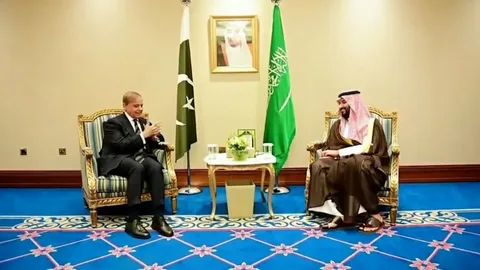
Iran war de-escalation received its most direct diplomatic push from Pakistan yet as Prime Minister Shehbaz Sharif held a telephone conversation with Saudi Crown Prince Mohammed bin Salman, hailing the Kingdom’s remarkable restraint and stressing the urgent need for an immediate end to hostilities across the Gulf.
PM Shehbaz reiterated Pakistan’s strong condemnation of the recent attacks on Saudi Arabia and expressed complete solidarity and unequivocal support for the Kingdom and its people in these challenging times. While appreciating the leadership of the Kingdom for demonstrating remarkable restraint in the current crisis, PM Shehbaz reassured that Pakistan would always stand by Saudi Arabia and its people, just as they had always supported Pakistan through thick and thin.
PM Shehbaz further stressed the urgent need for Iran war de-escalation, an end to hostilities, and unity in the ranks of the Ummah.
The call came as the Iran war entered its fourth week with no formal ceasefire in place — and as Pakistan simultaneously emerged as the country carrying a US 15-point ceasefire proposal to Tehran, making Islamabad arguably the most consequential diplomatic actor in the current Iran war de-escalation effort.
Background
The Iran war de-escalation push by Pakistan is built on a diplomatic architecture that has been carefully constructed since the first day of the conflict.
The latest war on Iran began on February 28 when the US and Israel launched coordinated strikes that killed Supreme Leader Ali Khamenei and many other senior officials, just a day after Oman’s foreign minister had declared a breakthrough within reach. Iran responded with sustained missile and drone attacks on Israel, US bases, and civilian infrastructure across Gulf states.
Iran struck Israeli targets in Tel Aviv and Haifa as well as multiple countries throughout the Persian Gulf region. Major targets included Bahrain’s capital Manama, Kuwait International Airport, the UAE’s capital Abu Dhabi, Riyadh and Eastern Province in Saudi Arabia, and Erbil International Airport and the US Consulate in Erbil in Kurdistan. Iran reported striking the US bases of Al Udeid Air Base in Qatar, Ali Al Salem Air Base in Kuwait, Al Dhafra Air Base in the UAE, and the US Navy Fifth Fleet headquarters in Bahrain.
The head of the International Energy Agency has warned that the disruption already exceeds the combined oil crises of 1973 and 1979.
Against that backdrop, Pakistan moved quickly to position itself as a bridge. Pakistan’s Prime Minister Shehbaz Sharif positioned Islamabad as the only country with active senior-level diplomatic contact on both sides of the conflict — calling Iranian President Pezeshkian and flying to Riyadh to meet the Crown Prince within hours of each other.
Why Saudi Arabia’s Restraint Matters
The Iran war de-escalation conversation cannot be separated from what Saudi Arabia has and has not done — a strategic choice that defines the current shape of the conflict.
By suffering Iranian aggression without retaliating offensively, Saudi Arabia has secured near-universal international sympathy. The UN Security Council condemned Iran’s attacks on Gulf states in a near-unanimous vote. Arab foreign ministers invoked collective defence provisions after Iran struck eight states, with Riyadh’s restraint — not its military power — positioned as the GCC’s unifying principle.
Saudi Arabia has never launched a direct military strike against Iran in the history of both nations. The two countries fought a proxy war in Yemen beginning in 2015, but even at the height of that conflict, Riyadh and Tehran avoided direct military confrontation. Saudi Arabia’s current restraint during the Iran war continues this pattern, reflecting a strategic assessment that direct conflict with Iran would be catastrophically costly regardless of outcome.
Saudi Arabia has told Tehran that while it favours a diplomatic settlement, continued attacks on the Kingdom and its energy sector could push Riyadh to respond in kind. Saudi Arabia is open to any form of mediation aimed at Iran war de-escalation and a negotiated settlement, underlining that neither Riyadh nor other Gulf states let the US use their airspace or territory to launch airstrikes on Iran.
PM Shehbaz’s recognition of that restraint in his call with MBS was therefore not merely courtesy — it was an acknowledgment of the single most important factor keeping the Iran war from expanding into a direct US-Saudi-Iran confrontation.
Pakistan’s Wider Iran War De-escalation Effort
The MBS phone call is one piece of a much larger Iran war de-escalation campaign Pakistan has been running across multiple capitals simultaneously.
PM Shehbaz has held multiple telephone conversations with leaders of Saudi Arabia, Qatar, Jordan, Bahrain, Oman, Turkey, Malaysia, Lebanon, Azerbaijan, and other countries, reaffirming Pakistan’s solidarity and urging restraint and Iran war de-escalation. In parallel, Deputy Prime Minister Ishaq Dar has maintained continuous diplomatic outreach, holding discussions with foreign ministers from Iran, Saudi Arabia, China, Canada, Oman, Bahrain, Azerbaijan, Malaysia, Bangladesh, and Gulf Cooperation Council leadership to explore pathways toward peace and stability.
Pakistan also condemned attacks targeting several regional states, stressing that violations of sovereignty risk widening the conflict and destabilising the entire region. Pakistan’s principled stance based on respect for sovereignty, adherence to international law, and commitment to diplomacy earned trust across regional capitals, enabling Islamabad to maintain open channels of communication among key stakeholders during the ongoing crisis.
That trust produced the most significant development yet in the Iran war de-escalation effort. The Trump administration presented a detailed 15-point ceasefire proposal to Iran, delivered through intermediaries from Pakistan, who also offered to host fresh negotiations between Washington and Tehran.
The Iran War 15-Point Plan
The Iran war 15-point plan represents the most concrete ceasefire framework to emerge since the conflict began — and Pakistan’s role in carrying it makes the current diplomatic moment uniquely significant.
The plan centres on previous Trump administration demands of Tehran. It demands Iran dismantle its three key nuclear sites and end enrichment, as well as its ballistic missile work. The plan also sets out ending support for proxies and reopening the Strait of Hormuz. The return benefits for Iran would include having nuclear-related sanctions lifted. The US would also monitor the country’s civilian nuclear programme.
Special envoy Steve Witkoff and presidential adviser Jared Kushner designed a process centred on the declaration of a month-long ceasefire period, during which the sides would negotiate the 15-point agreement. Israeli officials, who had been advocating for Trump to continue the conflict, were surprised by the submission of the plan.
Iran war news ceasefire signals from Tehran remain mixed. Iranian officials confirmed receiving messages through friendly countries conveying a US request for negotiations but said Iran had responded according to its principled positions. The Iranian military’s public position continued to describe US-Israeli military capability as steadily weakening — a posture that may be designed to improve Tehran’s negotiating leverage before any formal ceasefire.
Modi on Iran War — India’s Position
Modi on Iran war de-escalation has echoed many of Pakistan’s themes — though from a distinctly different diplomatic position.
Indian Prime Minister Narendra Modi said he had a useful exchange of views on the situation in West Asia after receiving a call from US President Trump. Modi said India supports Iran war de-escalation and restoration of peace at the earliest. He also said ensuring that the Strait of Hormuz remains open, secure, and accessible is essential for the whole world.
Addressing the Rajya Sabha on the Iran war, Modi said the war has caused a serious energy crisis in the world. He noted the war has impacted India’s trade routes and disrupted the routine supply of petrol, diesel, gas, and fertilisers. Modi said India wants to ensure peace through dialogue and diplomacy and advocated for de-escalation.
Iranian President Pezeshkian proposed creating a regional security framework made up of West Asian countries to preserve peace and stability without foreign interference, in a phone call with Indian Prime Minister Modi. Pezeshkian also told Modi that ending the war required an immediate halt to US and Israeli attacks and guarantees they would not be repeated. The Iranian president urged BRICS, under India’s rotating presidency, to play an independent role in stopping what he described as aggression against Iran.
Modi on Iran war positions reflects India’s difficult balancing act — deep economic dependence on Gulf oil, a strategic partnership with the US, and a long-standing relationship with Tehran that New Delhi has tried not to publicly damage despite the conflict.
Quotes
“I reiterated Pakistan’s strong condemnation of the recent attacks on the Kingdom and reaffirmed Pakistan’s unwavering solidarity and unequivocal support for Saudi Arabia in these challenging times.” — PM Shehbaz Sharif, on his call with Crown Prince Mohammed bin Salman
“I stressed the urgent need for de-escalation, an end to hostilities, and unity in the ranks of the Ummah.” — PM Shehbaz Sharif
“Pakistan would always stand by Saudi Arabia and its people, just as they had always supported Pakistan through thick and thin.” — PM Shehbaz Sharif
“India supports de-escalation and restoration of peace at the earliest. Ensuring that the Strait of Hormuz remains open, secure and accessible is essential for the whole world.” — PM Narendra Modi, following his call with President Trump
“A prolonged conflict in Iran serves no one’s interests, and a ceasefire and dialogue remain the only way out.” — Chinese Foreign Ministry statement
Impact
For Pakistan, the Iran war de-escalation effort has elevated Islamabad’s diplomatic profile in ways that few would have predicted when the conflict began. Pakistan’s importance stems from its standing as a major Islamic country with considerable credibility. It has ties with the Gulf, with Saudi Arabia, and with Iran — everybody is open to Pakistan playing a mediating role.Carrying the US 15-point plan to Tehran confirmed that credibility in the most concrete way possible.
For Saudi Arabia, PM Shehbaz’s public praise of Riyadh’s restraint reinforces the political and moral case the Kingdom has been building since the first Iranian strikes landed on its soil. Saudi Arabia’s foreign reserves reached a six-year high of $475 billion in early 2026. The Kingdom has the capability to strike Iran. It has chosen not to. The distinction between cannot and will not is critical.
For the region, Iran war news ceasefire signals — however cautious and contradictory — suggest that the diplomatic track is more alive than the military tempo of the conflict would suggest. Both sides are taking damage. Both sides are receiving messages through intermediaries. And Pakistan, sitting between Washington’s demands and Tehran’s red lines, is the country both have chosen to trust with those messages.
FAQs
What escalated the war between Israel and Iran?
The immediate escalation came from decades of accumulated hostility — Iran’s nuclear programme, its ballistic missile development, its support for proxy groups across the region, and the collapse of diplomatic negotiations. After the Middle Eastern crisis began in 2023, Iran and Israel exchanged missile strikes in 2024, and Israel and the US launched airstrikes against Iran in the Twelve-Day War in June 2025. In January 2026, Iranian security forces killed thousands of protesters during Iran’s largest protests since the Islamic Revolution. US President Donald Trump responded by threatening military action and launching the largest US military buildup in the region since 2003.When talks in Geneva collapsed at the last moment, the strikes followed within days.
How did the Iran War start in 2026?
The Iran war began on February 28 when the US and Israel launched coordinated strikes that killed Supreme Leader Ali Khamenei and many other senior officials, just a day after Oman’s foreign minister had declared a breakthrough within reach.Iran responded immediately with waves of missiles and drones targeting Israel, US military bases across the Gulf, and civilian infrastructure in multiple Gulf states. The conflict has since become the largest energy supply disruption in the history of the global oil market, with the IEA warning the damage already exceeds the combined oil crises of 1973 and 1979.
Did Iran close the Strait of Hormuz?
Yes, effectively. Within hours of the strikes, the IRGC transmitted warnings via VHF radio to vessels in the strait, stating that no ships would be permitted to pass. The threats led to a partial closure, with ship-tracking data first showing a 70 percent reduction in traffic.Iran achieved the closure not with a naval blockade but with cheap drones. All Iran had to do was several drone strikes in the vicinity of the Strait of Hormuz, and all of a sudden insurers and shipping companies decided it was unsafe to traverse that very narrow waterway. Iran subsequently granted selective passage to ships from neutral countries including Turkey, India, and Pakistan, while keeping the strait effectively closed to vessels from the US, Israel, and their allies.
Conclusion
Iran war de-escalation is no longer just a diplomatic aspiration — it is an active, structured process, with Pakistan at its centre and a 15-point framework now formally on the table.
Whether Tehran accepts, rejects, or negotiates the terms of that plan will determine whether the coming weeks bring a ceasefire or a fifth week of strikes, counter-strikes, and an energy crisis the world is already struggling to absorb.
PM Shehbaz’s call with MBS captures precisely where things stand: Saudi Arabia holding its fire, Pakistan carrying messages, and the entire region watching to see whether the Iran war de-escalation effort has arrived in time to matter.