
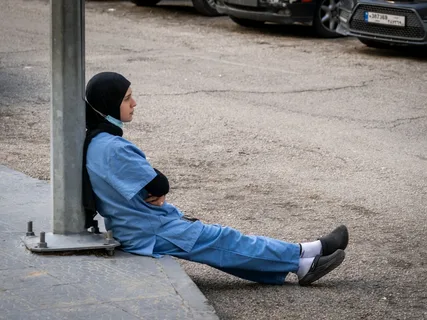
Israel’s relentless attacks on hospitals, clinics and medical workers are pushing southern Lebanon into a catastrophic health crisis — with no end in sight.
Southern Lebanon is bleeding — not just from bombs and bullets, but from the deliberate destruction of the very system built to save lives. Hospitals are shuttered. Ambulances are targeted. Doctors and paramedics are being killed in their uniforms. What is unfolding in southern Lebanon is not collateral damage. According to the World Health Organization, the United Nations, and international human rights groups, it is a systematic assault on healthcare infrastructure — one that is driving mass displacement and a spiralling humanitarian catastrophe.
The scale of destruction
The numbers are staggering. In less than one month since Israel intensified its military campaign on March 2, 2026, more than 128 Israeli strikes have hit medical facilities and ambulances across southern Lebanon. The WHO has confirmed that 4 hospitals and 51 primary healthcare centres have been forced to close, with dozens more operating at severely reduced capacity.
At least 51 health workers have been killed and more than 120 wounded — paramedics, nurses, and doctors who were simply doing their jobs.
The single deadliest moment came on March 13, 2026, when Israeli forces struck the healthcare centre in Burj Qalaouiyah, killing 12 doctors, paramedics and nurses on duty in a single blow. The UN called it a stark example of what two special rapporteurs have termed “medicide” — the systematic destruction of a population’s medical capacity.
One hospital in the southern city of Tyre has been struck at least five times. Nine hospitals have been damaged in total. The Lebanese Ministry of Public Health reports that since October 2023, Israel has killed at least 208 health sector workers and carried out over 280 attacks on emergency medical facilities across Lebanon, destroying or damaging 249 emergency vehicles
“A strategy to depopulate the south”
This destruction does not appear to be accidental. Al Jazeera’s Zeina Khodr, reporting from Beirut, described a clear and consistent pattern:
“The Israeli military has been destroying infrastructure across southern Lebanon — fuel stations, bridges, and health centres. It seems to be part of a strategy to depopulate the whole southern region.”
Israel’s own senior officials have been explicit about their intentions. Defence Minister Israel Katz stated that the military was instructed to destroy infrastructure near Lebanon’s border as it did in Rafah and Beit Hanoun in Gaza — cities that Israel left almost completely uninhabitable. Finance Minister Bezalel Smotrich publicly declared that the Litani River must become “the new Israeli border,” demanding annexation of southern Lebanon.
Meanwhile, the Israeli military has issued sweeping forced evacuation orders covering the entire area south of the Litani River — a zone comprising 15 to 20 percent of Lebanon’s entire territory — warning that anyone remaining risks being treated as a military target.
“Deliberately attacking medics is a war crime”
Under international humanitarian law, hospitals, ambulances, and medical workers are explicitly protected. Israel has attempted to justify its strikes by claiming — without providing any evidence — that Hezbollah uses ambulances to transport weapons.
Amnesty International rejected this argument outright. Deputy Regional Director Kristine Beckerle stated that even if such claims had merit, they would not justify treating medical facilities as battlefields or doctors as targets. “Deliberately striking medics performing their humanitarian functions is a serious violation of international humanitarian law,” she said, “and could constitute a war crime.”
The UN human rights office agreed, warning that Israeli attacks were “destroying and damaging houses, farmland and other civilian infrastructure” while over a million people remained displaced without access to healthcare, clean water or food. The leaders of Canada, the United Kingdom, Germany, Italy and France jointly condemned the attacks on health workers and civilian infrastructure as “unacceptable.”
The UNFPA’s representative in Lebanon, Anandita Philipose, highlighted a particularly overlooked dimension of the crisis: “Pregnant women do not stop giving birth in the middle of conflict. Women do not stop having periods in the middle of conflicts.” Thousands of pregnant women have been cut off from maternity wards — four of the hospitals that closed had active maternity units.
1.2 million displaced — and counting
The destruction of healthcare is inseparable from the broader displacement crisis sweeping Lebanon. More than 1.2 million people — roughly one in five Lebanese residents — have been forced from their homes since the escalation began. Schools, stadiums, and public squares have been converted into emergency shelters, most of which are already full.
CARE Lebanon’s Country Director Michael Adams described the situation bluntly: “One month into the escalation in Lebanon, this crisis is spiralling toward catastrophe.”
Lebanon’s Prime Minister Nawaf Salam warned that the situation is “very critical,” saying the country has “become a victim of a war whose outcome and end date no one can predict.” Lebanon’s displaced, he added, “are the main victims of a war they have nothing to do with.”
The crisis is hitting Lebanon’s most vulnerable the hardest — cancer patients who cannot access chemotherapy, dialysis patients cut off from hospitals, insulin-dependent diabetics without refrigerators to store their medicine, and Syrian and Palestinian refugees who were already living in extreme poverty before the bombs began falling again.
FAQ
Why is Israel attacking Lebanon in 2026?
The current escalation is rooted in the broader US-Israel war on Iran, launched on February 28, 2026. Following the assassination of Iranian Supreme Leader Ayatollah Ali Khamenei, Hezbollah — Iran’s most powerful regional ally — fired missiles and drones into Israel on March 2, 2026, declaring retaliation. Israel responded with massive air strikes across Lebanon including Beirut’s southern suburbs, and launched a full ground invasion on March 16, 2026. Israel’s stated objective is to dismantle Hezbollah and establish a permanent “security buffer zone” in southern Lebanon to prevent future rocket attacks on northern Israeli towns.
Did Israel withdraw from southern Lebanon?
Yes — twice. Israel first withdrew from southern Lebanon in May 2000, ending 18 years of occupation, after Hezbollah’s guerrilla campaign made the occupation untenable. Israel invaded again during the 2024 conflict, then withdrew following a US-brokered ceasefire in November 2024. However, Israel never fully complied with that ceasefire’s withdrawal terms, instead reinforcing military positions inside Lebanese territory and continuing near-daily strikes. By early 2026, the Lebanese government had recorded more than 2,000 Israeli ceasefire violations. When the 2026 war erupted, Israel launched a new ground invasion — this time with declared intent to stay and establish a permanent buffer zone, mirroring its 1982–2000 occupation.
What is the biggest problem in Lebanon?
Lebanon was already in crisis long before the bombs fell in 2026. Since 2019, the country has been experiencing one of the worst economic collapses in modern history — GDP crashed from $54.9 billion in 2018 to under $18 billion, the currency lost over 98% of its value, and the banking system wiped out the lifetime savings of ordinary Lebanese. The 2020 Beirut port explosion — one of the largest non-nuclear blasts in history — killed over 200 people and devastated the capital. Today, more than 70% of Lebanon’s population requires humanitarian assistance. Lebanon also hosts the highest number of refugees per capita in the world — over 1.5 million Syrians and Palestinians. The 2026 Israeli military campaign has added a further 1.2 million internally displaced Lebanese to an already overwhelmed system, pushing the country, in the words of international aid agencies, to the edge of catastrophe.