
plea yet to the United Nations — demanding the Security Council stop Iran’s relentless strikes on Gulf nations before they shatter global energy markets and the international order along with them.
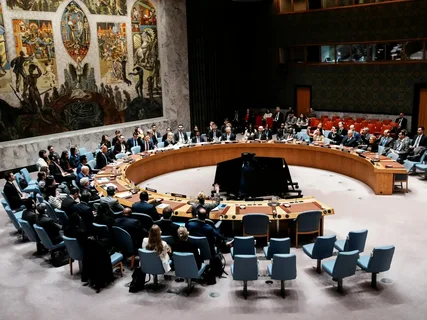
The Gulf has been burning for 34 days. Missiles have struck airports. Drones have set residential towers ablaze. Oil facilities, desalination plants, and ports across six Arab nations have been hit. And on Thursday, the head of the Gulf Cooperation Council walked into the United Nations Security Council chamber in New York and said, plainly: enough.
GCC Secretary-General Jassim al-Budaiwi delivered one of the most forceful diplomatic addresses of the entire Iran war, calling on the Security Council to “take all necessary measures” to bring an immediate end to Iranian missile and drone attacks on Gulf Arab states. He demanded the Council act to protect maritime corridors and guarantee “the uninterrupted navigation through all strategic waterways” — a direct challenge to Iran’s ongoing blockade of the Strait of Hormuz, the chokepoint through which one-fifth of the world’s oil flows every single day.
“We are not facing a fleeting crisis,” al-Budaiwi told the Council. “We are facing a true test of the international system’s credibility. Either collective security is upheld in practice, or it is left to the equations of power alone.”
A war that arrived on Bahrain’s doorstep
To understand why the GCC is now at the UN demanding action, you need to understand what happened on February 28, 2026 — the first day of the war.
Within hours of the United States and Israel launching joint strikes on Iran and assassinating Supreme Leader Ayatollah Ali Khamenei, Iran fired back across the entire Gulf. No country was spared. Missiles and drones hit US military assets in Qatar, Kuwait, and the UAE. But Bahrain took the most direct and devastating blow.
Iranian ballistic missiles and Shahed drones struck the headquarters of the US Navy’s Fifth Fleet in the Juffair district of Manama — one of the most strategically important American military installations on earth. Satellite communications terminals were obliterated. Aircraft hangars at Sheikh Isa Air Base were hit. A residential high-rise near the base was set ablaze when a drone smashed directly into it. Iran also struck Bahrain’s largest telecom operator and an Amazon Web Services data hosting site — reportedly the first Iranian strike on American tech infrastructure during the conflict.
Bahrain’s government called it “a treacherous attack” and “a blatant violation of the kingdom’s sovereignty.” The US Navy evacuated personnel from the Juffair base area entirely, declaring it no longer safe. Schools on base were shut down. Across the city of Manama, air raid sirens alternated with explosions throughout the night.
By the end of March, Bahrain’s Defence Force reported intercepting 125 Iranian ballistic missiles and 211 drones. Two people had been killed. More than 50 were injured. And the strikes were still coming.
Bahrain, Kuwait, Qatar, and the UAE all shut their airspace on February 28. The only GCC member not struck that opening day was Oman — which has served for decades as the key diplomatic back-channel between Iran and the rest of the world, and continues to carry that role even now.
What the GCC is demanding from the UN
Al-Budaiwi’s speech at the Security Council outlined three concrete demands that go to the heart of what Gulf nations need from the international community.
First, an immediate and unconditional halt to Iranian missile and drone attacks on GCC states. Since February 28, those strikes have hit airports, oil facilities, desalination plants, ports, fuel storage depots, residential areas, and diplomatic missions. Nearly 85 percent of all Iranian projectiles fired during the war have landed in Gulf countries, with the UAE bearing the heaviest volume.
Second, UN authorisation to use force to keep the Strait of Hormuz open. Iran has effectively closed the strait to American and Israeli-flagged vessels using naval mines, coastal missile batteries, and drone swarms. The result has been a global energy shock: Brent crude rose more than 7.78 percent in a single day this week, and Russian Urals crude surged above $123 a barrel. Shipping companies are diverting routes. Supply chains for oil, gas, fertiliser, and petrochemicals are breaking down worldwide.
Third, and perhaps most politically significant, the GCC is demanding a seat at the table. Al-Budaiwi called explicitly for Gulf nations to be included in any ceasefire talks or agreements between Iran and the United States. The message was clear: the Gulf states will not accept a deal that secures American and Iranian interests while leaving their cities, ports, and civilians exposed.
Bahrain went even further. Its Foreign Minister Abdullatif Al Zayani announced that a Bahraini draft resolution calling for “all necessary means” to secure the Strait of Hormuz would go to a Security Council vote on Friday. It was a bold move — and one that immediately exposed the Council’s deep divisions. China and Russia, both of whom condemned the original US-Israeli strikes on Iran as the “root cause” of the current crisis, signalled opposition to any resolution that could authorise military force in the region.
The world reacts — but divisions remain
UN Secretary-General António Guterres used Thursday to issue his starkest warning yet. “We are on the edge of a wider war that would engulf the Middle East with dramatic impacts around the globe,” he told reporters. He called for an immediate halt to US-Israeli strikes on Iran and to Iranian attacks on its neighbours in the same breath — a rare moment of even-handedness that reflected just how dangerous the situation has become.
China — which imports approximately 1.38 million barrels of Iranian oil per day and routes a significant portion of all its energy imports through the strait — said the US and Israel were “the root cause” of the Hormuz blockage and opposed any call for force. Russia’s ambassador blamed the entire crisis on what he called “an unprovoked act of aggression” by Washington and Tel Aviv. The Security Council remained deadlocked along predictable lines.
Meanwhile, the diplomatic effort to end the war continues to run parallel to the military escalation. Pakistan, Saudi Arabia, Turkey, and Egypt are pushing hard for direct US-Iran negotiations — with Islamabad acting as the primary conduit for backchannel messages between Tehran and Washington. Trump has set an April 6 deadline for Iran to accept his terms or face strikes on its energy infrastructure. Iran has called US demands “excessive and unreasonable.” As of Thursday, no deal has been reached.
FAQ
Who is Iran’s biggest oil buyer?
China is by far Iran’s largest oil customer. Beijing imported approximately 1.38 million barrels of Iranian crude per day in 2025 — roughly 12 percent of its total oil needs — at a heavily discounted rate that has served as Iran’s economic lifeline throughout years of Western sanctions. China has effectively been buying over 80 percent of all Iranian oil exports, which is precisely why Beijing has strong incentives to see this war end. The Strait of Hormuz blockage threatens not just Iranian supply but the entire Gulf region’s energy flows to China. India has also imported Iranian oil historically, but in smaller volumes and with more political sensitivity given New Delhi’s ties with Washington.
Why are Gulf countries not supporting Iran?
Gulf Arab states and Iran have a long history of rivalry, not solidarity. The tensions are sectarian at their core — the Gulf states are predominantly Sunni Muslim, while Iran’s government is a Shia Islamic republic that has spent decades funding and arming Shia militant groups across the Arab world, from Hezbollah in Lebanon to the Houthis in Yemen to armed factions in Iraq and Bahrain itself. Beyond ideology, Iran’s missiles and drones have directly struck Gulf airports, oil facilities, residential buildings, and military bases since February 28, killing civilians and destroying critical infrastructure. Gulf states also host major US military installations that Iran has specifically targeted — making neutrality increasingly difficult to maintain. While no GCC member has joined the US-Israeli military campaign, and all are actively backing Pakistan’s ceasefire diplomacy, they cannot extend solidarity to a country that is bombing their cities.
Who is richer — Iran or Israel?
By almost every measure, Israel is significantly wealthier. Israel’s GDP stands at approximately $540 to $610 billion, while Iran’s sits at around $400 to $475 billion — despite Iran having a population roughly ten times larger. The per-capita gap is even more striking: Israel’s GDP per capita exceeds $50,000, placing it among the world’s high-income economies. Iran’s is approximately $4,000 to $6,000, putting it in the lower-middle-income bracket. Iran holds the world’s fourth-largest proven oil reserves, but decades of US and European sanctions have blocked foreign investment, cut it off from international banking systems, and severely limited its oil earnings. Israel, by contrast, has built one of the world’s most successful knowledge economies — spending 5 percent of GDP on research and development, the highest ratio globally — with over 6,000 tech startups and major R&D hubs run by Intel, Google, and Microsoft. Iran’s currency has lost over 85 percent of its value in the past decade. More than half of Iran’s population lives below the poverty line.