

The China 2030 moon landing goal is now under intense global focus following recent successes by NASA’s Artemis missions. As the United States accelerates its return to the Moon, China is rapidly advancing its own ambitious lunar program, setting the stage for a new era of space competition.
Background: A New Space Race Begins
The global space race has entered a new phase, with both the United States and China aiming to establish a long-term human presence on the Moon. NASA’s Artemis II mission, which successfully carried astronauts around the Moon, marks a major milestone in human space exploration.
At the same time, the China 2030 moon landing goal reflects Beijing’s determination to achieve its first crewed lunar landing within this decade. This renewed competition is not just about exploration but also about technological leadership and geopolitical influence.
China’s Lunar Mission Strategy
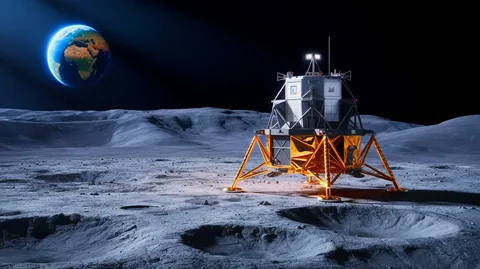
The China 2030 moon landing goal is supported by a well-structured and multi-phase program. China plans to use advanced systems, including the Long March-10 rocket, the Mengzhou crewed spacecraft, and the Lanyue lunar lander.
The mission will involve two separate launches—one carrying astronauts and another transporting the lunar lander. These components will dock in lunar orbit before astronauts descend to the Moon’s surface.
This complex approach highlights the scale and ambition of the china moon mission 2030, which aims not only to land astronauts but also to establish a foundation for long-term lunar exploration.
China’s Progress So Far
China has already demonstrated significant progress through its robotic missions. The Chang’e program has successfully landed probes on the Moon and even returned samples from the far side—an achievement unmatched by any other country.
Future missions, including Chang’e-7 and Chang’e-8, are planned to explore the Moon’s south pole, a region believed to contain water ice.
These missions are critical stepping stones toward achieving the China 2030 moon landing goal and building a sustainable lunar presence.
NASA vs China: Competing Timelines
NASA aims to land astronauts on the Moon by 2028 under its Artemis program, while China is targeting a crewed landing by 2030.
This close timeline has intensified the competition between the two nations. While NASA benefits from decades of experience, China’s rapid technological advancements and consistent progress make it a strong contender.
Some experts even suggest that China could achieve its goal earlier than expected, further increasing the pressure on NASA.
China Moon Landing Date and Future Plans
Although an exact china moon landing date has not been officially confirmed, current projections place the mission around 2029 or 2030.
Following the initial landing, China plans to establish an International Lunar Research Station (ILRS) by 2035 in collaboration with international partners.
This long-term vision extends beyond exploration, focusing on scientific research, resource utilization, and potential future missions to Mars.
Technological Innovations Behind China’s Mission
The China 2030 moon landing goal relies on cutting-edge technologies:
- Mengzhou spacecraft for crew transport
- Lanyue lander for lunar surface operations
- Long March-10 rocket for heavy-lift launches
These systems are being tested and refined to ensure mission success. China has also conducted experiments aboard its space station to prepare astronauts for long-duration missions.
Geopolitical Implications of the Moon Race
The race to the Moon is not just scientific—it is deeply political. Control over lunar resources, such as water ice, could play a crucial role in future space exploration and even energy production.
The China 2030 moon landing goal is part of a broader strategy to establish leadership in space. Meanwhile, NASA’s Artemis program represents a coalition-based approach involving international partners.
This competition is shaping the future of global space governance and cooperation.
Expert Insights on the Lunar Race
Experts believe the competition will accelerate innovation:
“The China 2030 moon landing goal is realistic given the country’s rapid advancements in space technology,” said a space policy analyst.
Another expert noted, “NASA’s recent missions have increased pressure, making this a true race to the Moon.”
These perspectives highlight the high stakes involved in this new space race.
Future Outlook: Collaboration or Competition?
While competition dominates headlines, there is also potential for collaboration. Both NASA and China aim to establish lunar bases in the 2030s, which could open opportunities for shared research and exploration.
However, geopolitical tensions may limit cooperation, making the China 2030 moon landing goal a key milestone in defining the balance of power in space.
Conclusion
The China 2030 moon landing goal represents one of the most ambitious space missions of the modern era. As NASA advances its Artemis program, China’s steady progress ensures that the race to the Moon will remain intense and closely watched.
Whether driven by competition or collaboration, this new era of lunar exploration promises to reshape humanity’s future beyond Earth.
FAQs
Is China planning a moon landing?
Yes, China is actively planning a crewed lunar landing as part of its China 2030 moon landing goal, supported by advanced spacecraft and mission systems.
What is the goal of China 2030?
The goal is to land astronauts on the Moon, conduct scientific research, and lay the groundwork for a permanent lunar base.
What is the Chinese moon mission 2026?
China’s 2026 mission includes testing new spacecraft and conducting lunar exploration through missions like Chang’e-7, which will support future crewed landings.