
Natural gas has long been the backbone of Pakistan’s energy mix. It powers homes, factories, fertiliser plants, and electricity generation across the country.
In FY 2024, local natural gas made up 29.3% of Pakistan’s total primary energy supply. Pakistan has a vast gas pipeline network stretching over 218,000 kilometres, serving more than 10.7 million customers. The country has a re-gasification capacity of 1,200 million cubic feet per day (MMCFD) through two Floating Storage Regasification Units (FSRUs).
Pakistan Natural Gas Reserves: A Shrinking Resource
Pakistan natural gas reserves have been declining steadily for years. This is the root cause of the country’s long-term Pakistan oil crisis and energy insecurity.
Pakistan’s proven natural gas reserves are estimated to be around 63.24 trillion cubic feet (TCF). However, these reserves are declining due to increasing consumption and limited exploration of new gas fields.
Yields from domestic natural gas fields are decreasing by 9% annually. By the year 2030, a significant supply shortfall of 35 million tonnes per annum (mtpa) is expected.
Pakistan LNG: From Surplus to Shock
The story of Pakistan LNG in 2025 and 2026 is one of dramatic reversal from dangerous oversupply to a sudden and severe shortage.
An over-reliance on long-term, rigid LNG contracts had led to a surplus of 177 LNG cargoes from 2026 to 2031, threatening the country’s gas distribution network with potential damage. High LNG costs and rising solar power reduced demand faster than expected.
LNG consumption dropped by 1.21 million tonnes in 2025 alone. With no large storage capacity, surplus gas was pushed into domestic pipelines at a loss. The resulting circular debt in the gas sector now stands at 3.3 trillion rupees approximately $11 billion.
Then the Iran war changed everything. Pakistan received between 8 and 12 LNG shipments a month through 2025 and into early 2026, with 12 arriving in January alone. In March 2026, when the war began, only two shipments arrived.
Gas Supply to Power Sector: The Crisis Unfolds
The Pakistan gas supply power sector situation deteriorated rapidly as Qatar’s LNG shipments stopped arriving.
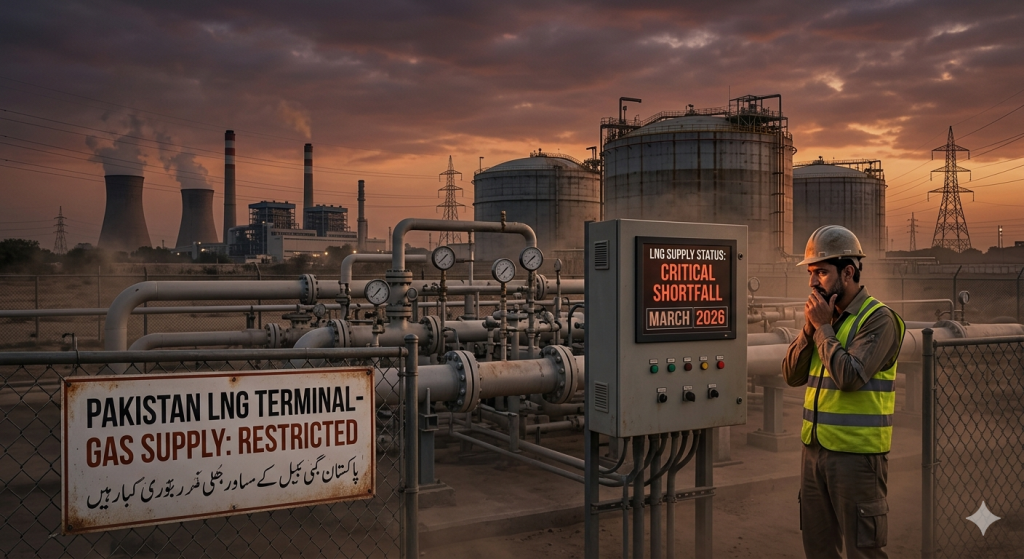
A production shutdown at a 77 million tonnes per annum LNG facility in Qatar in March 2026 led to force majeure being declared on shipments. Several cargoes scheduled for March 7, 11, 12, 16, 20 and 21 failed to arrive, intensifying supply risks for Pakistan’s power and industrial sectors.
LNG imports from Qatar had been completely suspended since March 2, raising concerns about gas availability for the power sector. Gas supply to the power sector fell from 300 mmcfd to just 130 mmcfd, while Sui Southern Gas Company reduced supply by 50% to one fertiliser plant.
The Senate was informed that LNG will no longer be available in Pakistan after April 14 due to supply disruptions linked to tensions in the Middle East.
Pakistan Gas Price Surge and Oil Crisis
The collapse in LNG supply has driven Pakistan gas prices upward sharply hitting industries, power plants, and ordinary consumers.
Alternative sources are being explored to bridge the shortfall, including the possibility of purchasing LNG from Azerbaijan. However, spot purchases could cost around $24 per unit compared with $9 under the Qatari contract potentially leading to significantly more expensive electricity generation.
LNG imports account for more than one-fifth of Pakistan’s electricity generation. The government is increasingly relying on furnace oil as a replacement fuel during peak demand, despite its significantly higher cost deepening the Pakistan oil crisis further.
The surge in Pakistan gas price is expected to translate directly into higher electricity bills for consumers and industries alike, worsening the country’s cost-of-living crisis.
Pakistan Energy Mix Under Pressure: Load-Shedding Risk
The current crisis is forcing a rethink of Pakistan’s entire energy mix strategy for the summer of 2026.
The government of Pakistan is weighing a mix of rolling blackouts, mandatory conservation measures, and higher electricity tariffs to manage peak summer demand as fuel shortages linked to Middle East tensions threaten power supplies.
In an immediate conservation measure, the government has suspended all new RLNG connections nationwide. The restriction will remain in force until supply chains are restored and normal operations resume.
Sui Northern Gas Pipelines Limited (SNGPL) has been directed to overhaul its domestic demand planning by aligning consumption forecasts with hourly load shedding patterns and seasonal demand shifts.
Expert Quotes and Official Statements
Energy analysts and officials have been vocal about the structural weaknesses exposed by this crisis.
An energy expert at PRIED told Al Jazeera that Pakistan’s gas supply contracts were such that the government had to “buy LNG even when demand collapsed” a fundamental flaw in Pakistan’s energy planning.
An IEEFA analyst noted: “Pakistan’s energy planning has mostly been bound by long-term contracts with very little flexibility” a structural problem that has now become a crisis.
An analyst at KTrade Securities noted that LNG demand would remain lower despite expectations of increased industrial activity, as many industries such as cement and textiles have shifted toward renewable energy to reduce costs.
What the Pakistan Gas Supply Power Sector Data Shows
Looking at the Pakistan gas supply power sector data whether in PDF reports, government essays, or official statistics from 2021 onwards a clear pattern emerges.
From July to March FY 2025, Pakistan’s average daily gas use was 3,143 MMCFD, including 798 MMCFD from RLNG. The largest consumers were the power sector at 973 MMCFD, households at 777 MMCFD, and the fertiliser industry at 764 MMCFD.
The share of LNG-fired power generation was projected to decline from around 23% of the power mix in 2017–2018 to around 11% by 2025 and to a negligible level by 2035 as coal and renewables were planned to take over.
The Pakistan gas supply power sector PDF reports and policy documents from 2021 onwards repeatedly warned of this vulnerability. The current crisis has simply accelerated what was already a slow-moving structural problem.
Impact on Industry and Ordinary Citizens
The gas supply crisis is not limited to power plants. It is hitting every corner of Pakistan’s economy.
Industrial gas demand, particularly from export-oriented sectors such as textiles and fertilizers, is expected to remain weak. High gas and electricity prices have already forced many industrial units to scale down or shut operations entirely.
Any shortfall from low international prices will be passed on to RLNG consumers, including power plants, export-oriented industries, the CNG sector, and domestic users receiving RLNG-based supplies.
For millions of ordinary Pakistanis, the result is higher bills, more load-shedding, and deeper economic pressure at an already difficult time.
Conclusion: What Must Pakistan Do Next?
The Pakistan gas supply power sector crisis of 2026 has exposed deep structural flaws. The path forward requires urgent reform, not just emergency fixes.
Pakistan’s current strategies focus on alleviating short-term supply shortages and price volatility. But without comprehensive reforms, the country may return to an LNG surplus once Middle East tensions ease meaning the cycle of crisis will simply repeat.
Pakistan’s energy companies are planning to increase drilling for tight and shale gas reserves, as well as offshore oil and gas exploration, to increase domestic petroleum production a step that is long overdue.
The government must urgently diversify its Pakistan energy mix, renegotiate rigid LNG contracts, invest in domestic gas exploration, and accelerate the shift to affordable renewables. Without these steps, the Pakistan oil crisis and gas supply crisis will remain a permanent feature of the country’s economic landscape.
FAQs
Who is the biggest supplier of LNG?
As of 2026, Qatar (via QatarEnergy) and the United States are the world’s two largest LNG suppliers. Pakistan’s primary long-term LNG supply agreements are with QatarEnergy, under two contracts — a 15-year and a 10-year deal for a combined nine cargo shipments per month. The US has recently overtaken Qatar as the world’s top LNG exporter by volume.
Which are the LNG power plants in Pakistan?
Pakistan’s key LNG-powered (RLNG) power plants include Balloki Power Plant (1,320 MW), Haveli Bahadur Shah Power Plant (1,230 MW), Port Qasim Power Plant, and Trimmu Power Plant, among others. These plants are run on Regasified LNG (RLNG) and are connected to the national gas transmission network. They account for a significant share of Pakistan’s thermal power generation capacity.
Where does Pakistan get its gas from?
Pakistan gets its gas from two main sources. Domestic production comes from gas fields in Balochistan (including the famous Sui gas field), Sindh, and Khyber Pakhtunkhwa. Imported LNG arrives primarily from Qatar, through two Floating Storage and Regasification Units (FSRUs) at Port Qasim in Karachi. Pakistan has also engaged Azerbaijan and other countries as potential alternative LNG suppliers to reduce dependence on Qatar.