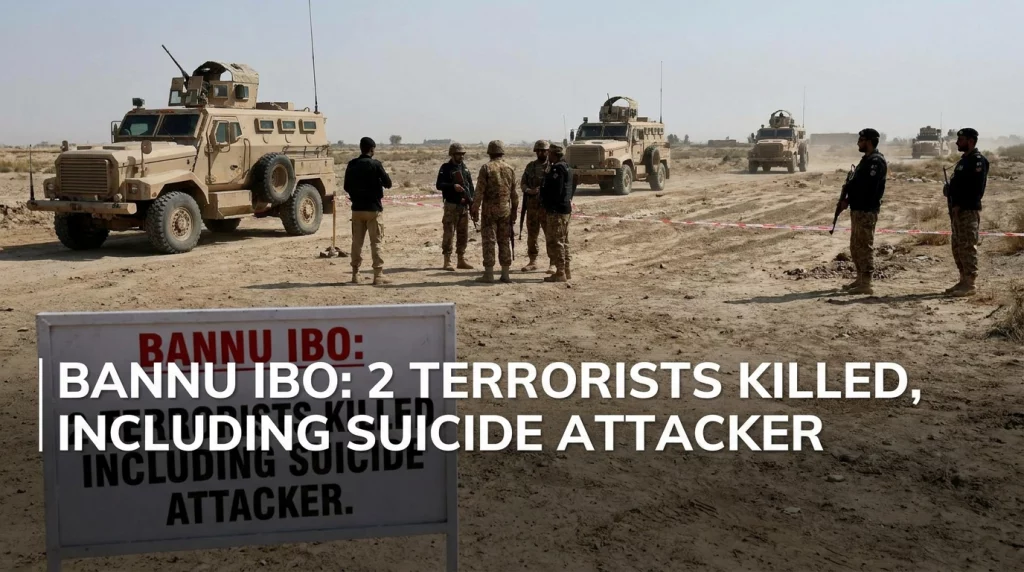

Bannu IBO terrorist killed confirmation has come from ISPR — with Pakistan’s military media wing announcing that 2 terrorists were killed in an intelligence-based operation in Bannu district including one individual directly involved in the February suicide attack that targeted security forces in the area.
The Bannu IBO terrorist killed announcement confirms that security forces acting on actionable intelligence conducted the operation with precision — eliminating the specific perpetrator of the earlier attack alongside a second terrorist whose removal further degrades the militant network operating in the district.
Background: The February Suicide Attack
The Bannu terrorist attack that preceded the current IBO took place in February 2026 — when a suicide bomber targeted a security forces checkpoint or installation in the Bannu district of Khyber Pakhtunkhwa. The attack resulted in casualties among security personnel and triggered an intensive intelligence operation to identify and locate those responsible.
Bannu district has historically been among the more challenging security environments in KPK — situated in the former tribal belt adjacent area where militant networks have used geographic proximity to the Afghanistan border and local terrain knowledge to sustain operational activity despite sustained counterterrorism pressure from Pakistan’s security forces.
The IBO — What Happened
Bannu IBO terrorist killed operation was conducted by security forces acting on intelligence developed in the weeks following the February suicide attack. The operation located 2 terrorists in a specific area of Bannu district and engaged them — resulting in the deaths of both individuals during the exchange of fire.
ISPR confirmed that one of the 2 Bannu IBO terrorist killed was directly involved in facilitating or executing the February suicide bombing — making the operation both a security success and a direct accountability measure for the earlier attack on Pakistani security personnel. Weapons and ammunition were recovered from the site of the operation.
ISPR Statement
ISPR’s announcement of the Bannu IBO terrorist killed outcome followed the standard format for intelligence-based operation reporting — confirming the location the number of terrorists killed the connection to previous terrorist activity and the recovery of weapons from the site.
ISPR described the Bannu IBO terrorist killed as a result of the security forces’ continued commitment to pursuing those responsible for attacks on Pakistani personnel — adding that intelligence-based operations would continue across KPK until terrorist networks were comprehensively degraded. The statement emphasised that the February suicide attack perpetrator’s elimination delivered direct accountability for the attack.
Security Context in Bannu
Bannu terrorist attack history reflects the district’s ongoing security challenges — with multiple incidents in recent years demonstrating that militant networks maintain operational capacity in the area despite sustained security force pressure. The district’s location on the periphery of the former FATA belt and its connectivity to South Waziristan make it a persistent focus of counterterrorism operations.
Bannu terrorist threat assessment includes the TTP and affiliated groups whose cross-border facilitation from Afghanistan continues to sustain militant activity in KPK’s southern districts. The Bannu IBO terrorist killed operation reflects the intelligence-led approach that Pakistan’s security forces have increasingly adopted — targeting specific individuals with confirmed attack involvement rather than broad conventional sweeps.
Quotes
ISPR Director General Major General Ahmed Sharif Chaudhry confirmed the Bannu IBO terrorist killed result — stating that security forces had successfully eliminated 2 terrorists including the individual involved in the February suicide attack and that the operation demonstrated the commitment of Pakistan’s armed forces to pursuing every individual responsible for attacks on security personnel and civilians.
KPK Inspector General Police stated that the Bannu IBO terrorist killed outcome was the result of close coordination between military intelligence and civilian law enforcement — adding that this collaborative intelligence model was producing increasingly effective results across KPK’s challenging security environment.
Impact
Bannu IBO terrorist killed outcome has both immediate and longer-term security implications for the district. The immediate impact is the removal of 2 active terrorist network members — including one whose direct involvement in a suicide bombing made his continued freedom a specific security and accountability concern.
The longer-term impact relates to the intelligence value generated by the operation itself — with the location and circumstances of the Bannu IBO terrorist killed engagement providing information about the network’s current structure safe houses and support infrastructure that feeds subsequent operations. Each successful IBO in KPK contributes to the cumulative intelligence picture that makes the next operation more targeted and more effective.
FAQs
Which Country Has the Highest Terrorism Index?
According to the Global Terrorism Index published annually by the Institute for Economics and Peace Afghanistan consistently ranks as the country most affected by terrorism — with Iraq Syria and Somalia also among the highest-ranked nations. Pakistan has historically featured in the top 10 of the Global Terrorism Index reflecting the sustained impact of TTP and affiliated militant activity particularly in KPK and Balochistan. The index measures the impact of terrorism on each country based on the number of incidents fatalities injuries and property damage recorded annually.
What Is the Terrorism Rate in Pakistan?
Pakistan’s terrorism rate has fluctuated significantly over the past 2 decades. At its peak between 2007 and 2014 Pakistan experienced hundreds of terrorist attacks annually with thousands of casualties. The major military operations — particularly Zarb-e-Azb in North Waziristan from 2014 — significantly reduced attack frequency and severity. However TTP’s resurgence following the Taliban’s return to power in Afghanistan in 2021 has driven an increase in attacks since 2022 — with KPK and Balochistan being the most affected provinces. The Bannu IBO terrorist killed operation is one component of Pakistan’s response to this renewed terrorist threat.
How Much Did the War on Terror Cost Pakistan?
Pakistan’s economic cost of the war on terror has been estimated at over 150 billion US dollars across the period from 2001 to the present — covering direct military operational costs infrastructure destruction economic disruption foreign investment deterrence and the social costs of displacement affecting millions of people in conflict-affected areas. The Pakistani government has repeatedly presented these figures to international forums arguing that Pakistan has been one of the most economically damaged countries by the global war on terror despite not being the originating source of the threat. The ongoing Bannu terrorist attacks and the counterterrorism operations they require represent the continued economic and human cost that Pakistan bears in sustaining its counterterrorism campaign.
Conclusion
Bannu IBO terrorist killed confirmation from ISPR delivers both a security achievement and an accountability message — demonstrating that Pakistan’s security forces will pursue those responsible for attacks on their personnel through sustained intelligence-driven operations that do not conclude with the initial incident.
Bannu terrorist attack perpetrators are not beyond reach. The February suicide bomber’s involvement in the militant network has been met with a direct operational response that the Bannu IBO terrorist killed announcement confirms. The counterterrorism campaign in KPK continues — operation by operation intelligence lead by intelligence lead — building the cumulative pressure that Pakistan’s security establishment has identified as the only sustainable approach to the terrorist threat that Bannu and districts like it continue to face.