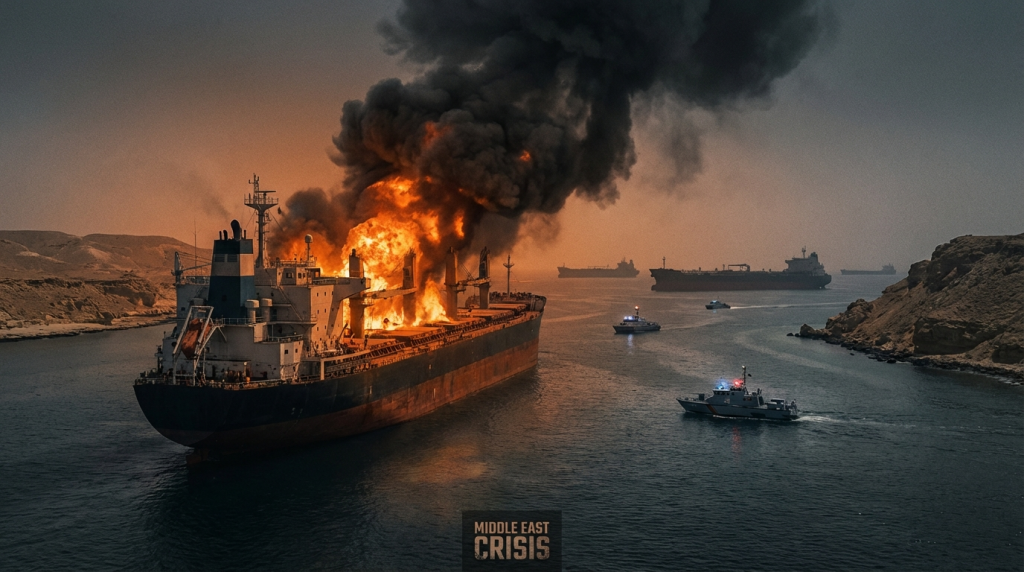

Oil prices have broken above $106 per barrel and markets are not calming down. With both the US and Iran now enforcing competing blockades in the Strait of Hormuz, global energy supply is tighter than at any point since the war began. The brief window when traders hoped for oil prices dip Iran ceasefire relief has firmly closed.
Brent crude topped $106.80 per barrel in early Friday trading up nearly 5% from Wednesday’s close while WTI settled near $96 per barrel. The Strait of Hormuz, which normally carries one-fifth of the world’s oil and gas, is effectively at a standstill.
What Pushed Oil Prices Above $106
Brent crude topped $106 per barrel early on Friday morning as Washington and Tehran stepped up their confrontation over the key maritime route for transporting the world’s energy. Brent stood at $106.80 as of 01:00 GMT, up nearly 5 percent from its closing price on Wednesday, when it surpassed $100 per barrel for the first time in two weeks.The catalyst was a sharp escalation in ship seizures with both the US Navy and Iran’s IRGC boarding and capturing commercial vessels in the same waterway within days of each other.
Trump Seals the Strait”Tight Until a Deal”
Trump said in a post that he had ordered the US Navy to destroy any Iranian boats laying mines in the strait, shortly after the Pentagon announced it had seized a tanker carrying sanctioned Iranian oil for the second time in less than a week. Trump also appeared to expand the scope of the US naval blockade beyond Iranian ports, writing that no ship “can enter or leave” the strait without the approval of the US Navy. “It is ‘Sealed up Tight,’ until such time as Iran is able to make a DEAL!!!” Trump said. This language spooked markets immediately, erasing any remaining expectation of an oil prices dip Iran ceasefire bounce.
Iran Fires Back Ship Seizures and Mine Threats
Iran did not back down. Tehran demonstrated its grip over the vital Hormuz chokepoint by attacking vessels and diverting two of them into its waters. Tehran also noted it will not take part in negotiations while the US naval blockade on its ports is in place, and Iranian state TV cited the foreign ministry as saying its armed forces are ready to respond to further threats. Iran is continuing to demand that ships receive its permission to cross the strait, even as Trump claimed the US has “total control” over the sea lane. Two rival powers are now both claiming authority over the same waterway and oil prices are reflecting that chaos.
Strait of Hormuz Traffic Near Zero
The shipping numbers tell the real story behind global oil prices. Only nine commercial vessels transited the strait on Wednesday, compared with seven on Tuesday and 15 on Monday, according to maritime intelligence data. Before the war, hundreds of ships crossed daily, carrying more than 20 million barrels of oil and gas per session. Even if a lasting deal to reopen the Strait of Hormuz emerges, analysts say it could take months for oil shipments to return to normal levels and for fuel prices to go down with backed-up tanker traffic, nervous shipowners, and damaged energy infrastructure all slowing any recovery.
Oil Prices Forecast How High Can It Go?
The oil prices forecast community is split between cautious and alarmed. As long as flows through the Strait remain restricted and oil inventories keep falling, oil prices will remain supported, according to analysts. Efforts to revive talks between Washington and Tehran remain deadlocked on Iran’s nuclear capabilities, the blockade, and Israel’s invasion of Lebanon.Crude traded at roughly $70 a barrel before the conflict, spiked to more than $119 at times, and had previously closed at $82.59 for US oil and $90.38 for Brent before the latest surge. Most oil prices forecast models now point to a range of $100 to $120 unless talks resume with $130-plus possible if the ceasefire collapses entirely.
Heating Oil Prices Today Consumers Under Pressure
The surge in oil prices is hitting household budgets directly. Wholesale gas prices rose by 4% and heating oil futures a proxy for jet fuel spiked 5% in a single session, adding to weeks of dramatic price swings. Heating oil prices today in Europe and Asia have followed Brent higher, with LNG spot prices in some Asian markets more than double their pre-war levels. Consumers in Pakistan, India, the Philippines, and across the Middle East are feeling the pain through higher fuel costs, electricity bills, and food prices all directly linked to the breakdown in oil prices dip Iran ceasefire hopes.
Pakistan Petrol Price The Local Impact
Pakistan has not been spared. Petrol reached an all-time high of Rs. 458.41 per litre on April 3, 2026 driven directly by Brent crude surging past $131 and the government absorbing Rs. 129 billion in fuel subsidies. Following the initial ceasefire on April 8, Prime Minister Shehbaz Sharif announced two emergency cuts totalling Rs. 91.83 per litre, bringing the price down to Rs. 366.58 effective April 11. However, with oil prices now back above $106 and the Strait standoff deepening, the next OGRA revision due around April 16 is widely expected to reverse some of those gains. High-speed diesel currently stands at Rs. 385.54 per litre nationwide.
What Comes Next for Oil Prices
The ceasefire could be unravelling, with ships being boarded, Iran thumbing its nose at the US, and Washington expanding its zone of activity well beyond the Middle East, according to one senior analyst. Markets are watching four signals: whether Iran confirms a delegation for the second Islamabad talks, whether the US adjusts the naval blockade, actual ship counts through the strait, and any new military action. The oil prices forecast for Q2 2026 now averages above $105 per barrel in most bank models with the upside risk far larger than the downside. Until the Strait of Hormuz reopens fully, oil prices will remain a daily referendum on whether this war is ending or escalating.
Frequently Asked Questions
What are the oil prices today?
As of April 24, 2026, Brent crude is trading at approximately $106.80 per barrel up nearly 5% in 24 hours. US WTI crude is near $96 per barrel. Both benchmarks surged after the US expanded its naval blockade of the Strait of Hormuz and Iran responded by seizing additional commercial vessels in the waterway.
What is the petrol price in Pakistan today?
The current OGRA-notified petrol price in Pakistan is Rs. 366.58 per litre, effective from April 11, 2026. High-speed diesel stands at Rs. 385.54 per litre. Pakistan hit an all-time petrol price record of Rs. 458.41 per litre on April 3, before two government-led emergency cuts brought prices lower following the US-Iran ceasefire. With oil prices rising again, the next revision may push rates back up.
Will oil reach $200 a barrel?
Most mainstream oil prices forecast models do not project $200 per barrel unless the ceasefire collapses entirely and the Strait of Hormuz remains closed for several more months. However, $130 to $140 per barrel is considered realistic if the current standoff continues through May. The International Energy Agency has described the Strait closure as the largest supply disruption in the history of the global oil market and every week without resolution brings $200 closer to the range of possibility.