
A devastating fireworks factory explosion in China’s Hunan province has killed at least 21 people and left 61 others injured. The blast prompted President Xi Jinping to call for a thorough investigation, as reported by state media on Tuesday. The tragedy has once again raised serious questions about industrial safety in China’s fireworks manufacturing sector.
Background
China’s official news agency Xinhua said the blast occurred around 4:40 p.m. local time on Monday at a fireworks plant in Changsha city in Hunan province. Liuyang, the city at the center of the Hunan explosion, has a centuries-old legacy of fireworks production. It is widely recognized as the fireworks capital of the world and is home to dozens of manufacturing operations.
The Chinese firework factory sector is a massive global industry. Last year, China exported over $1.14 billion US worth of fireworks, accounting for more than two-thirds of global sales. This level of output makes safety standards in Chinese firework factories a matter of international concern, not just domestic policy.
Details of the Fireworks Plant Explosion
The blast occurred at the Liuyang Huasheng Fireworks Manufacturing and Display Co. in Liuyang, which is under the jurisdiction of Hunan’s capital, Changsha. The plant was a major player in China’s fireworks industry, and the force of the explosion caused widespread structural damage across the facility.
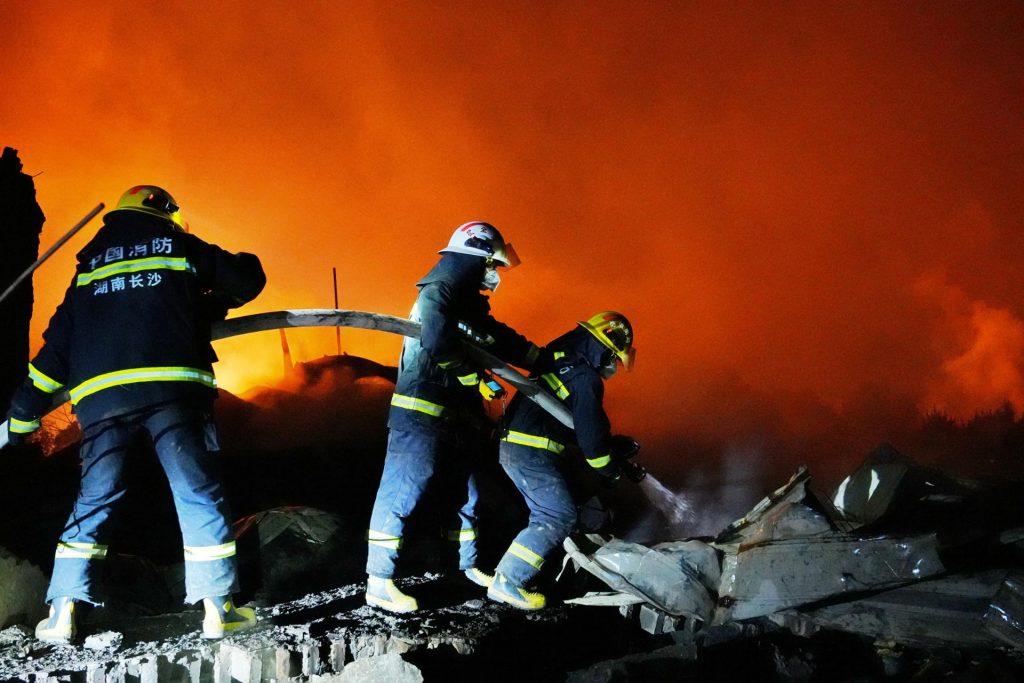
Aerial footage from state broadcaster CCTV showed white smoke still billowing on Tuesday in parts of the area, with facilities collapsed or damaged and debris scattered around. The scale of the destruction indicated that the China explosion 2025 was one of the most serious industrial accidents in the country this year.
Authorities deployed nearly 500 personnel to conduct search and rescue operations and treat the injured, while robots were used to help find those trapped within the building. Emergency crews faced additional dangers due to the volatile nature of the site.
Authorities said that two gunpowder warehouses within the factory area posed a high risk amid rescue efforts. To manage these risks, rescuers adopted measures such as spraying and humidification to eliminate potential hazards. People living within a three-kilometre radius were evacuated as a precaution.
Official Quotes and Response
Chinese leadership moved quickly to respond to the Hunan explosion. Chinese President Xi Jinping called for “all-out efforts” to save injured victims and to search for people who remain unaccounted for.
He called on authorities to investigate the cause swiftly and pursue serious accountability. Xi also ordered effective risk screening and hazard control in key industries and the strengthening of public safety management.
Police have detained the person in charge of the company as authorities press forward with a criminal investigation into what caused the fireworks plant explosion. This action signals that accountability will be pursued at the corporate level.
Impact of the China Explosion 2025
The Hunan fireworks disaster has had an immediate human and regional impact. Dozens of families are now dealing with loss and injury, and the broader community of Liuyang which economically depends on the Chinese firework factory industry faces disruption.
Blasts at fireworks factories and shops are not uncommon in China and are often deadly. In February, 12 people were killed in an explosion at a fireworks store in Hubei province. This pattern of recurring accidents at fireworks plants points to deeper systemic issues in the regulation of explosive materials manufacturing.
On the global stage, the China fireworks explosion raises concerns about supply chain safety. Since China dominates the world’s fireworks market, any major disruption to production or tightened regulation could affect fireworks availability worldwide particularly ahead of major holidays and festivals.
Hinglaj Mata Temple Recently in the News
Separately, the Hinglaj Mata Temple has recently been seen in the news amid discussions about Balochistan’s political situation. Hinglaj Mata Temple is a Hindu temple in Hinglaj, a town on the Makran coast in the Lasbela district of Balochistan, Pakistan.
Assam Chief Minister Himanta Biswa Sarma highlighted the temple’s significance, calling it one of the 51 revered Shakti Peethas in Hindu tradition, nestled in the rugged terrains of the Hingol National Park. The temple is believed to mark the spot where the head of Goddess Sati fell, making it one of the holiest sites in Shaktism. It has drawn renewed global attention amid the ongoing Balochistan independence movement.
Conclusion
The China fireworks factory explosion in Hunan is a stark reminder of the deadly risks embedded in large-scale explosives manufacturing. With 21 people dead, 61 injured, and an investigation now underway, Chinese authorities face pressure to enforce more rigorous safety standards across the nation’s fireworks industry. President Xi Jinping’s direct intervention signals that the government views this as a serious accountability issue.
As rescue operations wind down and investigations ramp up, the world will be watching to see whether China translates political will into lasting industrial reform. The Liuyang fireworks industry, and the many workers who depend on it, deserves both justice for the victims and meaningful protection going forward.
FAQs
Where do 99% of fireworks come from?
China produces the overwhelming majority of the world’s fireworks. China exported over $1.14 billion worth of fireworks last year, representing more than two-thirds of global sales. Cities like Liuyang in Hunan province are at the heart of this industry, making China the undisputed global leader in fireworks manufacturing.
What is the biggest factory tragedy in the world?
One of the deadliest industrial disasters in history was the Texas City Disaster of 1947 in the USA, which killed nearly 600 people. In China, the Tianjin explosions of August 2015 often called the “China explosion 2015” were among the most catastrophic, killing over 170 people and injuring hundreds more at a chemical storage facility. That China explosion 2015 became a landmark moment for industrial safety reform discussions globally.
What is the #1 cause of death in China?
According to health data, cardiovascular diseases (heart disease and stroke) are the leading cause of death in China, accounting for nearly 40% of all deaths annually. Industrial accidents, while tragic and high-profile, represent a far smaller share though they remain a significant public safety concern, especially in sectors like fireworks, mining, and chemicals.