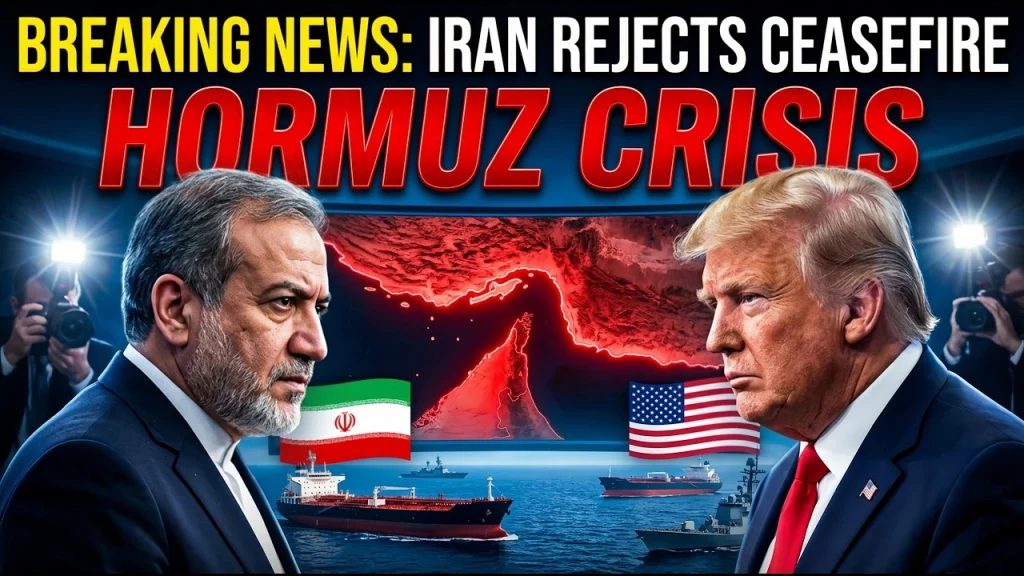

The world is watching closely as Iran’s reply to Trump’s latest peace proposal remains pending, even as fresh clashes break out in the Strait of Hormuz. The US-Iran war ceasefire, in place since April 8, is under severe strain. US Secretary of State Marco Rubio told reporters that Washington expected a response from Iran on Friday to a US proposal to end the war. The Iran war pause that many hoped for is proving fragile.
Background How the US-Iran War Began in 2026
To understand the current standoff, it is important to trace how this conflict started. Since February 28, 2026, the United States and Israel have been engaged in a war with Iran and its regional allies. The conflict began when the US and Israel launched airstrikes on Iran, targeting military and government sites and assassinating several Iranian officials, including Supreme Leader Ali Khamenei.
Iran responded with missile and drone strikes on Israel, US bases, and US-allied Arab countries in West Asia, as well as the closure of the Strait of Hormuz, disrupting global trade.
Until the US-Israeli war against Iran, the Strait of Hormuz was open and roughly 25 percent of the world’s seaborne oil trade and 20 percent of the world’s liquefied natural gas passed through it. The war instantly turned it into one of the most dangerous flashpoints on the planet.
Iran Response to Trump What Tehran Is Saying Right Now
The Iran response to Trump on his latest 14-point peace document has become the most watched diplomatic development in the world this week.
Iran is “currently reviewing” messages from the US that it received via Pakistani mediators, but it has yet to reach a conclusion or deliver a reply, according to an Iranian official citing Iran’s Ministry of Foreign Affairs spokesman Esmaeil Baqaei.
Iranian state media reported that Washington had conveyed its response to Iran’s 14-point proposal via Pakistan, and that Tehran was now reviewing it. Iran’s Foreign Ministry spokesperson Esmaeil Baghaei was quoted saying, “At this stage, we do not have nuclear negotiations,” an apparent reference to Iran’s proposal to set aside nuclear talks until after the war ends.
Iran’s parliament speaker and chief negotiator also sent a pointed message. Iran’s parliament speaker Mohammad Bagher Qalibaf signaled that Iran has yet to fully respond to the US attempt to reopen the waterway, writing on social media: “We know full well that the continuation of the status quo is intolerable for America; while we have not even begun yet.”
Meanwhile, Iran’s parliament speaker appeared to mock reports that both sides were close to a deal. He wrote on social media in English that “Operation Trust Me Bro failed.”
Iran Denies Talks With US The Nuclear Disagreement at the Heart of It All
A major reason Iran denies talks with US on nuclear terms is a fundamental disagreement over enrichment rights.
According to US media reports, Washington sent Iran a 14-point document earlier this week. Under its proposals, Iran would be required to agree not to develop a nuclear weapon and halt all enrichment of uranium for at least 12 years. It would also be required to hand over an estimated 440 kg of uranium enriched to 60 percent. In return, the US would gradually lift sanctions, release billions of dollars in frozen Iranian assets, and withdraw its naval blockade of Iranian ports.
An Iranian proposal rejected by Trump would open shipping in the Strait of Hormuz and end the US blockade of Iran while leaving talks on Iran’s nuclear programme for a later stage. This sequencing disagreement remains the central obstacle to any deal.
Talks between the US and Iran are being mediated by Pakistan, and issues under discussion include freedom of navigation through the Strait of Hormuz, Iran’s nuclear and ballistic programme, reconstruction and sanctions relief, and a long-term peace agreement.
Iran Attack on Israel Today Update Lebanon Front Adds More Pressure
The Iran attack on Israel today update is closely tied to what is happening in Lebanon, where a parallel front continues to burn.
Israeli attacks killed at least 31 people in southern Lebanon on Friday, including a rescue worker, according to Lebanon’s official National News Agency.
Since the war began, Iran has frequently targeted US military assets and infrastructure in neighbouring Gulf countries, with the UAE taking the largest share of hits. The UAE Ministry of Defence said that “audible blasts reported throughout the nation stem from active operations to intercept and engage incoming missiles and drones coming from Iran.”
Iran has insisted that Lebanon must be included in any ceasefire framework. Iran asserted that Lebanon must be included as part of a ceasefire deal, thereby making a ceasefire conditional on an end to the 2026 Lebanon war against Hezbollah. Israeli Prime Minister Benjamin Netanyahu rejected this, asserting that the ceasefire “does not include Lebanon,” a position backed by Trump and Vance.
US-Iran War Who Is Winning?
The question of US-Iran war who is winning does not have a simple answer. Both sides have suffered real costs, and neither has achieved its stated goals cleanly.
The conflict left enormous damage, thousands of people dead in Iran and Lebanon, dozens dead in Israel and the Gulf Arab states, and millions of people displaced in the region, including more than one-sixth of the population in Lebanon.
The 2026 Iran war disrupted global travel and trade, halted flights in and out of the Middle East, and led to shipping reroutes to avoid the Strait of Hormuz and the Red Sea. US gasoline prices surged 52 percent compared to before the Iran war began.
At the same time, Iran has paid a severe military price. The talks follow extensive damage to Iran’s military infrastructure and defenses as well as to regional energy production.While the increase was disruptive for much of the global economy, the surge in oil prices led to a windfall for Iran, which in March saw an average boost in oil revenue of nearly $25 million per day, and Russia, which saw an average increase of about $150 million per day.
In short, both sides are hurting. The US is under domestic pressure from rising fuel prices, while Iran faces severe economic and military damage. Neither side has declared victory, and the war remains unresolved.
Iran War Pause The Ceasefire That Keeps Breaking Down
On April 8, 2026, the United States and Iran agreed to a two-week ceasefire in the 2026 Iran war, mediated by Pakistan. Iran had rejected a draft proposal for a 45-day two-phased ceasefire framework, instead proposing its own 10-point plan for a peace agreement.
Since its declaration, the ceasefire has been violated by both sides. On April 21, President Trump said that Iran had violated the ceasefire “numerous times.”
After the failure of the Islamabad Talks, Trump said he no longer cared about negotiations, and announced a naval blockade of Iran from April 13. There is currently a “dual blockade,” with the US Navy blockading Iran and Iran blockading the Persian Gulf. On May 4, the US Navy began a mission to escort ships out of the Gulf.
The Iran war pause is neither stable nor fully broken. It is better described as an armed standoff, with both sides probing limits while diplomats work behind the scenes.
Iran Peace Proposal What Tehran Actually Wants
Understanding the Iran peace proposal helps put the deadlock in context.
Trump stated that while Iran’s 10-point plan was a “significant proposal,” it was “not good enough.” Iran’s earlier proposal came on April 7 in response to a 15-point plan drafted by the US on March 25. Washington’s plan included a one-month ceasefire while the two sides negotiated terms to end the war via Pakistan.
Vice President JD Vance has said Iran must “act like a normal country” before the US treats it economically like one. The Iranian economy is heavily sanctioned, particularly by the US, and has experienced high rates of inflation since the US withdrew from the nuclear deal in 2018.
Russia has welcomed the ceasefire agreement and called for a “comprehensive settlement.” In February, Russia had offered to take Iran’s enriched uranium as part of any political settlement. China has also opposed new sanctions and is playing a quiet but watchful role.
Opinion A Deal Is Possible, But the Window Is Narrowing
From an analytical standpoint, this conflict has reached a point where neither escalation nor delay serves either side well. Trump is facing domestic pressure from high fuel prices ahead of midterm elections. Iran’s economy, already weakened by years of sanctions, cannot sustain a prolonged dual blockade.
Trump is under domestic pressure to break Iran’s hold on the Strait of Hormuz, which has choked off 20 percent of the world’s oil and gas supplies and pushed up US gasoline prices. Trump’s Republican Party faces the risk of a voter backlash over higher prices in midterm congressional elections in November.
The Iran reply to Trump, when it comes, will define whether this conflict moves toward resolution or slides back into active warfare. A genuine Iran war pause requires both sides to make compromises neither has yet been willing to commit to publicly. The world is watching, and the clock is ticking.
Frequently Asked Questions (FAQs)
Did Iran reject the US nuclear proposal?
Iran rejected an earlier 15-point plan from the US and instead proposed its own 10-point plan. Iran’s parliament speaker appeared to dismiss reports that the two sides were close to a deal, writing that “Operation Trust Me Bro failed.” Iran is currently reviewing a new 14-point US document but has not yet formally responded.
Is the US at peace with Iran?
Not fully. The United States and Iran have exchanged fire in the Strait of Hormuz, prompting fears that the already fragile ceasefire between the warring nations could collapse. Despite the exchange of fire, neither side has yet announced the collapse of the ceasefire, which has been in place since April 8. The situation is best described as a fragile armed truce, not peace.
Who gave nuclear power to Iran?
Iran’s nuclear program dates back to the 1950s, when the United States provided Iran with its first research reactor and nuclear assistance under President Eisenhower’s “Atoms for Peace” program. Iran then developed its own enrichment capabilities over subsequent decades. The 2015 JCPOA nuclear deal, signed under President Obama, sought to limit Iran’s program in exchange for sanctions relief a deal Trump exited in 2018, triggering the current cycle of escalation.