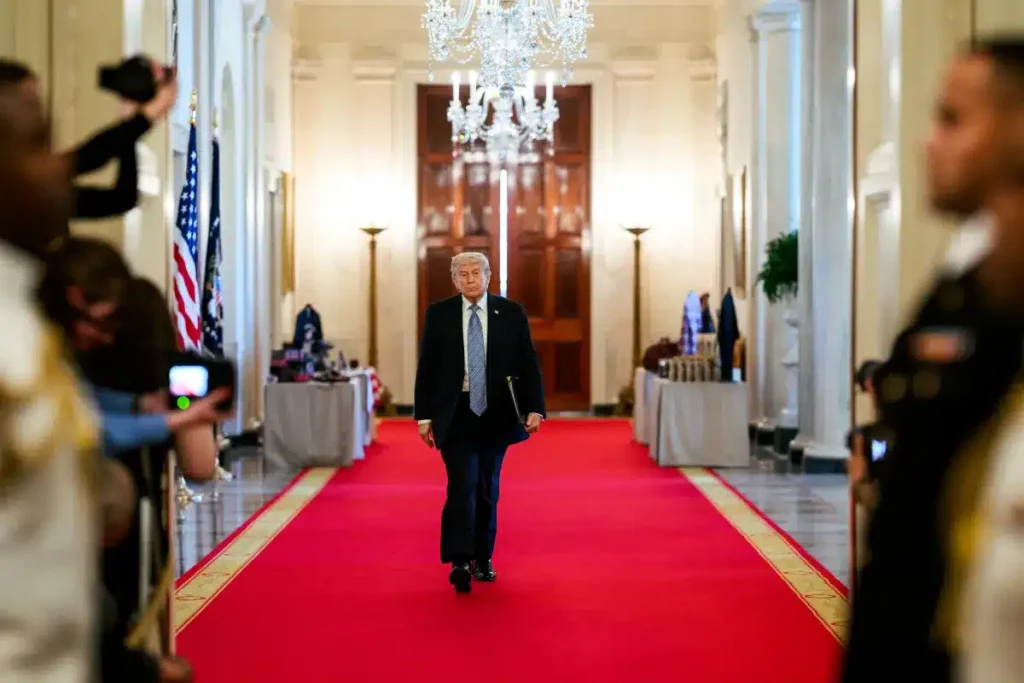

Trump’s latest news on Iran has sent shockwaves across the globe. President Donald Trump has rejected Iran’s response to the US peace proposal, calling it “totally unacceptable.” The Iran war deal is now at a dangerous impasse, with both sides trading accusations and military tensions rising fast.
Trump News Today Iran War The Rejection Heard Around the World
Trump, in a post on social media, wrote he didn’t like Iran’s response and called it “TOTALLY UNACCEPTABLE!” Earlier on Sunday, Trump accused Iran in another social media post of “playing games with the United States, and the rest of the World.”
This was Trump’s latest news on Iran a blunt, public dismissal of a proposal that Iranian officials had described as “realistic and positive.” The gap between the two sides could not be wider. Iran wanted an end to the war and sanctions relief. Trump wanted nuclear surrender first.
The Iran news Trump attack watchers feared has moved one step closer. With the Iran war deal rejected and talks at a standstill, the ceasefire that has been in place since April 8 is under enormous strain.
Background How the US-Iran War Began
On February 28, 2026, US and Israeli forces launched nearly 900 strikes in 12 hours targeting Iranian missiles, air defenses, military infrastructure, and leadership. The initial wave of strikes killed Supreme Leader Ali Khamenei and dozens of other officials.
The conflict had been building for years. Tensions between the United States and Iran stretch back to the Islamic Revolution in 1979. The immediate concerns leading up to the 2026 Iran war included Iran’s nuclear program, its ballistic missiles, its military reach in the Middle East, and failed attempts to renegotiate a nuclear deal after the collapse of the 2015 Joint Comprehensive Plan of Action.
Iran retaliated massively. Iran launched hundreds of drones and ballistic missiles at Israel, US military bases in the region, and at neighbouring Arab countries including Bahrain, Jordan, Kuwait, Oman, Qatar, Saudi Arabia, and the United Arab Emirates. The war quickly became the most destabilizing conflict in the Middle East in decades.
What Iran Actually Proposed in Its Response
Iran’s response to the US peace proposal was sent through Pakistani mediators. It was not a blank refusal but it was far from what Washington wanted.
Iran’s response included demands of an end to war on all fronts, the lifting of US sanctions on the sale of Iranian oil, lifting the US blockade on Iranian ports, and the unfreezing of assets, according to Iran’s semi-official Tasnim news agency. Iran delivered its response to Pakistani mediators on Sunday.
Iranian state media reported the Iranian response focused on ending the war and enshrining guarantees it won’t resume, before anything else. Iran also demanded an immediate end to the US naval blockade upon signing. The response maintains the proposed format of an initial memorandum of understanding followed by 30 days of negotiations, but insists on lifting US sanctions related to Iranian oil sales during that 30-day window.
Tehran’s position is clear: stop the war first, then talk about everything else. Washington’s position is equally clear: nuclear concessions first, then relief. This is the core deadlock driving the Iran war news today.
What the US Demanded The 14-Point Proposal
Trump news today on Iran cannot be understood without knowing what Washington actually asked for. The US presented a sweeping 14-point peace proposal.
Under its conditions, Iran would have to agree not to develop a nuclear weapon and stop all uranium enrichment for at least 12 years. It would also be required to hand over its estimated 440kg of uranium enriched to 60 percent. In return, the US would gradually lift sanctions, release billions of dollars in frozen Iranian assets, and halt its naval blockade of Iranian ports.
For Iran, this was a humiliating set of demands. Trump has drawn a hard line on the Iranian nuclear program, which Tehran has resisted. Iranian officials made clear they would not surrender their nuclear programme as a precondition for anything.
Iran War News Israel Medics Killed in Lebanon, Ceasefire Fraying
The Iran war news Israel dimension is equally alarming. Even as the US-Iran ceasefire nominally holds, Israel continues its assault on Lebanon, where Hezbollah Iran’s most powerful regional ally is fighting back hard.
Israel killed two Lebanese paramedics in Bint Jbeil with airstrikes, and later accused Hezbollah of making “extensive military use” of ambulances and other medical facilities.
The conflict between Hezbollah and Israel escalated into the 2026 Lebanon war, killing more than 2,000 civilians and militants. Iran has insisted that any Iran war deal must include Lebanon. It has made the lifting of hostilities against Hezbollah a condition of any final agreement. Israel flatly refuses.
Benjamin Netanyahu said there is still “work to be done” in the joint US-Israeli offensive against Iran, emphasizing that Tehran has not given up its enriched uranium or dismantled its nuclear sites. The Iran war news Israel front remains as dangerous as the US-Iran diplomatic track.
US Iran War Who Is Winning A Complex Picture
The question of US Iran war who is winning has no simple answer. Military analysts say it depends entirely on what “winning” means.
It is difficult to tell which side is winning in the US-Israeli war with Iran because the objectives and strategies for victory of the combatants are so different. President Donald Trump and his advisers have laid out multiple goals for the United States, some quite limited and others expansive. These include ending Iran’s nuclear program, degrading its missile capabilities, stopping Tehran’s support for Hezbollah and other proxy forces, and, most ambitiously, regime change in Tehran.
Militarily, the US and Israel have made significant gains. Within a week of the war’s beginning, Iran’s missile attacks fell by 90 percent due to US and Israeli bombing and suppression efforts. The US military claims it has sunk over 90 percent of Iran’s navy.
But Iran is surviving. Iran seeks to preserve its regime and, if it can, restore deterrence with the United States and Israel. Tehran believes, probably correctly, that if it can survive the bombing, it can achieve many of its goals. The US Iran war who is winning question may ultimately be decided not in the battlefield but in the negotiating room.
The Strait of Hormuz The World’s Most Dangerous Chokepoint
The Strait of Hormuz has become the Iran war’s most powerful weapon and its biggest economic threat. Iran shut the strait to foreign shipping after the US imposed its naval blockade, triggering a global energy crisis.
Brent crude is nearly $20 more expensive than it was before the war started and US crude is roughly $10 more expensive. Average gas prices are $4.52 a gallon. The Iran war deal failure is being felt at gas stations across America.
Iran’s parliamentary speaker and lead negotiator, Mohammad Bagher Ghalibaf, said a full ceasefire could only work if the US naval blockade is lifted. In response to US actions, Iran closed the Strait of Hormuz to all foreign shipping and captured several foreign-flagged ships.
Kuwait and the United Arab Emirates detected several drones in their airspace, while Qatar says a commercial cargo ship was targeted by a drone in its territorial waters. The Iran war news today shows that even during the ceasefire, attacks on international shipping have continued.
Pakistan’s Role Mediator in the Middle
One of the most important stories in Trump news today Iran war coverage is Pakistan’s role as a back-channel mediator. Iran chose to deliver its response to the US through Pakistani intermediaries a sign of trust in Islamabad that carries enormous diplomatic weight.
Pakistan is pushing Iran to “come to a middle ground” in negotiations. The stakes are very high Pakistan is suffering economically as well, with fuel prices sky-high. Pakistan has good relations with Iran, and it is in a favourable position with the Trump administration, so the likelihood of some sort of breakthrough is possible.
Pakistan’s position as a trusted go-between for both Washington and Tehran makes it a critical player in whether the Iran war deal eventually succeeds or collapses entirely.
Expert Voices What Comes Next?
National Security Advisor Mike Waltz made clear that while the US is prepared for the resumption of military hostilities, Trump wants to focus on diplomacy. “He is giving diplomacy every chance that he can before going back to hostilities,” Waltz said.
But voices in Washington are pushing for escalation. Senator Lindsey Graham wrote on social media that Trump should now consider taking military action. “Between their constant attacks on international shipping, the persistent attacks on our Middle Eastern allies and now a totally unacceptable response to America’s diplomatic proposal, it is in my view, time to consider changing course.”
Iranian officials pushed back firmly on Trump’s reaction. An Iranian official said: “The negotiating team should draft proposals only for the rights of the Iranian people, and when Trump is dissatisfied with them, naturally that is better.” Tehran is not backing down.
Conclusion Is War About to Resume?
The Iran response to Trump has pushed the Iran war deal to the edge of collapse. The ceasefire in place since April 8 is holding by a thread. If diplomacy fails, war news Trump will shift from rejected proposals to resumed bombardment.
The conflict left enormous damage thousands of people dead in Iran and Lebanon, dozens dead in Israel and the Gulf Arab states, and millions of people displaced in the region. Another round of fighting would be catastrophic.
The next few days are critical. Pakistan will continue to mediate. Qatar, Saudi Arabia, Turkey, and China are all engaged. But with Trump calling the Iran response “totally unacceptable” and Iran refusing to surrender its nuclear programme, the Iran war deal remains elusive and the world holds its breath.
FAQs
Who is Iran’s main ally?
Iran’s most powerful regional ally is Hezbollah in Lebanon, which it funds, arms, and directs. Beyond Hezbollah, Iran supports Hamas in Gaza and various Shia militia groups in Iraq, Syria, and Yemen collectively known as the “Axis of Resistance.” On the global level, Iran maintains close strategic ties with Russia and China, both of which have opposed US sanctions and military action against Tehran. In the current Iran war news context, China remains the largest buyer of Iranian oil and has played a quiet but significant diplomatic role.
Why does the US oppose Iran?
The US opposition to Iran dates back to the 1979 Islamic Revolution and the Iran hostage crisis, which shattered diplomatic relations. Since then, the US has consistently opposed Iran over its nuclear programme, its ballistic missile development, its support for militant groups across the Middle East, and its stated hostility to Israel. Trump news today on Iran reflects these decades-old tensions. The 2026 war was triggered by the collapse of nuclear diplomacy and US-Israeli fears that Iran was on the verge of producing a nuclear weapon.
Which US president went to Iran?
No sitting US president has ever visited Iran. Diplomatic relations between the two countries were severed after the 1979 Islamic Revolution and have never been formally restored. The closest the two nations came to diplomatic engagement was through indirect nuclear talks, including the 2015 JCPOA deal under President Obama which Trump withdrew from in his first term in 2018. All Iran war news and Iran war deal negotiations in 2026 have taken place through intermediaries including Pakistan, Qatar, and Oman, with no direct presidential contact.