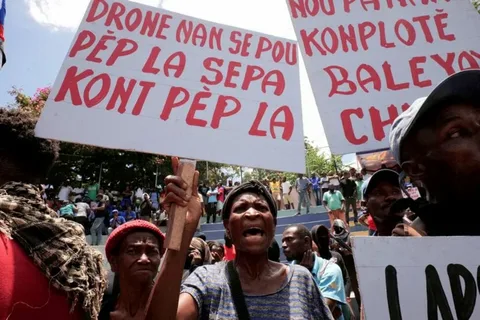

Haiti is once again at the center of a devastating humanitarian and political crisis. Haiti’s Prime Minister Alix Didier Fils-Aime has stated that the security situation in the Caribbean nation is not stable enough to hold the presidential elections scheduled for August. This latest development adds yet another dark chapter to the country’s long history of political instability and armed conflict.
Background A Nation Long Trapped in Crisis
To understand what is happening in Haiti today, one must look at the deep roots of the Haiti political instability that has plagued this nation for decades.
Haiti has endured cycles of dictatorship, foreign intervention, natural disasters, and gang warfare for generations. The Haiti conflict of 1994 saw a major U.S.-led military intervention, known as Operation Uphold Democracy, which restored elected President Jean-Bertrand Aristide to power after a military coup. That intervention temporarily stabilized the country but failed to address its structural problems.
Then came the catastrophic 2010 earthquake, which killed over 200,000 people, left millions homeless, and destroyed Haiti’s already fragile infrastructure. The disaster drew global attention and billions in aid, yet the Haiti crisis only deepened over the following years as corruption, mismanagement, and political chaos consumed whatever recovery was attempted.
The most recent turning point came in July 2021, when President Jovenel Moïse was assassinated inside his private residence. His killing created a dangerous political vacuum that powerful armed gangs quickly moved to fill.
What Happened in Haiti Yesterday and Today May 11, 2026
The latest wave of violence erupted this past weekend and continued through Monday, May 11, 2026. Clashes between rival gangs escalated in Haiti’s capital, Port-au-Prince, forcing hospitals to evacuate patients and hundreds of people to flee their homes.
The situation on the ground is alarming. Doctors Without Borders, known by its French initials MSF, announced the evacuation of its hospital in the neighbourhood of Cite Soleil following intense clashes there on Sunday.
MSF reported having treated more than 40 gunshot victims within 12 hours while providing temporary shelter to 800 people fleeing the violence. This is not just a political story it is a human catastrophe unfolding in real time.
Another hospital in the area, Fontaine Hospital, evacuated newborns from its intensive care unit. Pregnant women and wounded civilians were among those caught in the crossfire.
Hospitals Shut Down, Civilians Flee Into the Streets
The Haiti crisis has now directly targeted medical services one of the most disturbing escalations yet. MSF stated that currently not a single hospital is open in the area where the fighting is taking place.
One displaced civilian, Monique Verdieux, 56, who fled to a highway after watching armed men burning houses in her neighbourhood, said she was unsure where members of her family were after they scattered in different directions. “I am now sleeping in the street,” she said, noting it was unsafe to return.
This is what is happening in Haiti today live families torn apart, hospitals empty, and streets engulfed in gang warfare with no immediate end in sight.
Haiti Political Situation PM Casts Doubt on August Elections
The Haiti political situation has become increasingly dire at the institutional level as well. Prime Minister Fils-Aime made a frank admission on Monday. “It is clear that the security conditions are not met at the level for us to have elections in August,” Fils-Aime said in an interview broadcast on Magik9 radio.
He expressed a cautious hope, however. “I would like for elections to happen by the end of the year,” he added. “On February 7, we would have an elected president.”
Haiti has not held elections since 2016, with successive governments delaying polls as powerful armed gangs cemented their control over the capital. The electoral council had approved more than 280 political parties to compete, but without basic security, a free and fair vote remains nearly impossible.
The Gang Problem Who Is Fighting Whom?
Local business leaders said the fighting near the capital’s port and just a few kilometres from its international airport involved the Chen Mechan gang, its partners, and their former allies. The groups had all been part of a broad alliance known as Viv Ansanm, a coalition of hundreds of armed gangs across the capital.
The breakdown of this gang alliance has triggered new and even more unpredictable violence. Former allies are now turning on each other, and civilians are paying the price. This internal gang conflict is a new and dangerous dimension of the Haiti political instability history that analysts are closely watching.
Over 1.4 Million Displaced The Scale of Suffering
The numbers tell a staggering story of human suffering. According to a report published earlier this year by the International Organization for Migration, gang violence has displaced more than 1.4 million people in Haiti. About 200,000 of them are now living in crowded and underfunded sites in the nation’s capital.
The violence has killed thousands of people and displaced more than a million, limiting the ability of authorities to guarantee a free and fair voting process. The Haiti crisis is now one of the worst displacement situations in the Western Hemisphere.
International Response UN Force Restructured, Chad Deploys Troops
The international community has struggled to mount an effective response to the Haiti conflict. The renewed violence comes after the last members of a Kenyan-led mission in Haiti left the country as part of a restructuring of a UN-backed force mandated to help restore security.
The mission had been hamstrung by a lack of troops, funds, and equipment. It had also faced sexual abuse accusations.
The UN’s new plan aims to deploy some 5,500 new troops in Haiti by the end of October, but it is not clear where all of the troops will come from or who will fund their operations.
Chad’s government said in April that it plans to send 1,500 personnel to Haiti and that some 400 have already been deployed. Whether this force can turn the tide remains deeply uncertain.
Global and Regional Impact of Haiti’s Ongoing Crisis
The Haiti political instability has wide-reaching consequences beyond its borders. Massive displacement drives irregular migration toward other Caribbean islands and the United States. The collapse of healthcare and basic services creates conditions for disease outbreaks that can spread regionally.
Internationally, the Haiti crisis tests the credibility of UN peacekeeping mechanisms and raises questions about long-term commitments from wealthy nations. The United States and the UN have both tied their support to the condition that Haiti holds elections but as the PM himself now admits, those elections may not be possible this year.
Conclusion What Comes Next for Haiti?
The Haiti political situation in May 2026 is at one of its bleakest points in recent memory. Hospitals are shut, hundreds are sleeping in streets, gangs are dividing and fighting even among themselves, and the prospect of democratic elections grows dimmer by the week.
What happened in Haiti yesterday and today is not an isolated incident it is the latest episode in a long and painful history of Haiti political instability that stretches from the 1994 conflict to the 2010 earthquake to the 2021 presidential assassination.
The world must ask: how long can the people of Haiti be left to endure this? Without sustained international support, real security sector reform, and genuine political will, the Haiti crisis will continue to spiral. The next few months and whether a UN force can be properly deployed before October will be critical.
Frequently Asked Questions (FAQs)
Which president was killed in Haiti?
President Jovenel Moïse was assassinated on July 7, 2021, at his private residence in Port-au-Prince. His murder left a political vacuum that allowed already powerful gangs to extend their influence over almost all of Port-au-Prince. In May 2026, four individuals were convicted in the United States in connection with his killing.
Is Haiti stable yet?
No. Haiti is not stable. As of May 2026, Prime Minister Fils-Aime himself has confirmed that security conditions are not met for elections, and gang violence continues to displace civilians and shut down hospitals. The country has not held any elections since 2016, and political instability remains extremely high.
Why is Haiti so unstable right now?
Haiti’s instability today is the result of decades of compounding crises corrupt governance, the devastating 2010 earthquake, the 2021 assassination of its president, and the unchecked rise of powerful armed gang networks. Efforts by authorities to quell the fighting and curb the influence of criminal groups have largely proven ineffective, while the United Nations and the United States have tied their commitments to support Haiti’s security forces to the government holding elections. The breakdown of the Viv Ansanm gang alliance has now added fresh, unpredictable violence to an already catastrophic situation