
The Indus basin water issues have escalated into one of the world’s most dangerous water conflicts. After India suspended the Indus Water Treaty in April 2025 following the Pahalgam attack, Pakistan’s agricultural lifeline came under direct threat. With over 300 million people depending on the Indus basin aquifer and river system, this is no longer a diplomatic dispute it is a humanitarian emergency.
Background What Are the Indus Basin Water Issues?
The Indus basin water issues date back to the partition of British India in 1947. When borders were drawn, rivers that had irrigated a unified agricultural system were suddenly split between two hostile nations. For over half a century, rivalry over river resources has been a source of interstate tension between India and Pakistan. During the partition of British India in 1947 and the formation of the two states, border lines were drawn along what was defined as the “Indus watershed.”
The Indus Water Treaty of 1960 was meant to resolve these Indus basin water issues permanently. Brokered by the World Bank, the treaty divided the six rivers of the Indus system between India and Pakistan. For six decades, despite wars and crises, the treaty held. But Indus basin water issues never truly disappeared they only waited for the right political moment to explode.
That moment came in April 2025. And the consequences are still unfolding in 2026.
The 2025 Suspension When Water Became a Weapon
On April 22, 2025, armed militants opened fire on tourists near Pahalgam in Indian-administered Kashmir, killing at least 26 people. India blamed Pakistan for the massacre. In retaliation, Delhi suspended the Indus Waters Treaty, informing Islamabad it would hold the 65-year-old agreement in abeyance until Pakistan credibly abjures its support for cross-border terrorism.
Senior Indian officials vowed to ensure that “not even a drop of water goes to Pakistan.” Pakistan denied any role in the assault, warning it would consider any effort to interrupt the river’s flow as an act of war.
This single decision transformed the Indus basin water issues from a legal and technical dispute into a live geopolitical crisis. The water conflict between India and Pakistan crossed a threshold that experts had long warned about the weaponization of water between two nuclear-armed states.
Following the militant attack, India chose to temporarily suspend its participation in the treaty and subsequently restricted the flow of water for short periods through the Baglihar and Kishanganga dams. These are not just infrastructure moves. They are signals — and Pakistan received them clearly.
Indus Basin Water Issues 2021 to 2026 A Timeline of Escalation
The Indus basin water issues did not begin in 2025. They built up slowly over years. India made multiple calls for renegotiating the Indus Water Treaty in 2021, 2023, and 2024, citing its limitations in addressing climate change, population growth, and water quality issues. India also perceived the treaty as favoring Pakistan and constraining India’s ability to develop the western tributaries within its territory.
India has refused to participate in the Permanent Indus Commission’s meetings since 2023. This breakdown in the Indus Water Commission the body specifically designed to manage Indus basin water issues made the 2025 suspension almost inevitable.
Indus basin water issues 2021 marked the beginning of formal renegotiation demands. By 2024, the water conflict between India and Pakistan was already straining every diplomatic channel. The 2025 suspension was the culmination of a five-year slide toward open water confrontation.
Indus Water Treaty Main Points What Was Suspended?
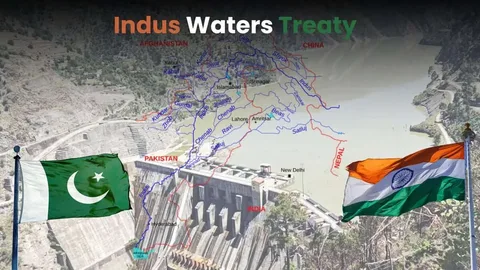
Understanding what India suspended requires knowing what the Indus Water Treaty actually governed. The treaty allocated the three eastern rivers Ravi, Beas, Sutlej to India, and the three western rivers Indus, Jhelum, Chenab to Pakistan. These western rivers feed the Indus basin aquifer and support Pakistan’s entire irrigation network.
The Indus River Basin has a total area of around 1.12 million square kilometres, distributed among four countries: Pakistan at 47 per cent, India at 39 per cent, China at eight per cent, and Afghanistan at six per cent. The basin’s population was around 320 million in 2025 and is likely to reach 380 million by 2050.
Around 80 per cent of Pakistanis live within the Indus Basin region. This is why Indus basin water issues are not a peripheral concern for Pakistan they are existential. Every farmer, every village, every city downstream depends on what flows through this system.
Indus River Delta Map The Geography of Vulnerability
The Indus river delta map tells a story of shrinking hope. The Indus originates in Tibet, flows through Ladakh, enters Pakistan near Attock, and runs south through Punjab and Sindh before emptying into the Arabian Sea near Karachi. The Indus river delta map shows that Pakistan sits entirely downstream of India’s upstream infrastructure.
The Indus river delta map also reveals the ecological crisis at the river’s mouth. Decades of upstream water extraction have reduced the Indus delta from a thriving ecosystem to a stressed, shrinking landscape. The Indus basin aquifer the underground water storage that millions depend on during dry seasons is being depleted faster than it can be replenished.
The Indus basin aquifer crisis is well documented in Indus basin water issues PDF reports published by the World Bank, IUCN, and Pakistan’s own water authorities. The Indus basin aquifer in Punjab alone has seen water tables drop by several meters over the past two decades. Add India’s treaty suspension to this already stressed system, and the Indus basin water issues become catastrophic.
Water Conflict Between India and Pakistan Who Is Winning?
The water conflict between India and Pakistan is deeply asymmetric. India controls the headwaters. India controls the dams. India controls the data. Since 2016, Indian Prime Minister Narendra Modi’s government has repeatedly invoked the language of revisiting, restricting, or canceling the treaty after security crises, altering how the agreement functions in public and diplomatic life.
After the May 2025 skirmish, India’s decision to keep the treaty in abeyance signaled that cooperation itself had become conditional and reversible. This renders India-Pakistan water competition not just a diplomatic issue but a domestic governance and security problem.
Pakistan has pushed back through international law. On January 30, 2026, speaking at an Arria-formula meeting of the United Nations Security Council, Pakistan’s Permanent Representative Ambassador Asim Iftikhar Ahmad raised the water conflict between India and Pakistan as a matter of international concern.
Pakistan’s President Asif Ali Zardari stated that India’s decision to place the treaty in abeyance, disrupt hydrological data-sharing, and impede agreed mechanisms undermines both the letter and spirit of a long-standing international agreement that has governed equitable sharing of the Indus river system for over six decades.
India’s Home Minister Amit Shah responded bluntly. In an interview, Shah said the Indus Water Treaty “will never be restored.” That statement, if upheld, would make the water conflict between India and Pakistan permanently unresolvable through existing legal channels.
Indus Basin Water Issues PDF What Research Shows
Every serious Indus basin water issues PDF from the World Bank, Chatham House, or academic institutions identifies the same converging threats. Climate change is reducing glacial meltwater. Population growth is increasing water demand. Agricultural inefficiency is wasting what little water remains. And now political weaponization is cutting off treaty protections.
Per-capita water availability globally has declined sharply, from 18,000 cubic metres in 1950 to just over 5,000 in 2025, making cooperative management increasingly vital. For Pakistan, sitting at the tail end of a stressed Indus basin aquifer with a hostile upstream neighbor, these global trends are magnified dramatically.
The Indus basin water issues PDF literature also documents that the Indus basin aquifer is among the most stressed in the world. Over-extraction for agriculture Pakistan’s dominant economic sector has made Pakistan structurally dependent on a water source that is shrinking from above and below simultaneously.
Top 10 Water Conflicts Where Does Indus Rank?
The Indus basin water issues place the India-Pakistan dispute firmly among the top 10 water conflicts in the world. Water conflict scholars rank disputes by population affected, political volatility, and potential for armed escalation. On all three measures, the Indus basin water conflict scores at the top.
Other disputes in the top 10 water conflicts globally include the Nile River dispute between Ethiopia, Sudan, and Egypt over the Grand Ethiopian Renaissance Dam; the Mekong River conflict between China and downstream Southeast Asian nations; the Colorado River dispute between the United States and Mexico; and the Jordan River conflict between Israel and Palestine.
What makes the Indus basin water issues unique among the top 10 water conflicts is the nuclear dimension. Climate stress risks narrowing diplomatic off-ramps between two nuclear-armed states, where water disputes escalate from technicalities to existential threats. No other dispute in the top 10 water conflicts involves two nuclear powers in direct confrontation over a single river system.
The suspension of the Indus Water Treaty in 2025 has left no clear timeline for restoration. Worsening effects of climate change on Himalayan glaciers could also increase the likelihood of disasters, threatening the long-term water security of communities.
What September 19, 1960 Means Today
September 19, 1960 was the day the Indus Water Treaty was signed in Karachi by Pakistan’s President Ayub Khan and India’s Prime Minister Jawaharlal Nehru, with the World Bank as guarantor. It was celebrated as a triumph of diplomacy over geography. It was proof that Indus basin water issues could be resolved through law rather than war.
The Indus Waters Treaty survived diplomatic tensions for almost sixty years, proving remarkably durable and acting as a stabilizing force for broader India-Pakistan relations.Today, September 19, 1960 risks becoming a historical footnote. Water scarcity during summer could increase the likelihood of India reducing downstream river flows into Pakistan, critical for irrigation, drinking supplies, and hydropower generation. Should India’s reservoir storage capacities improve amid surging water scarcity, there are risks of an escalating crisis.The date that once represented hope for the Indus basin water issues now represents how fragile that hope always was.
Conclusion Can the Indus Basin Water Issues Be Resolved?
The Indus basin water issues in 2026 require more than diplomacy they require a fundamental rethinking of how two nuclear-armed neighbors share a depleting resource in a warming world. The Indus Water Treaty, even at its best, was designed for a different era. It did not anticipate climate change. It did not anticipate upstream dam proliferation. And it certainly did not anticipate being used as a political weapon.
Re-engagement between India and Pakistan on water could help bring lasting peace. Water has long been entangled with the political and security dynamics between the two countries, but the Indus River Basin is also a lifeline for more than 300 million people who deserve better than to be caught in a geopolitical standoff.
The Indus basin water issues are ultimately not about who owns the water. They are about whether two countries can choose survival over conflict. The Indus river delta map, the Indus basin aquifer data, and every Indus basin water issues PDF point to the same conclusion: time is running out.
FAQs
Is Indus River water stopped for Pakistan?
India placed the Indus Water Treaty in abeyance in April 2025 following the Pahalgam attack and has not restored it. India temporarily restricted flows through the Baglihar and Kishanganga dams. As of 2026, India’s Home Minister Amit Shah has stated the treaty will never be restored. Full stoppage of the Indus River is technically difficult given infrastructure limitations, but the Indus basin water issues have severely disrupted data sharing, cooperation mechanisms, and the legal framework governing water flows to Pakistan.
What is the Indus River water conflict?
The water conflict between India and Pakistan centers on the Indus Water Treaty of 1960, which divided the six rivers of the Indus basin between the two countries. India controls the headwaters and has built dams on rivers allocated to Pakistan. After the 2025 Pahalgam attack, India suspended the treaty, creating a crisis for Pakistan’s 300-million-strong population dependent on the Indus basin aquifer and river system. The conflict involves legal disputes, dam construction objections, data-sharing breakdowns, and geopolitical tensions that rank among the top 10 water conflicts in the world.
What happened on 19 September 1960?
On September 19, 1960, the Indus Water Treaty was signed in Karachi between Pakistan’s President Ayub Khan and India’s Prime Minister Jawaharlal Nehru. The World Bank’s President also signed as guarantor. The treaty resolved Indus basin water issues that had festered since the 1947 partition by dividing the six rivers of the Indus system giving India the three eastern rivers and Pakistan the three western rivers including the Indus itself. It established the Indus Water Commission to manage ongoing cooperation and dispute resolution. The treaty held for 65 years before India suspended it in 2025.