Most people couldn’t point to New Caledonia on a map without some help. But this French Pacific territory about the size of New Jersey, sitting roughly 1,200 kilometers east of Australia is navigating political questions that many much larger places would find overwhelming.
On Sunday, residents voted in the territory’s first provincial elections since 2019. The vote comes after years of unrest, three independence referendums, constitutional disputes, and periods of violence that left real economic damage and genuine social fractures. What happens here matters not just for the 270,000 people who live here, but for France, for the Pacific region, and for global industries that depend on what’s underneath New Caledonia’s soil.
Some Basic Questions, Answered
Is New Caledonia a country?
No though the answer requires a little nuance. New Caledonia is a French overseas territory with a special constitutional status that gives it considerably more self-governance than a typical French region. It has its own elected institutions, manages many internal affairs, and has a distinct political identity. But France retains control over defense, foreign affairs, and currency. It’s not independent, but it’s not quite like being a regular part of France either.
Is it independent?
Not yet, and not by vote. Three independence referendums were held between 2018 and 2021. The first two produced majorities for remaining with France. The third, in 2021, also produced a pro-France result but was boycotted by most pro-independence groups, who argued the timing was inappropriate given COVID-19 restrictions on Indigenous communities observing mourning customs. That boycott left the legitimacy of the result contested, and the independence question very much unresolved.
Who Lives Here and Why It Matters Politically
New Caledonia’s population of around 270,000 is one of the Pacific’s most diverse. Indigenous Kanak people make up the largest single ethnic group, alongside Europeans (many descended from French settlers), Wallisians, Futunans, Polynesians, and others.
This diversity isn’t just demographic background it’s the engine of the territory’s political conflict. Different communities have different relationships to the land, different economic positions, and different visions for what New Caledonia should become. Indigenous Kanak communities, particularly in rural provinces, tend to support independence and self-determination. Urban populations, particularly in and around the capital Nouméa, have historically leaned toward maintaining ties with France.
Provincial elections matter partly because provincial assemblies determine the composition of New Caledonia’s Congress which means demographic shifts and voting patterns directly shape political power.
What’s Been Happening: The Recent Unrest
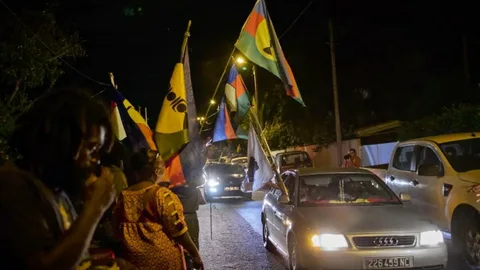
The 2026 elections take place against a backdrop of genuine turmoil. In 2024 and 2025, proposed constitutional reforms from Paris specifically around electoral rolls and voting eligibility triggered widespread protests that escalated into serious violence in parts of the territory.
The damage was significant. Businesses were destroyed, economic activity was disrupted, and the social tensions that had been simmering for years came to the surface in ways that couldn’t be ignored. The unrest drew international attention and forced France into a more active engagement with New Caledonia’s political situation than it had wanted.
The elections on Sunday were, among other things, an attempt to channel that energy back into democratic institutions rather than the streets.
The Independence Question Isn’t Going Away
New Caledonia has political parties that fall, roughly, into two camps though the reality is more complex than a simple binary.
Pro-independence parties, largely representing Kanak interests, argue that Indigenous people should exercise full sovereignty over their homeland. They point to historical dispossession, ongoing economic inequality between communities, and what they see as an unfinished decolonization process.
Pro-France parties argue that independence would risk economic stability, cut off access to significant French financial support, and leave a small island territory vulnerable in an increasingly competitive global environment.
Neither camp has ever fully dominated provincial politics, which makes coalition-building essential and compromise unavoidable even when both sides are genuinely far apart on the fundamental question.
The presidency of the New Caledonian government it’s called President of the Government, not President, reflecting the territory’s status is formed through elected Congress members rather than direct election. France’s president remains the head of state. This dual institutional structure is either a pragmatic accommodation or an unsatisfactory halfway house, depending on who you ask.
What New Caledonia Is Actually Like
Set aside the politics for a moment and New Caledonia is, by almost any measure, extraordinarily beautiful. A lagoon recognized as a UNESCO World Heritage Site one of the world’s largest surrounds the main island. Coral reefs, tropical forests, and white-sand beaches make it a destination that punches well above its weight in Pacific tourism.
The official language is French, but numerous Kanak languages are spoken throughout the islands. The culture is a layered mix of French administrative tradition, Indigenous Melanesian heritage, and Pacific Island influences from the many communities that have made their home here.
Economically, New Caledonia is among the wealthier territories in the Pacific largely because of nickel. But wealth distribution is deeply uneven. Urban areas, particularly Nouméa, have living standards that compare reasonably well with metropolitan France. Many Indigenous communities, especially in rural areas, experience significantly higher unemployment and fewer economic opportunities.
That inequality is both a cause of political tension and one of the things any future government will have to address seriously.
The Nickel Factor: Why the World Is Watching
New Caledonia sits on one of the world’s largest known nickel reserves. That single fact gives this territory a significance in global supply chains that far exceeds its population.
Nickel is essential for stainless steel production and increasingly for the batteries that power electric vehicles and store renewable energy. As the world tries to transition away from fossil fuels, the minerals needed to do that have become strategically important in ways they weren’t a decade ago.
Political instability in New Caledonia doesn’t just affect the Pacific. It affects investment decisions, mineral supply chains, and the energy transition calculations of governments and industries worldwide. France is acutely aware of this, as is China, Australia, Japan, and others with interests in the Indo-Pacific.
New Caledonia’s geographic location also gives it strategic value for France’s presence in an increasingly contested Pacific. That’s another reason Paris isn’t simply a passive observer of what happens here.
Is It Safe to Visit?
For most tourists, New Caledonia remains a genuinely appealing destination. The popular coastal areas, diving sites, and resorts have not been the epicenter of political unrest.
That said, travelers should check current advisories before visiting. Demonstrations and political events can disrupt transportation and public services without much warning, and periods of tension have occasionally spilled into areas tourists frequent. The standard advice applies: stay informed, follow local guidance, and avoid areas where protests are occurring.
What These Elections Could Mean
The provincial elections won’t resolve the independence question nothing about Sunday’s vote will answer whether New Caledonia eventually becomes its own country. But the results will shape the political landscape significantly.
Provincial governments will determine economic recovery strategies following the 2024-2025 unrest. Investment confidence, infrastructure decisions, and tourism development all depend on political stability and the ability of elected governments to function effectively.
The composition of the new Congress will also influence how future constitutional talks proceed. France has signaled it wants to continue dialogue about New Caledonia’s institutional future but the terms and pace of those conversations will be shaped by who wins provincial seats.
For Indigenous Kanak communities, the elections are a test of whether political engagement within French institutions can deliver meaningful progress, or whether the case for independence is strengthened by continued frustration.
The Bottom Line
New Caledonia is a place of genuine beauty, significant mineral wealth, and deep political complexity that its small population has been navigating for decades. The 2026 provincial elections are a moment not a resolution.
The independence debate will continue regardless of the results. The inequality between communities will still need addressing. The relationship with France will still need renegotiating. The nickel industry will still need managing in a way that works for everyone, not just investors.
What the elections offer is a democratic foundation for those conversations to continue and after a period of genuine unrest, that’s not nothing.
FAQs
What is the core controversy in New Caledonia?
At its heart, it’s a question of self-determination. Indigenous Kanak communities and their political allies argue that New Caledonia should be independent, with Kanak people exercising sovereignty over their land. Other communities particularly those with European heritage generally support remaining part of France for reasons of economic stability and security. Three independence referendums haven’t resolved the question, partly because the last one was boycotted by pro-independence groups, leaving its legitimacy disputed.
Who actually governs New Caledonia?
It’s a power-sharing arrangement. Local elected institutions handle education, taxation, economic development, and many other domestic functions. France retains control over defense, foreign policy, currency, and national security. It’s more autonomy than most French regions have, but less than full independence and exactly where that line should be drawn is the subject of ongoing negotiations.
Is New Caledonia wealthy or poor?
Relative to its Pacific neighbors, it’s wealthy the nickel industry and French financial support give it a higher GDP per capita than most of the region. But that wealth is unevenly distributed in ways that are politically significant. Urban areas around Nouméa have relatively high living standards. Many Indigenous and rural communities experience substantially higher rates of poverty and unemployment. Addressing that gap is one of the central challenges for any government here and one of the reasons the independence debate carries such economic weight.