

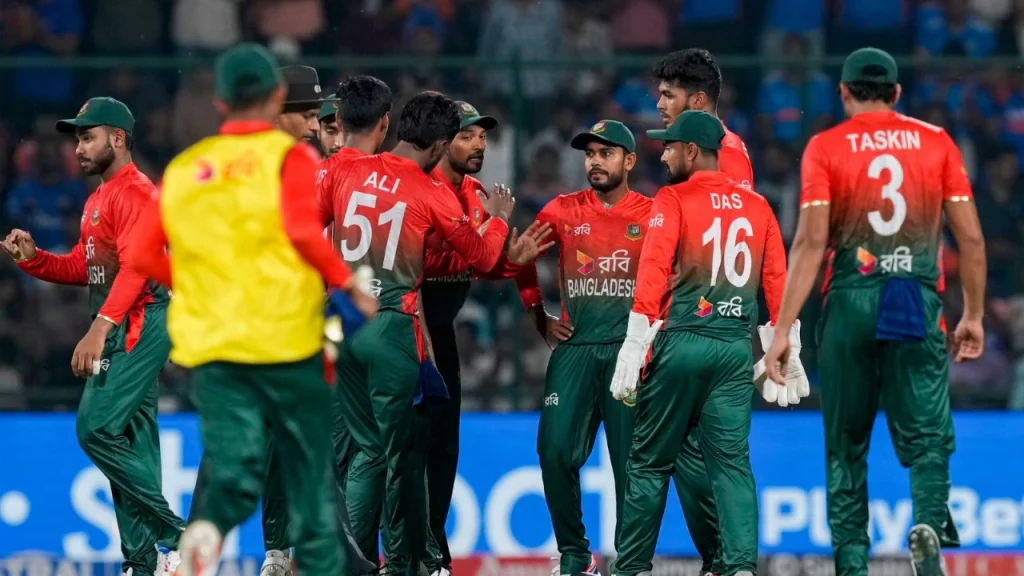

A government-appointed committee has concluded that the Bangladesh national cricket team should have taken part in this year’s ICC Men’s T20 World Cup. The panel has placed the blame squarely on the former interim government and its then youth and sports adviser, Dr Asif Nazrul.
Background
Bangladesh’s T20 World Cup participation fell apart months before a ball was bowled. The trouble began in early January 2026, when the Board of Control for Cricket in India instructed Kolkata Knight Riders to drop Bangladesh pacer Mustafizur Rahman from their IPL squad.
No official reason was given, but the move landed at a moment when relations between the two governments were already strained. Within a day, Asif Nazrul had gone public, asking the ICC to shift Bangladesh’s matches away from India and over to Sri Lanka instead.
The Bangladesh Cricket Board followed his lead. It wrote to the ICC citing security concerns and pushed for a change of venue. The ICC turned the request down, saying it had found no credible or verifiable threat to the team in India.
What followed was a standoff. The interim government refused to clear the team’s travel, and the ICC eventually removed Bangladesh from the tournament altogether, bringing in Scotland as a replacement. The T20 World Cup itself went ahead as planned, jointly hosted by India and Sri Lanka from February 7 to March 8.
Details: What The Committee Found
The Ministry of Youth and Sports set up a three-member probe committee in March, months after Bangladesh’s exit from the tournament had already become a national talking point. It was chaired by Dr AKM Wali Ullah, an additional secretary at the ministry, alongside former national captain Habibul Bashar and Supreme Court lawyer Barrister Faisal Dastagir.
How The Investigation Was Carried Out
The committee spoke to players, officials and other people connected to the decision, and cross-checked their accounts against media coverage from the time. Its brief was broad: figure out exactly who decided Bangladesh would not travel, and why that decision stuck even after the ICC rejected every alternative on the table.
The Committee’s Conclusion
At a press conference on September 15, the panel delivered its verdict. Bangladesh, it said, should have played in the World Cup. The players themselves had been ready to go and had raised no objection to travelling to India. It was the government’s call that kept them home.
The report also weighed up the different factors behind the withdrawal. Political tension between India and Bangladesh, combined with the ICC’s refusal to budge on the venue, were rated as having had a “very high” impact on the final outcome. The Sports Ministry, the committee found, made the decision and passed it on to the cricket board, which did not push back.
Quotes From The Committee And Asif Nazrul
Barrister Faisal Dastagir, who represented the committee at the briefing, put the responsibility on one name. “The person responsible was then youth and sports adviser Asif Nazrul,” he told reporters, adding that the interim government as a whole shared the blame.
Dastagir also addressed the players directly, saying they had been prepared to travel and had no issue with playing in India. It was the instruction from the top, he said, that forced their hand.
Asif Nazrul did not dispute the finding. Hours after the report came out, he posted on Facebook that the decision had been his, and that he had said as much in public more than once before. He also stood by the call itself, pointing to an ICC assessment that had acknowledged genuine security concerns in India, and arguing that Indian authorities never made a real effort to get Bangladesh to the tournament.
That is a shift from where Nazrul stood back in February, when he told reporters the call to skip India had come from the cricket board and the players, not from him or the government.
Impact On Bangladesh Cricket
Missing a T20 World Cup is not a small thing for any cricket board, and the fallout for Bangladesh cricket has run well beyond a single tournament. Players lost a shot at global exposure, sponsors lost a marquee event to sell around, and the board’s standing with the ICC took a hit at a time when regional politics were already testing it.
The episode also nudged neighbouring boards into an uncomfortable spot. Pakistan weighed pulling out in solidarity before deciding to stay in, a reminder of how quickly a bilateral dispute between India and Bangladesh could ripple across the wider region.
For a board still finding its footing after the political upheaval that reshaped Bangladesh’s government in 2024, the report is another mark against an administration already under scrutiny for how it handled cricket during the transition.
Conclusion
With responsibility now formally assigned, the question is what the Bangladesh Cricket Board does with the finding. There has been no word yet on disciplinary steps, and Nazrul himself is no longer in office, which limits what direct consequences the report can carry.
What it does set is a marker for how future decisions of this kind get made. The next time politics threatens to keep the Bangladesh national cricket team off the field, this report is likely to be the reference point everyone reaches for first.
FAQs
Is Bangladesh out from T20 WC?
Yes. Bangladesh did not take part in the 2026 ICC Men’s T20 World Cup. After the Bangladesh Cricket Board declined to send the team to India over security concerns and the ICC rejected a request to move the matches to Sri Lanka, the ICC formally removed Bangladesh from the tournament and brought in Scotland as a replacement side.
Is Bangladesh playing the 2026 T20 World Cup?
No. The 2026 T20 World Cup, held jointly in India and Sri Lanka between February 7 and March 8, went ahead without Bangladesh. The team’s spot was taken by Scotland after the withdrawal was confirmed, and a new government committee has since found that Bangladesh should have played after all.
Why did the ICC remove Bangladesh?
The Bangladesh Cricket Board asked the ICC to shift Bangladesh’s matches from India to Sri Lanka, citing security concerns after tension between the Indian and Bangladeshi governments. The ICC said it found no credible or verifiable threat and declined the request. When the Bangladesh government then refused to clear the team’s travel to India, the ICC treated it as a withdrawal and replaced the team in the tournament.