
In April 2011, a 73-year-old retired army driver sat down at Jantar Mantar in New Delhi and refused to eat. He was not a politician. He held no office. His declared net worth was barely a few thousand rupees. And yet, within days, Anna Hazare’s hunger strike galvanised millions and turned the abstract demand for an anti-corruption law into a household conversation across the world’s largest democracy. What followed was one of the most powerful civil society movements India had ever seen a people’s uprising that forced a stubborn government to the negotiating table without a single weapon being raised.
Who Is Anna Hazare?
Kisan Baburao Hazare, known to everyone as Anna, was born on 15 June 1937. He grew up in Maharashtra, served in the Indian Army for fifteen years, and was posted across Punjab, Sikkim, Bhutan, Mizoram, and Jammu before being honourably discharged in 1975. When he returned to his native village of Ralegan Siddhi in Ahmednagar district, he found it trapped in poverty, alcoholism, and hopelessness. He gathered like-minded youth and organised a Tarun Mandal, a Youth Association, to work toward rebuilding the village. The Mandal helped close down over thirty liquor breweries and banned the sale of tobacco and cigarettes.
The World Bank Group later noted that Ralegan Siddhi transformed from a severely impoverished village in a semi-dry district into one of the most self-sufficient in the country. Anna Hazare turned a forgotten village into a living model of sustainable governance, and it was this credibility earned through decades of quiet grassroots work that made millions trust him when he stood up against corruption at the national level.
What Is Anna Hazare’s Net Worth?
This is a question people ask often, and the answer is striking. On April 16, 2011, Hazare publicly declared his bank balance of just Rs 67,183 and Rs 1,500 as the money in hand. He owns no property of note, drives no car, and has lived in a small room attached to the Sant Yadavbaba temple in Ralegan Siddhi since 1975. His Anna Hazare net worth is essentially zero in conventional terms and that is precisely the point. In a country drowning in political corruption and financial scandal, a man who voluntarily chose poverty held a moral authority that no minister or billionaire could match.
That austere lifestyle was not a performance. It was the foundation of the entire anti-corruption protest he would eventually lead. People trusted Anna Hazare because he was incorruptible in the most literal sense he had nothing to lose and nothing to gain.
What Is the Anti-Corruption Protest?
The anti-corruption protest led by Anna Hazare grew from a specific political moment but reflected a decades-old frustration with systemic graft in India. The movement arose from multiple corruption scandals during the Indian National Congress-led United Progressive Alliance regime and demanded an independent, citizen-driven body to investigate and prosecute corruption cases against people holding public office.Political corruption in India had long been a perennial problem, recently exposed by two spectacular scandals the sale of telecommunications spectrum and the troubled 2010 Commonwealth Games, which together cost the country as much as $40 billion according to government auditors. Years of broken promises, whitewashed investigations, and unpunished wrongdoing had exhausted ordinary citizens. When Anna Hazare announced his Anna Hazare hunger strike, that exhaustion turned into action. The anti-corruption movement was the outlet millions had been waiting for.
Background: What Is the Jan Lokpal Bill?
At the heart of the anti-corruption protest was a single, clear demand the passage of the Jan Lokpal Bill. The Jan Lokpal Bill, or People’s Ombudsman Bill, incorporated strict rules and regulations against corruption by providing greater power to Lokpal and Lokayuktas, the constitutional ombudsmen, to act against those in public office.
The Jan Lokpal Bill was designed to give wider powers to the Lokpal by bringing the judiciary and the Prime Minister under its purview a demand the existing government draft deliberately excluded. Anna Hazare and his supporters argued that a toothless Lokpal was worse than no Lokpal at all. According to Hazare, the government-proposed bill was “complete eyewash” rather than strengthening anti-corruption systems, it demolished whatever systems existed.The Jan Lokpal Bill was not just a piece of legislation. It was a statement of principle that no one in power should be above the law, including the Prime Minister.
The Anna Hazare Hunger Strike: What Happened
The movement for the Jan Lokpal Bill gained decisive momentum during the 2011 mass protests led by Anna Hazare. After the rejection of his proposal to form a joint committee to draft the anti-corruption bill comprising both civil society members and government officials, Hazare began a hunger strike on April 5, 2011, which attracted support from various political parties and national and international forums.
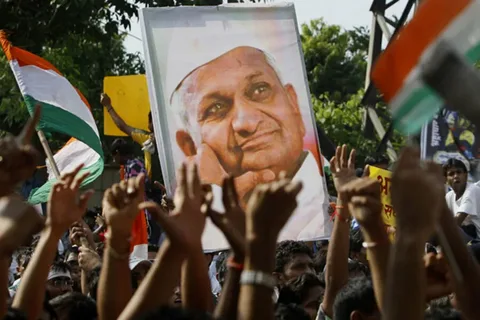
The government’s response was to arrest him. The arrest sparked an outpouring of popular anger across the country, and political parties cutting across the ideological spectrum united in their condemnation. From the BJP to the CPM, thousands demonstrated in the streets of state capitals and other urban centres in support of the anti-corruption crusader.
Thousands of flag-waving supporters cheered the 74-year-old as he walked from the gates of Delhi’s Tihar Jail, smiling and waving, leading the ecstatic crowds in chants of “Hail Mother India” and vowing to pursue his hunger strike protest until India was corruption-free. The scenes were extraordinary. A man who had just been released from prison walked back into a crowd of hundreds of thousands and they roared.
Anna Hazare broke his fast after twelve days when MPs expressed support for proposed changes to anti-corruption legislation. Doctors said his condition was stable, describing him as “dehydrated and exhausted,” and he was placed on a liquid diet before gradual recovery. It was not a complete victory, but it was a watershed moment.
The Nature of the Anti-Corruption Movement
The nature of the anti-corruption movement led by Anna Hazare was deeply Gandhian peaceful, principled, and built entirely on moral pressure rather than political power. The movement demonstrated that Gandhian methods of non-violent resistance still had the power to shake the foundations of the world’s largest democracy.
It was also genuinely popular in a way that most political movements are not. Students, professionals, housewives, retired soldiers, software engineers, farmers people from every background joined the protests. Social media amplified the movement at a speed that no previous Indian protest had experienced. Candle marches happened in cities across the country and among Indian diaspora communities in the United States, United Kingdom, and Australia.
The anti-corruption movement was not merely about one bill. It was an expression of collective frustration with a political class that had treated public office as a private opportunity. Anna Hazare gave that frustration a face, a voice, and a non-violent path.
Quotes and Statements
During the peak of the protest, Prime Minister Manmohan Singh called the hunger strike campaign “totally misconceived” and “deliberately confrontational,” insisting that parliament not street protests was the appropriate place to change laws. His address to parliament was repeatedly interrupted by cries of “shame” from the opposition benches.
Anna Hazare, characteristically, disagreed. He said in a recorded message to supporters: “My dear countrymen, the second freedom struggle has begun, and now I have also been arrested. But will this movement be stopped by my arrest? No, not at all. Don’t let it happen.”
The language was intentional. Calling it a “second freedom struggle” positioned the anti-corruption movement not as a political campaign but as a moral continuation of India’s independence movement. It was a framing that resonated because for millions of Indians, the corruption of the political class felt like a betrayal of everything that independence was supposed to mean.
Impact of the Movement
The impact of the anti-corruption protest was immediate and lasting. The government, under immense public pressure, agreed to include civil society representatives in the drafting committee for the Lokpal Bill. After a long struggle, the bill was eventually passed on 1st January 2014, though it was yet to be fully implemented.
The movement also changed India’s political landscape in ways no one predicted. Arvind Kejriwal, one of Anna Hazare’s closest associates during the protest, eventually broke from the movement to found the Aam Aadmi Party which went on to win multiple elections in Delhi. The anti-corruption sentiment channelled by the Anna Hazare protest became a political force in its own right.
The movement also proved that digital-age civil society could create accountability in ways that opposition parties alone could not. It set a template for large-scale peaceful protest in India that activists, students, and ordinary citizens would draw on repeatedly in the years that followed.
Anna Hazare and Cricket: An Unexpected Connection
Many people search for a connection between Anna Hazare and cricket and there is an indirect one worth noting. In 2011, police denied Hazare permission to fast near a cricket stadium, insisting on conditions including limiting attendance to five thousand people and capping the hunger strike at three days. Hazare refused all conditions. The standoff itself became news, with the protest site at Jantar Mantar drawing crowds that rivalled those at major cricket matches. In a country where cricket is a religion, the comparison was not lost on commentators an old man sitting in silence drew more national attention than almost any sporting event that year.
2026: The Legacy Lives On
The Anna Hazare anti-corruption protest continues to inspire. In July 2026, when educationist and activist Sonam Wangchuk began a hunger strike at Jantar Mantar demanding education reform and the resignation of India’s Education Minister over the NEET paper leak scandal, it was Anna Hazare who publicly called on the government to respond. Hazare said in a video message: “The government should not test his limits. Say yes or no to his demands, but what is wrong in holding discussions?”
Police forcibly transferred Wangchuk to a hospital in New Delhi after his health deteriorated during a 20-day hunger strike tied to India’s viral Cockroach Janta Party movement for education reform, with authorities tightening security around New Delhi’s Jantar Mantar, where Wangchuk had been camped along with students demanding the resignation of the Education Minister after allegations that exam papers were leaked in advance.n
The echoes of 2011 were unmistakable. Once again, Jantar Mantar. Once again, a determined activist refusing food in protest. Once again, an Indian government facing a public demanding accountability. The nature of the anti-corruption movement patient, principled, non-violent had not changed.
Conclusion
Anna Hazare is not a politician, a billionaire, or a celebrity. He is a man from a small Maharashtra village who chose to live simply, work honestly, and speak loudly when it mattered most. His anti-corruption protest of 2011 was not just a demand for the Jan Lokpal Bill it was a reminder that democracy belongs to the people, not only to those who hold power.
His Anna Hazare hunger strike changed the terms of political conversation in India. It forced a government to acknowledge civil society. It gave birth to new political formations. It showed a generation of Indians that peaceful resistance, done with conviction, still works.
More than a decade later, as new activists continue to fast at the same protest grounds in New Delhi, his name keeps being invoked. That is not coincidence. It is because the problem he identified deep, systemic corruption eroding the foundations of democratic life has not gone away. And neither has the spirit of the anti-corruption movement he started.
FAQs
Why is Sonam Wangchuk protesting?
Sonam Wangchuk, the 59-year-old engineer and education reformer who inspired the film 3 Idiots, began an indefinite hunger strike in June 2026 at Jantar Mantar in New Delhi to demand the resignation of India’s Education Minister Dharmendra Pradhan. His protest was directly connected to the NEET examination paper leak scandal, in which thousands of students across India were affected by alleged advance leaks of competitive exam papers. The movement also called for sweeping reforms to India’s examination system and compensation for the families of students who died by suicide in connection with the leaks or their exam results. His hunger strike, tied to the viral Cockroach Janta Party movement which ironically took its name from a Supreme Court Chief Justice’s comparison of unemployed youth to cockroaches gained enormous national attention as his health deteriorated over more than twenty days.
What is the biggest protest in India?
The Anna Hazare anti-corruption protest of 2011 is widely considered one of the largest and most impactful civil society protests in independent India’s history. At its peak, demonstrations were held simultaneously in hundreds of cities and towns across the country, with tens of thousands gathered at Jantar Mantar in New Delhi alone. Supporters spilled into the streets in Mumbai, Chennai, Kolkata, Hyderabad, and dozens of smaller cities, while Indian communities abroad held solidarity marches. The movement was unique because it crossed every social boundary rich and poor, urban and rural, young and old, all mobilised around a common demand for accountability. In sheer geographic spread, emotional intensity, and political impact, the anti-corruption movement led by Anna Hazare stands as a defining moment of mass mobilisation in post-independence India.
What is the reason for corruption in India?
Corruption in India is a deeply rooted, multi-layered problem with structural, historical, and institutional causes. First, weak enforcement mechanisms have historically meant that powerful individuals could act with near-total impunity the absence of an independent and powerful Lokpal for decades is a perfect example. Second, the bureaucratic system inherited at independence created multiple layers of government approval for basic services, giving officials enormous discretionary power that opened the door to bribery and rent-seeking behaviour. Third, the high cost of election campaigns in India has long driven politicians to raise illegal funds, creating a cycle in which public office becomes a means of recovering political investment rather than serving citizens. Fourth, judicial delays mean that corruption cases can stretch on for decades, effectively removing any real deterrent.