
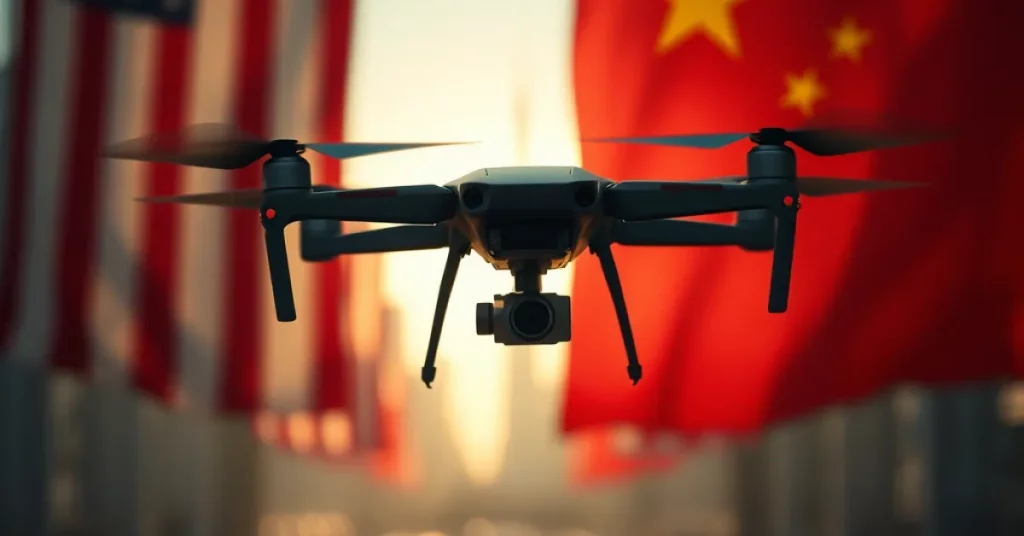
The United States has taken one of its most significant steps yet in its ongoing technological standoff with China. The US government bans DJI drones and all other new Chinese-made drones from entering the American market, marking a decisive moment in the years-long debate over national security, airspace control, and the dominance of Chinese technology in American skies.
This is not a sudden decision. It is the result of years of warnings, legislative pressure, court battles, and regulatory action that finally converged at the end of 2025 and into 2026. Whether you are a drone pilot, a business owner, a farmer, or simply someone following the US-China technology rivalry, this story matters and it is far from over.
Background: How the US Got Here
The concerns about Chinese-made drones did not start overnight. As far back as 2017, the US Army quietly stopped using DJI drones in certain operations, citing cybersecurity concerns. The US Interior Department followed, grounding its entire fleet of DJI aircraft over fears that the drones were transmitting sensitive data back to China.
By 2019, Congress had taken formal notice. Lawmakers included a provision in the National Defense Authorization Act (NDAA) that prohibited the Pentagon from purchasing Chinese-made drones for military operations. It was a clear signal that Washington viewed Chinese drone technology as a threat not just a competitor.
In 2020, the Commerce Department placed DJI on its Entity List, a trade blacklist that required American companies to obtain government licenses before doing business with DJI. The following year, the US Treasury Department added investment restrictions. Then in 2022, the Department of Defense formally listed DJI among companies allegedly linked to the Chinese military. DJI disputed that characterization fiercely, but a federal judge upheld the Pentagon’s decision in September 2025, ruling that the evidence of DJI’s contributions to China’s defense industrial base was substantial.
The writing was on the wall. The FCC foreign drone ban was coming it was only a matter of when.
The FCC Foreign Drone Ban: What Happened in December 2025
On December 22, 2025, the Federal Communications Commission made it official. The FCC announced that it would ban all new foreign-made drone modelsincluding those from DJI and Autel Robotics — from receiving the equipment authorization required for legal import, marketing, and sale in the United States.
<cite index=”1-1″>The FCC said that allowing foreign-made unmanned aircraft systems and their component parts to be sold in the US “undermines the resiliency of our UAS industrial base, increases the risk to our national airspace, and creates a potential for large-scale attacks during large gatherings.”</cite> The agency specifically pointed to upcoming events including the 2026 FIFA World Cup and the 2028 Summer Olympics in Los Angeles as reasons for urgent action.
<cite index=”7-1″>The FCC said the review found that all drones and critical components produced in foreign countries — not just by the two Chinese companies posed “unacceptable risks to the national security of the United States and to the safety and security of US persons.”</cite>
This is how the FCC foreign drone ban works in practice. In the United States, any device that uses radio-frequency components must receive an FCC equipment authorization before it can be legally sold or imported. By adding foreign-made drones to its “Covered List” a registry of equipment deemed to pose unacceptable national security risks the FCC effectively shut the door on any new DJI models or other foreign drone products from entering the American market through standard channels.
The banned drone list now includes new models from DJI, Autel Robotics, HoverAir, and other foreign manufacturers. Critically, the ban does not make existing, already-authorized drones illegal to own or fly. <cite index=”6-1″>There is not a blanket ban that makes DJI drones illegal to own or fly in the US. But there is a major restriction in place: new foreign-made drone models can no longer move through the normal FCC equipment authorization pathway needed for legal import, marketing, and sale.</cite>
The Partial Reversal: US Reverses Foreign Drone Ban But Only for Some
Just two weeks after the initial announcement, the story took a turn. On January 7, 2026, the US government partially walked back its sweeping restrictions. <cite index=”10-1″>The FCC partially reversed its broad ban on foreign-made drones but maintained the prohibition on China’s DJI due to national security concerns. New exemptions permit the sale of drones and components on the Pentagon’s “Blue List” and US-manufactured drones meeting a 65% domestic content threshold until 2027.</cite>
So what does it mean when people say the US reverses foreign drone ban? It is important to be precise here. The reversal was not a full rollback. It was a targeted set of exemptions that opened a narrow pathway for certain non-Chinese drone makers to continue operating in the US market temporarily. <cite index=”5-1″>This exemption was specifically carved out for drones made by US allies or companies participating in US-approved security programs. For example, models from France’s Parrot, Switzerland’s Wingtra, and US-based firms like Teledyne FLIR and ModalAI were allowed to continue importing new units through 2026.</cite>
DJI and Autel received no such relief. They remain fully on the FCC’s Covered List, with no grace period or exemption pathway currently available. The partial reversal benefited allied-nation drone makers and companies with Pentagon-vetted supply chains not Chinese manufacturers.
The Banned Drone List: Who Is Affected?
The banned drone list under the FCC foreign drone ban captures a broad range of products, but its real impact is concentrated in Chinese-made drones. Here is who is affected and how.
Fully Restricted (New Models Cannot Be Sold or Imported): DJI the world’s largest drone manufacturer, holding approximately 70% of the global consumer drone market is the most prominent name on the list. New DJI drone models cannot receive FCC authorization, meaning they cannot legally enter the US market. Autel Robotics, another major Chinese drone maker, faces the same restrictions.
Partially Exempted (Temporary Relief Until End of 2026 or 2027): Drones on the Department of Defense’s Blue UAS Cleared List, and products meeting the 65% domestic content standard, received conditional exemptions. These include select models from European and allied-nation manufacturers that passed rigorous national security reviews.
Not Affected: <cite index=”3-1″>DJI can still import and sell all the drones it has already been importing and selling. Existing drones like the Mini 5 Pro and the Mavic 4 Pro all the way back to classics like the Mavic 2 Pro are all still eligible for import and sale.</cite> Consumers who already own DJI drones can continue flying them without any legal issues.
DJI Drone Ban 2026: The Company Fights Back
DJI has not accepted these restrictions quietly. The company called the FCC’s decision “disappointing” and said that concerns about its data security “have not been grounded in evidence and instead reflect protectionism, contrary to the principles of an open market.”
<cite index=”16-1″>DJI has already pushed back, filing a legal challenge that argues the restrictions unfairly limit competition and deny US customers access to its newest technology.</cite> The lawsuit was filed with the argument that the FCC exceeded its statutory authority in adding consumer electronics to the Covered List in the way it did.
DJI’s US ban update took another serious turn in April 2026. <cite index=”11-1″>The Pentagon made it clear that this conclusion wasn’t reached lightly or based only on publicly available concerns about data security or supply chains. Instead, it said the determination relied on both classified and unclassified intelligence, including a classified annex that was submitted to Congress as recently as April 3, 2026.</cite> That revelation significantly raised the stakes of the debate and made it far harder for DJI to argue that the ban was based on insufficient evidence.
As of mid-2026, DJI remains on both the FCC’s Covered List and the Pentagon’s list of Chinese military-linked companies. <cite index=”14-1″>DJI is still on the FCC Covered List, so new models cannot be imported into the US, but every drone already here keeps working. Firmware and security updates are now confirmed through at least January 1, 2029 under the latest FCC notice.</cite>
Quotes
FCC on the threat landscape: <cite index=”9-1″>”Criminals, terrorists, and hostile foreign actors have intensified their weaponization of these technologies, creating new and serious threats to our homeland,” the FCC said in its formal notice.</cite>
DJI’s response: “Concerns about DJI’s data security have not been grounded in evidence and instead reflect protectionism, contrary to the principles of an open market,” a DJI spokesperson said following the initial ruling.
US District Judge Paul Friedman, upholding the Pentagon blacklist: <cite index=”22-1″>”Whether or not DJI’s policies prohibit military use is irrelevant. That does not change the fact that DJI’s technology has both substantial theoretical and actual military application.”</cite>
Impact: What the DJI US Ban Means for Americans and the World
The real-world impact of the US banning Chinese drones is already being felt across multiple industries. Farmers, construction companies, public safety agencies, filmmakers, and real estate photographers have all relied heavily on DJI equipment for years. <cite index=”2-1″>DJI alone commands about 70% of the global market, according to data from market research firm Research and Markets.</cite> Replacing that technology infrastructure will not happen quickly or cheaply.
For American businesses, the DJI drone ban 2026 creates an immediate procurement challenge. There are simply not enough affordable, high-quality alternatives to DJI in the current US market. <cite index=”3-1″>The reality is that there is still a significant gap when it comes to affordable, high-quality prosumer drones from non-Chinese brands.</cite> American manufacturers like Skydio are ramping up production, but they are not yet able to match DJI’s range, pricing, or ecosystem at scale.
Globally, the move signals a broader shift in how the United States is approaching technology supply chains. Chinese-made drones have become a dominant tool in modern warfare, as seen in Russia’s use of modified DJI systems in Ukraine. The US is clearly drawing a line between what it considers commercial technology and what it views as a potential instrument of foreign intelligence gathering or military utility.
For China, the ban represents another significant loss of market access in a high-value technology sector. DJI is not just a drone company it is a symbol of China’s ability to produce world-class consumer technology. Blocking it from the US market sends a message that goes far beyond aviation policy.
Conclusion: What Comes Next
The DJI US ban update heading into the second half of 2026 points to a market that is in transition but not yet resolved. The FCC’s exemptions for some foreign drones expire at the end of 2026, and no one knows yet whether they will be extended, eliminated, or replaced with something more permanent.
DJI’s legal challenge is still moving through the courts, and it is possible though far from certain that a court ruling could force some adjustment to how the ban is implemented. The classified intelligence that the Pentagon cited in April 2026 makes a full reversal less likely, but the commercial pressure from American industries dependent on drone technology is real and growing.
What is clear is this: the era of unrestricted access to Chinese-made drones in the United States is over. The US government bans DJI drones from its future market, and while existing owners can keep flying their machines, the pipeline for the next generation of Chinese drone technology entering America has been shut down possibly for good.
The broader US-China technology rivalry will continue to shape this story. Whether it ends in a permanent ban, a negotiated framework, or a US drone industry capable of filling the gap on its own, the decisions made in the coming months will define America’s skies for years to come.
Frequently Asked Questions
Does the US military use Chinese drones?
No — the US military has not used Chinese-made drones in official operations for years. The US Army stopped using DJI drones in 2017 after internal cybersecurity assessments flagged concerns about data transmission and potential intelligence exposure. Congress followed up in 2019 with a provision in the National Defense Authorization Act that formally prohibited the Pentagon from purchasing any Chinese-made drones for military use. Since then, the Department of Defense has actively invested in building a domestic drone supply chain through programs like the Blue UAS Cleared List, which vets and approves American-made or allied-nation drone platforms for official military and government use. While individual service members or contractors may have used DJI drones in unofficial or improvised capacities particularly given the drone’s widespread availability the official US military position has been to actively move away from Chinese drone technology.
Is DJI still blacklisted in the US in 2026?
Yes — as of mid-2026, DJI remains blacklisted across multiple US government lists. The company sits on the FCC’s Covered List, which means no new DJI drone models can receive the equipment authorization required for legal import or sale in the United States. DJI is also still on the Pentagon’s Section 1260H list of companies allegedly linked to China’s military, a designation that was upheld by a federal court in September 2025. Additionally, DJI remains on the Commerce Department’s Entity List, where it was placed in 2020 over alleged involvement in surveillance activities against Uyghur Muslims in Xinjiang. DJI has filed legal challenges against multiple listings, and in early 2026 it sued the FCC directly, arguing the agency exceeded its authority.
Who has more drones the USA or China?
This is a question with two very different answers depending on whether you are talking about consumer drones or military drones. In the consumer and commercial drone market, China dominates overwhelmingly. DJI alone holds approximately 70% of the global consumer drone market, and Chinese manufacturers collectively produce the vast majority of the world’s commercially available drones. The United States has far fewer domestic drone manufacturers capable of competing at scale, which is one of the core problems driving the ban there is currently no American alternative that can replace DJI in terms of price, performance, and product range. In terms of military drones, the picture is more complex. The United States has invested heavily in sophisticated military unmanned aerial vehicles, including long-range surveillance and strike drones like the MQ-9 Reaper and the RQ-4 Global Hawk. China has developed its own military drone fleet, including the Wing Loong and CH series, and has exported them to numerous countries.