

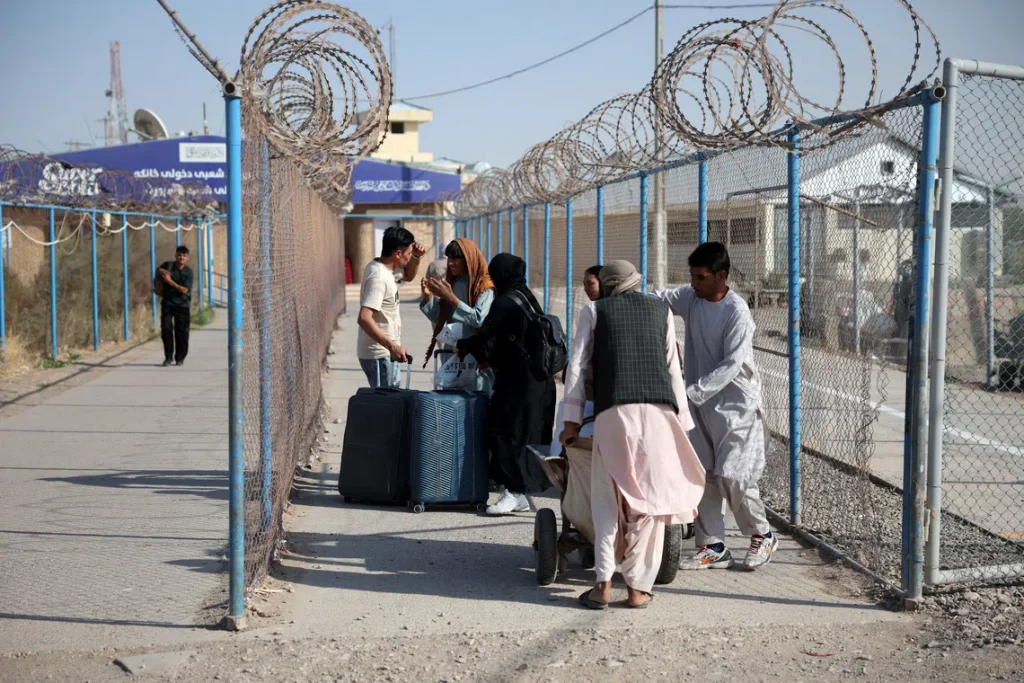

A Border Crossing Overwhelmed by Returnees
Thousands of Afghan migrants are walking back across the Islam Qala border into Afghanistan every day, driven out of Iran not by choice but by necessity. Local officials say voluntary returns have surged sharply in recent weeks. Most of these families are arriving with almost nothing.
For years, Iran offered Afghans an escape from poverty and from Taliban rule at home. That equation has now flipped. A collapsing economy, a fractured currency, and the fallout of the recent conflict with the United States and Israel have made staying in Iran harder than going back to Afghanistan.
How Iran Became Unlivable for Many Afghan Families
For decades, Iran’s larger and more industrialised economy gave Afghans a way out of hardship. Many built new lives there after fleeing war, and again after the Taliban’s return to power in 2021.
That refuge is disappearing. The Iranian rial has lost much of its value, wiping out savings that families had built up over years of work. Wages that once supported a household now barely cover food and rent.
One returning migrant, Mohammad Saeed, fled to Iran with his parents and siblings the year the Taliban retook Kabul. He and his family came back this month with almost nothing left. He said his family’s savings, held in rial, lost more than two-thirds of their value once the currency fell.
Traders who once profited by reselling goods in Iranian bazaars say that business has dried up completely. What is left, several returnees said, is low-paid day labour, often at the same rate they were earning a year ago, if the work is available at all.
Women and Girls Face the Harshest Return
The hardest part of this return is what awaits women and girls once they cross back into Afghanistan. Since 2021, the Taliban has barred girls from secondary school and university, restricted women from most forms of work, and limited how freely they can travel without a male guardian.
United Nations data cited in recent reporting suggests roughly half of Afghan women now leave their homes only once or twice a month under these restrictions. For mothers who kept their daughters in Iran specifically to protect their access to education, the decision to return is not really a choice at all. It is a trade-off between hunger in Iran and lost freedom in Afghanistan.
One young woman, speaking about the education and friendships she had built in Iran, said plainly that she would go back if she could.
What Officials at the Border Are Seeing
At the Islam Qala crossing in Herat province, officials describe a steady, near-constant flow of returning families. Document checks and registration are being carried out from makeshift shipping containers set up along the border.
Abdul Ghani Qazizadeh, a senior Taliban official stationed at the crossing, said dozens of families are returning voluntarily each day. He said many Afghan workers in Iran have gone unpaid for months, with employers withholding wages before they left. “Everyone complains that their money has been left behind,” he said.
The Department of Migrants and Returnees at Islam Qala has also recorded a sharp rise in daily crossings compared with earlier in the year, with local officials pointing to fear of further conflict as an added reason people are leaving Iran now rather than waiting it out.
A Regional Pattern That Has Been Building for Years
This is not an isolated moment. Since the Taliban takeover in 2021, both Iran and Pakistan have carried out large-scale returns of Afghan nationals, through a mix of voluntary departures, deportation campaigns, and shifting legal deadlines for undocumented migrants.
Pakistan has repeatedly set and revised deadlines for Afghans without valid documentation to leave, with hundreds of thousands returning through crossings such as Torkham in successive waves since 2023. Iran, for its part, intensified deportations through 2025, with UN agencies recording well over a million returns from Iran alone in a single year.
What is different now is the scale and speed tied directly to Iran’s economic and security crisis, rather than to policy deadlines alone. Aid organisations tracking the situation have found that only a small share of recently returned families still have any savings left, and that average incomes have fallen sharply compared with before the crisis.
Why This Matters Beyond Afghanistan’s Borders
The scale of this return is straining Afghanistan’s already fragile capacity to absorb people. Aid groups and Taliban administration officials alike have flagged shortages of housing, jobs, and basic services in the border provinces where most returnees first arrive.
It also puts renewed pressure on international donors and the UN refugee agency, which has already named Afghans as the single largest group in need of global resettlement heading into 2026. Every family that returns to a system with limited services adds to a humanitarian caseload that aid budgets have struggled to keep pace with.
For the region, it is a reminder that Afghanistan’s neighbours were never meant to be permanent hosts, and that economic and security shocks anywhere in the region can quickly reroute hundreds of thousands of lives at once.
What Comes Next
Aid agencies expect the pace of returns from Iran to stay high as long as the rial remains weak and job prospects remain thin. Much will depend on whether Iran’s economy stabilises in the coming months, and on whether the Taliban administration can expand support for returnee families in Herat, Farah, and other border provinces.
For families like Saeed’s, the immediate future is about rebuilding from almost nothing. For Afghan women and girls among the returnees, it is about adjusting to restrictions many had hoped to leave behind for good.
Frequently Asked Questions
Who is Afghanistan’s best friend?
Afghanistan does not have a single formally declared “best friend” in diplomatic terms, and the Taliban government’s international relationships remain limited since most countries have not granted it full recognition. Pakistan, China, and Iran have maintained the most consistent working relations with Kabul on trade and security matters, though these ties have also been marked by tension, including friction with Pakistan over border security and the treatment of Afghan refugees. Russia and several Central Asian states have also expanded economic and diplomatic contact with the Taliban administration in recent years.
Is the US deporting Afghan refugees?
Yes. Since early 2025, US authorities have ended Temporary Protected Status for thousands of Afghan nationals and have carried out a rising number of removals to Afghanistan, according to federal removal data. Deportations climbed from the hundreds in 2023 to several hundred a year by 2025, and thousands more Afghans who were previously shielded from removal now face the possibility of being sent back to a country still under Taliban rule.
What is the deadline for Afghan refugees to return to Pakistan?
Pakistan has set and revised multiple deadlines for undocumented Afghans since 2023, and there is no single fixed date that has held permanently. Successive deadlines have targeted Afghans without legal documentation, including holders of Afghan Citizen Cards, with each extension typically followed by a renewed push toward enforcement. Afghans in Pakistan are advised to check current guidance from Pakistani authorities or UNHCR directly, since the timeline has changed repeatedly.