The History of Indian Film Music and the Journey of Cinema is a Long and Fascinating Tale
By Iftikhar Ahmed
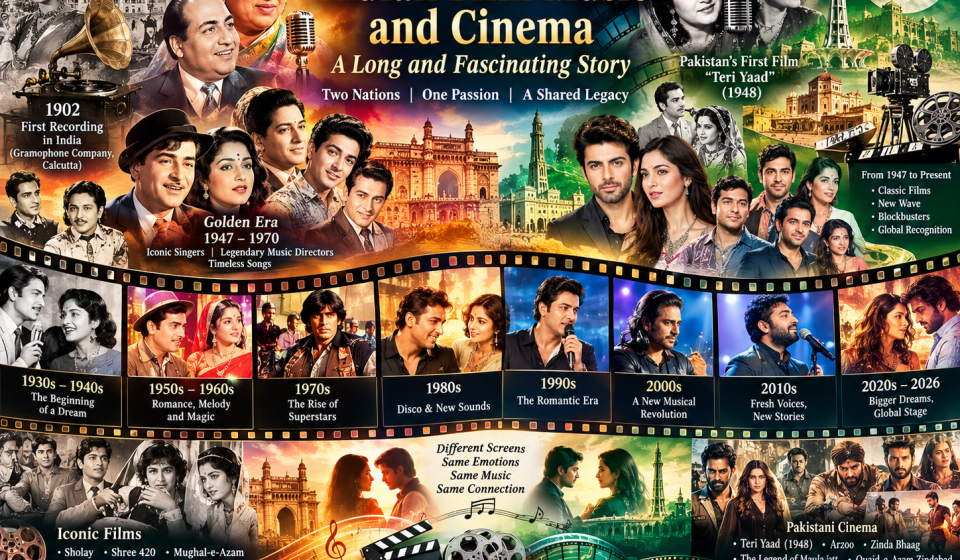
The history of Indian film music and cinema from the year 1902 to the present is a long and fascinating tale that began in the late nineteenth century when the concept of sound recording was still rare in India. The regular recording of songs in India began in 1902 when Frederick William Gaisberg, a recording engineer for the Gramophone Company, came to Calcutta with a recording machine and completed India’s first recording in November 1902. The first recording took place on 8 November 1902 and was of a fourteen-year-old dancer named Soshi Mukhi, who became the first Indian artist to be recorded on Indian soil. The next day, the famous singer Gauhar Jaan also made her first recording, who was later called the first famous artist of the Indian gramophone industry, and she recorded approximately six hundred songs and sang in more than ten languages. However, although the first recording in India itself took place in 1902, some songs in Indian languages had been recorded earlier in 1899 in England, and therefore some sources state the beginning of recording history as 1899, but the year of the first recording on Indian soil is 1902. Historical records about the recording of Indian songs in England between 1899 and 1902 are very limited, and currently verified information is primarily from recordings made in 1899 at the Gramophone Company’s studio in London, which is the earliest confirmed Indian sound recording. Those who participated in these recordings were primarily some Indians who were residing in London at the time, about whose specific backgrounds detailed information is currently unavailable, and among them was Dr. Harnamdas, who sang approximately ten songs, most of which were taken from the Ramayana, and Captain Bholanath recorded two parts of the Ram Mandal opera, Hazrat recorded three couplets of Ghalib, and Ahmed recorded the most records, including verses of the Quran and Persian poetry such as Zahir Faryabi and Ferdowsi and Hafiz and a speech about the gramophone. Existing historical records do not include information about specific musicians or lyricists, and according to the May 1899 catalogue, the recorded repertoire included Hindi and Urdu and Persian and Gurmukhi and Arabic, including excerpts from the Ramayana and Sikh prayers and Ghalib’s couplets, etc., but unfortunately the physical copies of these early recordings have not been found to date, so further verification of the specific details of the songs cannot be made. It is noteworthy that the Indian songs recorded in London in 1899 have not been found to date, and the original tapes or records of all these recordings have been lost, therefore the specific names of the songs cannot be verified, and only from the May 1899 catalogue of the Gramophone Company is it known what type of material was recorded at that time, according to which the types of material recorded at that time included Hindu religious recitations totaling fifteen, most of which were excerpts from the Ramayana, and Sikh hymns were two, which were hymns of Guru Nanak, and Urdu poems and speeches were five, which also included couplets of Mirza Ghalib, as well as a speech on the introduction of the gramophone, and Arabic recitations were two, including a recitation of the Quran, and besides this, the catalogue states that the singers of that time sang or recited in Persian and Hindi and Urdu. In the period between 1899 and 1902, the recording of Indian songs took place in two main phases, one the 1899 recording in London and the other the 1902 recording in Calcutta, however finding complete details of the artists and songs and musicians of both phases is difficult, especially as no copy of the 1899 recorded material has been found to date.
The period from 1947 to 1970 is called the golden age of Indian film music, and during this period films reflected post-independence sentiments and romance and modernity, and such a trinity of singers and musicians and lyricists emerged that set a standard for future generations. Among the most prominent playback singers of this era were Lata Mangeshkar, who was the most prominent female singer of this era and whose voice had a deep impact on film music, and Mohammed Rafi, who from 1950 to 1969 was the voice of every major actor, and Kishore Kumar, who was successful both as an actor and singer and after the 1969 film Aradhana he became more popular than Mohammed Rafi, and Mukesh, who was the voice of Raj Kapoor’s films, and Manna Dey, who had mastery of classical music, and Talat Mahmood, who possessed a soft and emotionally captivating voice, and Geeta Dutt, who was a singer discovered by S.D. Burman, and Asha Bhosle, who along with O.P. Nayyar gave many popular songs, and Shamshad Begum, who was a popular singer of the 1950s especially with Naushad, and Mubarak Begum, who sang in films like Devdas 1955 and Madhumati 1958. Among the musicians of this era were Shankar Jaikishan, who were the duo that ruled Bollywood from 1949 to 1971 and gave timeless music for Raj Kapoor’s films, and Naushad, who was famous for music based on classical ragas and who introduced Mohammed Rafi in films like Baiju Bawra 1952, and O.P. Nayyar, who was known for his unique rhythm and modern sound and who was banned by All India Radio for being too trendy, and S.D. Burman, who was the musician who introduced singers like Geeta Dutt and Hemant Kumar, and Madan Mohan, who was famous for his ghazals, especially his pairing with Lata Mangeshkar was very successful, and C. Ramachandra, who was active from 1942 and composed many comic songs for Kishore Kumar, and Salil Choudhury, who worked with artists like Kishore Kumar and Shailendra. Among the lyricists of this era were Shailendra, who wrote songs for Raj Kapoor’s films with Shankar Jaikishan, including Mera Joota Hai Japani from Shree 420 1955, and Hasrat Jaipuri, who was Raj Kapoor’s other important lyricist and was called the King of Romance, and Sahir Ludhianvi, who was a lyricist with progressive ideas and who highlighted social issues in his poetry, and Kaifi Azmi, who like Sahir was associated with the progressive movement and who wrote songs for films like Kagaz Ke Phool, and Majrooh Sultanpuri, who had a long career and who wrote many successful songs from Aar Paar 1954 to Yaadon Ki Baraat 1973, and Rajendra Krishan, who was famous for unique similes and metaphors, and S.H. Bihari, who along with O.P. Nayyar gave many successful songs. A special feature of this era was the singer-actor pairing; Mohammed Rafi’s voice became associated with actors like Dev Anand and Dilip Kumar and Shammi Kapoor and Guru Dutt, while Mukesh’s voice became the identity of Raj Kapoor. After 1970, the journey of Indian film music passed through several important stages, first the golden era of the 1970s and 1980s in which singers like Mohammed Rafi and Kishore Kumar and Lata Mangeshkar ruled, then the romantic era of the 1990s in which Nusrat Fateh Ali Khan and Alka Yagnik and Kumar Sanu dominated, and finally the contemporary era from 2000 onwards in which artists like A.R. Rahman and Sonu Nigam and Shreya Ghoshal and Arijit Singh introduced new dimensions. In the 1970s, Mohammed Rafi sang timeless songs like Kuchh To Log Kahenge and Hum Hain Rahi Pyar Ke, and Kishore Kumar’s star shone and he sang songs like Yeh Dosti from Sholay 1975 and Khaike Paan Banaraswala from Don 1978, and Lata Mangeshkar remained at the forefront among female playback singers even in this decade, and Asha Bhosle’s popularity increased with songs from films like Caravan 1971 and Hare Rama Hare Krishna 1971. In the 1980s, Alka Yagnik emerged and soon began ruling millions of hearts with her melodious voice, and Anuradha Paudwal had been active since 1973 but in the 1980s she reached the heights of fame with films like Aashiqui 1990, and Suresh Wadkar was a popular male singer. In the 1990s, Kumar Sanu became the most successful singer and gained fame with songs from Aashiqui 1990, and he also set a Guinness World Record for recording the most songs in twenty-four hours, and Udit Narayan became popular with songs from Qayamat Se Qayamat Tak 1988 and in the 1990s he competed with Kumar Sanu, and Sonu Nigam emerged in the late 1990s and his fame came from Bewafa Sanam 1995, and Usha Uthup became popular in the 1980s with songs like Rambha Ho, and Mithun Chakraborty was a popular male singer of the 1990s. From 2000 to the present, Shreya Ghoshal has been the most successful female singer of the 2000s and is called the Nightingale of India, and Arijit Singh has been the most popular singer of Hindi films since 2010 and his songs Tum Hi Ho and Channa Mereya became very famous, and Shankar Mahadevan along with Shreya Ghoshal and others gave many hit songs, and Sukhwinder Singh also sang many popular songs, and Neha Kakkar is a popular singer of recent years. Among the musicians of the 1970s, R.D. Burman was the most experienced musician of this decade and introduced new voices in films like Caravan 1971, and Laxmikant Pyarelal were one of the most successful musician duos of the 1970s and 80s and composed songs for films like Bobby 1973 and Satyam Shivam Sundaram 1974, and Kalyanji Anandji composed songs for films like Purab Aur Paschim 1970 and Shor 1972, and Salil Choudhury composed songs for Anand 1971 including Maine Tere Liye Hi Saat Rang Ke Sapne Chune, and Madan Mohan composed songs for Heer Ranjha 1970. In the 1980s, Bappi Lahiri ruled, beginning with Disco Dancer 1982, and Shiv Hari emerged, and Anu Malik emerged in the late 1980s. In the 1990s, Nusrat Fateh Ali Khan composed songs for films like Miti Ki Mala 1993 and Aur Deewana 1997, and Jatin Lalit composed songs for films like Dilwale Dulhania Le Jayenge 1995 and Kuch Kuch Hota Hai 1998, and Alka Yagnik also composed, and Nadeem Shravan were one of the most successful musician duos of the 1990s and composed songs for Aashiqui 1990. From 2000 to the present, A.R. Rahman is a world-renowned musician who composed songs for Lagaan 2001 and Slumdog Millionaire 2008, and Pritam composed songs for films like Dilwale 2015 and Brahmastra 2022, and Amit Trivedi composed songs for films like Dev D 2009 and Queen 2013, and Vishal Shekhar composed songs for many successful films, and Salim Sulaiman also composed many popular songs. Among the lyricists from 1970 to the present are Gulzar, who received the most Filmfare Awards thirteen times and who wrote songs for Anand 1971, and Javed Akhtar, who won eight Filmfare Awards and who wrote songs for Lagaan 2001, and Anand Bakshi, who received forty-one nominations and who wrote songs for Sholay 1975, and Sameer, who wrote more than five thousand film songs including songs for Aashiqui 1990, and Prasoon Joshi, who wrote songs for Rang De Basanti 2006 and Bhaag Milkha Bhaag 2013, and Irshad Kamil, who is considered among the most successful lyricists of the present era. It is not possible to make a complete list of all films from 1902 to the present, but from the details of some important and famous films, one can gauge what kind of artists worked in different eras. Among the important films of the 1940s is Kismet 1943, whose hero was Ashok Kumar and heroine was Mumtaz Shanti, and it was a Bombay Talkies production and the director was Gyan Mukherjee, and this film was a blockbuster and is considered Indian cinema’s first classic thriller film, and its famous song Aaj Himalaya Ki Choti Se Phir Hum Ne Lalkara Hai was by Kavi Pradeep, and Anmol Ghadi 1946 is included, whose heroes were Surendra and heroine Noor Jehan and Suraiya, and it was a Mehboob Productions production and was the highest-grossing film of that year, and its story was a love story revolving around a poor boy and a rich girl, and Basant 1942 is included, whose heroes were Mumtaz Shanti and Ulhas, and in this film Madhubala worked on screen for the first time as a child, and its musician was Pannalal Ghosh, and it was the highest-grossing film of that time. In the 1950s and 1960s, Awaara 1951 is included, whose hero was Raj Kapoor and heroine Nargis and villain Pran, and it was an R.K. Films production and the story was written by Khwaja Ahmad Abbas, and its famous songs were Awaara Hoon and Ghar Aaya Mera Pardesi, and Shree 420 1955 is included, whose hero was Raj Kapoor and heroine Nargis, and it was an R.K. Films production and the story was by Khwaja Ahmad Abbas, and its famous songs were Mera Joota Hai Japani and Pyar Hua Iqrar Hua, and Gumrah 1963 is included, whose hero was Sunil Dutt and heroine Mala Sinha, and its musician was Ravi, and its famous song Chalo Ek Bar Phir Se Ajnabi Ban Jayen Hum Dono was by Sahir Ludhianvi. In the 1970s, Sholay 1975 is included, whose heroes were Dharmendra and Amitabh Bachchan and heroine Hema Malini and villain Sanjeev Kumar as Gabbar Singh, and the story was written by Salim Javed and G.P. Sippy produced it, and its famous songs were Yeh Dosti and Mehngai Dayain Khaye Jaat Hai, and Deewaar 1975 is included, whose heroes were Amitabh Bachchan and Shashi Kapoor and villain Pran, and the story was by Salim Javed. From 1980 to the present, in the Western era, the 1980s saw the rule of disco music represented by Bappi Lahiri, and in the 1990s A.R. Rahman revolutionized film music, and among important films in the 2000s are Kaho Naa Pyaar Hai and Kabhi Khushi Kabhie Gham and Lagaan and Dhoom 2, and in the 2010s are Dabangg and 3 Idiots and Dangal and women-centric films like Queen. From this brief review, it is evident that among production houses, Bombay Talkies and Mehboob Productions and R.K. Films gave many memorable films, and among storytellers, writers like Khwaja Ahmad Abbas and Salim Javed provided a strong foundation for films, and in music, each era had its own musicians and singers who made films timeless. Now speaking of Pakistan’s cinema, Pakistan became independent on 14 August 1947, and at that time Lahore was the only city where the tradition of filmmaking remained, but after partition, due to communal riots, all film studios in Lahore except Pancholi Studios were partially or completely burned down, and most non-Muslim artists and technicians migrated to Bombay, and in such a situation, continuing filmmaking in Lahore seemed difficult, but artists and producers and directors who came from Bombay to Lahore helped restart filmmaking in Lahore, and in less than a year, a film named Teri Yaad was presented for exhibition on 7 August 1948. Pakistan’s first film Teri Yaad was released in 1948, whose director was Sheikh Latif and in which Jehangir and Najma and Asha Posley acted, and the music was composed by Inayat Ali Nath, and the singers were Munawar Sultana and Asha Posley and Ali Bakhsh Zahoor. The lyrics of this film were written by Qateel Shifai, and from here his career as a lyricist began. In 1949, the first Punjabi film Pharey was released, whose director was Nazir Ahmed Khan and in which Suran Lata and M. Ismail and Nazar and Zainat acted, and the music was composed by Ghulam Ahmed Chishti, and the singers were Munawar Sultana and Inayat Hussain Bhatti. In the same year, Do Aansoo was made, which was released in 1950 and was Pakistan’s first film to celebrate a silver jubilee, and its director was Anwar Kamal Pasha and in it Santosh Kumar and Sabiha Khanum and M. Ajmal and Alauddin acted, and the music was composed by Mubarak Ali. In 1950, Beqarar was released, whose director was Nazir Ajmeri and in which Ragini and S. Gul and Shammi and Irshad Begum acted, and the music was composed by Ghulam Haider, and the lyrics were written by Arsh Lucknowi and Tufail Hoshiarpuri. In 1951, Chanway was released, which was directed by Noor Jehan herself and was her first directorial venture, and in it Noor Jehan and Ghulam Mohammed and Santosh Kumar acted, and the music was composed by Feroz Nizami, and the famous song Mundian Sialkotia was sung by Noor Jehan. In 1952, Dupatta was released, whose producer was Aslam Lodhi and director was S. Fazli, and in it Noor Jehan and Ajay Kumar and Sudhir and Yasmeen acted, and its timeless songs were Baat Hi Baat Mein and Chandni Raatein. In 1953, Gulnar was released, in which Noor Jehan and Santosh Kumar and Zarif and Shah Nawaz acted, and the music was composed by Ghulam Haider, and the songs were sung by Noor Jehan, including Ae Raat Zara Tham Tham Ke Guzar and Bachpan Ki Yaad Garu. In these early years, Qateel Shifai wrote memorable songs for films like Teri Yaad and Anarkali and Intezar and Koel and Jhoomer and Naila and Gulnar and Gumnaam, and he was awarded the Presidential Medal for Pride of Performance in 1994. Masroor Anwar wrote songs for Banjaran and Shararat and Badnaam, and then became part of the team of Waheed Murad and Pervez Malik and Sohail Rana, with whom he got the opportunity to write songs for Hira Aur Patthar and Armaan and Ehsan and Dooraha. Musician Sohail Rana composed music for films like Dooraha and Ehsan and Shehnai and Rootha Na Karo. Khwaja Khurshid Anwar composed music for 227 films, and his famous films include Intezar and Ghunghat and Chingari and Humraz and Mirza Jat and Shirin Farhad. In the 1960s, when in 1965 the exhibition of Indian films was banned on the other side of Wagah Border, there was a tremendous increase in the number of Pakistani films released, and in the 1970s this number exceeded one hundred. In 1975, Arzoo was released, in which Muhammad Ali and Zeba and Babra Sharif acted, and the music was composed by M. Ashraf, and the songs Jeevan Bhar Saath Nibhain Hum Dono and Tarasta Hai Yeh Dil Tujhe Pyar Kar Loon and Mere Hamdam Tujhe Pa Kar Qarar Aaya Hai became popular. In the same year, Zeenat was released, in which Shabnam and Shahid and Talish acted, and the music was composed by Naushad, and its famous song Rafta Rafta Woh Meri Hasti Ka Saman Ho Gaye was sung by Mehdi Hassan. In 1983, Dehleez was released, whose producer was Masood Qureshi and director was Javed Fazil, and in it Nadeem and Shabnam acted, and it received seven Nigar Awards. In the same year, Love Story was released, whose director was Nazrul Islam and in which Faisal Rehman and Leela and Talish and Nanha acted, and the music was composed by M. Ashraf, and the songs Saath Chalen Hum Dono and Neeli Neeli Aankhen Dohraen Afsana and Leela Leela Tu Hi Bata Kya Karoon became popular. In the same year, Kabhi Alvida Na Kehna was released, whose producer and director was Zafar Shabab, and in it Shabnam and Javed Sheikh and Sabita and Muhammad Rafi Khawar (Nanha) acted, and the music was composed by Amjad Bobby, and the songs Mera Pyar Bhi To Zindagi Bhi Hai Tu and Hum To Kahenge Chup Na Rahenge and Aaya Hoon Main Tujh Ko Lene and Apni Sanson Mein Tujh Ko Basa Loongi became popular. In 1991, the only successful Urdu film was Watan Ke Rakhwale, whose director was Hasnain and in which Nadeem and Sultan Rahi and Izhar Qazi and Nadira acted, and the lyrics were written by Habib Jalib and Javed Rahi, and the music was composed by Nazir Ali, and the songs Jeevan Ka Har Ek Pal Tere Naam Laga Doongi and Aankhen Milen Neenden Uren were sung by Hameera Channa. In 1992, Mr. 420 was the only successful Urdu film, whose producer was Pervez Kaleem and director and actor was Umar Sharif, and in it Madiha Shah and Ruby Niazi and Abid Ali acted, and the music was composed by M. Ashraf, and the songs Sohna Lagta Hai Man Mohna Lagta Hai and Oye Hoye Hoye Aankhon Ki Galiyon Mein Honton Ki Kaliyon Mein were sung by Tarannum Naz. In 2001, Khoey Ho Tum Kahan was released, whose director was Ajab Gul and in which Meera and Babar Ali and Deeba and Naghma acted, and the music was composed by Zain, and it received ten Nigar Awards including Best Film and Best Director and Best Actress and Best Actor and Best Musician. In 2013, Zindagi Bhaag and Waar were released, and Zindagi Bhaag was Pakistan’s first film nominated for the Oscars, and Waar earned more than 300 million rupees. In 2014, Na Maloom Afraad and 021 and Dukhtar were released, and in Na Maloom Afraad Javed Sheikh and Fahad Mustafa and Mohsin Abbas Haider acted, and this comedy film was successful at the box office. The year 2015 was somewhat better than the previous few years in terms of film production and release. In 2015, 23 Pakistani films were released, including Good Morning Karachi, Jalebi, Teacher, Insaf, Gujjar Pura Dina Da, Teen Bahadur, Ziddi Mityar, Wrong Number, Bazaar, Bin Roye, Gunahgar, Razia Phans Gayi Ghundon Mein, Karachi Se Lahore, Moor, Dekh Magar Pyar Se, Shah, Baghi Commando, Manto, Halla Gulla, Jawani Phir Nahi Ani, Swarangi, Sohna Gujjar and Sanam. Among the 23 films mentioned, Bin Roye, Halla Gulla, Jawani Phir Nahi Ani, Dekh Magar Pyar Se, Manto, Wrong Number, Moor and Karachi Se Lahore were quality films that people liked. The film Bin Roye was released not only in Pakistan but also in India, America, Britain, Canada, United Arab Emirates and many other countries. Two films of actor Humayun Saeed, Bin Roye and Jawani Phir Nahi Ani, became super hits. With the success of films, the trend of filmmaking also increased, and at present numerous new films are being made, including filmmaker and director Sangeeta’s Tum Hi To Ho, filmmaker Ijaz Kamran’s Blind Love, director Noor’s Ishq Positive, actor Moammar Rana’s directorial debut film Sikandar, director Pervez Kaleem’s Shoot Heart. In 2015, nearly 50 films from India were released. It is interesting that the exhibition of Indian films was banned in Pakistan. In 2016, Actor In Law was released, whose director was Nabeel Qureshi and in which Fahad Mustafa and Mahwish Hayat acted, and it was very successful. In 2017, Punjab Nahi Jaungi and Na Maloom Afraad 2 and Yalghaar were released, and Punjab Nahi Jaungi was very successful. In 2018, Jawani Phir Nahi Ani 2 and Parwaaz Hai Junoon and Teefa In Trouble were released, and in Teefa In Trouble Ali Zafar and Mahira Khan acted. In 2022, The Legend of Maula Jatt was released, whose director was Bilal Lashari and in which Fawad Khan and Humayun Saeed and Mahira Khan and Hamza Ali Abbasi acted, and it became Pakistan’s highest-grossing film and earned 396 crore rupees. In the same year, London Nahi Jaunga and Quaid-e-Azam Zindabad and Ghabrana Nahi Hai were released. In 2023, Money Back Guarantee and Teri Meri Kahaniyan and Super Punjabi and Huey Tum Ajnabi were released, and Money Back Guarantee was the highest-grossing film, earning 39 crore rupees. In 2024, Umar O Ayyar and Dagha Baz Dil and Mastani and Nabaligh Afraad and Kattar Karachi and Texali Gate and Leech and Glass Worker and Nayab and Poppay Ki Wedding were released, and Umar O Ayyar was the highest-grossing film, earning 13.90 crore rupees. In 2025, Love Guru and Deemak and Neelofar and Welcome to Punjab were released, and Love Guru earned 8.2 billion rupees and broke Maula Jatt’s record, and Deemak became Pakistan’s first horror film, earning 2.1 billion rupees, and Neelofar earned 1.5 billion rupees. In 2026, on Eid-ul-Fitr, Aag Lage Basti Mein and Bulla and Delhi Gate are being released, and in Aag Lage Basti Mein are Fahad Mustafa and Mahira Khan and Javed Sheikh and Tabish Hashmi, and in Bulla are Shaan Shahid and Mona Lisa and Saleem Sheikh, and in Delhi Gate are Yasir Khan and Shamoon Abbasi and Javed Sheikh and Roma Michael. Besides this, the television premieres of Love Guru and Neelofar and The Legend of Maula Jatt are also happening on Eid. From this entire history, it can be concluded that the cinemas of both India and Pakistan saw ups and downs in their respective journeys, and the artists and musicians and lyricists of both learned from each other and influenced each other, and despite partition, a deep relationship always remained between the cinemas of both.