
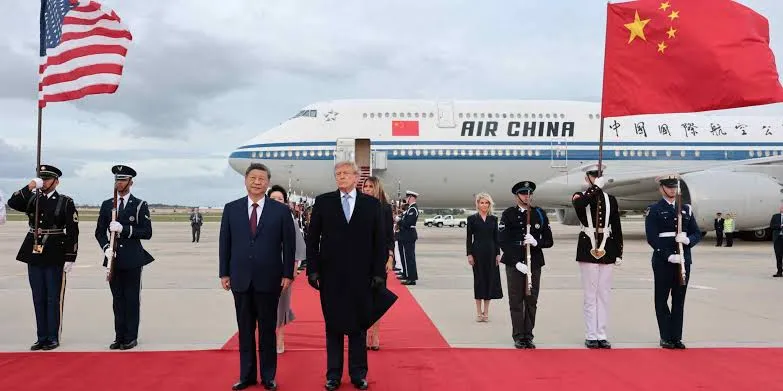
Trump Xi summit highlights trade, AI cooperation and efforts to stabilize US-China relations.
The Trump Xi summit came four months after the two leaders last met and marked Xi Jinping’s first visit to Washington in more than a decade.
The meeting was closely watched because of the continuing economic and geopolitical rivalry between the United States and China. However, the summit produced relatively few major new agreements and was dominated by diplomatic gestures, mutual praise and efforts to maintain stability in bilateral relations.
Trump and Xi agreed to extend their existing trade truce, while both sides signaled an interest in avoiding further escalation between the world’s two largest economic powers.
The leaders also exchanged gifts and spoke positively about the relationship between the American and Chinese peoples.
During a White House state dinner, Xi emphasized cooperation between the two countries and presented China’s growing global influence as something that could benefit the United States rather than pose an inherent threat.
“The friendship between the two peoples is a worthy cause that holds great promise,” Xi said, calling for the two nations to move forward together.
Xi also drew a comparison between Trump’s “Make America Great Again” slogan and China’s long-term goal of achieving the “Great rejuvenation of the Chinese nation.”
China’s strategic vision includes expanding its economic, industrial, technological and military capabilities and strengthening its position as a global power.
The Trump Xi summit took place against the backdrop of continued US efforts to restrict China’s access to certain technologies, investments and markets.
Washington has introduced various measures aimed at limiting China’s ability to obtain advanced technology and strengthening protections for US industries.
Despite those restrictions, China has maintained strong exports and continued developing sectors such as artificial intelligence and robotics.
China also remains an important global supplier of rare earth elements and other materials used by American industries.
These developments have given Beijing significant economic leverage in its relationship with Washington.
One notable element of the Trump Xi summit was the acknowledgment that the United States and China could potentially cooperate on managing the risks associated with artificial intelligence.
AI has become an increasingly important area of competition between the two countries, particularly in advanced computing, technology development and national security.
At the same time, both governments have expressed concerns about the potential risks created by rapidly developing AI systems.
The possibility of cooperation on AI safety therefore represents an area where Washington and Beijing could maintain dialogue despite broader strategic disagreements.
The Washington meeting was described as relatively muted compared with the highly choreographed diplomatic events that have accompanied previous Trump-Xi meetings.
The leaders exchanged compliments and emphasized the importance of stable relations, but several major disagreements between the two countries remained unresolved.
The Trump Xi summit therefore appeared focused more on maintaining stability than announcing sweeping changes in US-China relations.
Cui Hongjian, an international relations scholar at Beijing Foreign Studies University, told CNN that Xi’s decision to travel without a large group of business executives suggested that significant breakthroughs in trade and business relations had not yet been achieved.
Cui said both countries remained focused on stabilizing their political relationship.
Business and Trade Remain Key Challenges
Xi used his remarks to encourage the United States to remain open to Chinese companies and businesses.
Trump also highlighted the long history of trade and people-to-people ties between the United States and China.
“President Xi and I both understand that we represent different systems, but the ties between our people endure,” Trump said.
Despite the friendly rhetoric, significant differences remain over trade, technology, investment, industrial policy and China’s global ambitions.
Those disputes are likely to remain important factors in the relationship even as Washington and Beijing seek to prevent another major escalation.
White House Press Dispute Overshadows Summit
The summit also unfolded amid controversy surrounding Trump’s decision to restrict access for some news organizations covering the White House.
Major television networks did not broadcast the leaders’ meeting after reporters from CNN, MS Now and Politico were barred from the White House press pool.
A court later overturned the restrictions, but the dispute created an unusual backdrop for a major international summit.
The situation contrasted with the tightly controlled and government-approved coverage commonly seen in Chinese state media.
The Trump Xi summit demonstrated that Washington and Beijing can maintain diplomatic engagement despite their deep strategic rivalry.
The extension of the trade truce provides both governments with additional space to manage economic tensions, while discussions over AI create another potential channel for cooperation.
However, the summit did not resolve the fundamental disputes between the two countries.
Issues involving technology restrictions, trade, investment, industrial competition and China’s expanding global influence remain central to the relationship.
For Xi, the diplomatic tone of the Washington visit offered an opportunity to demonstrate China’s growing economic and technological strength while maintaining dialogue with the United States.
For Trump, the meeting provided another opportunity to emphasize trade ties and cooperation while keeping tensions with Beijing from escalating further.
The outcome leaves the US-China relationship in a period of cautious stabilization, with future negotiations likely to determine whether the diplomatic goodwill can translate into concrete agreements.