
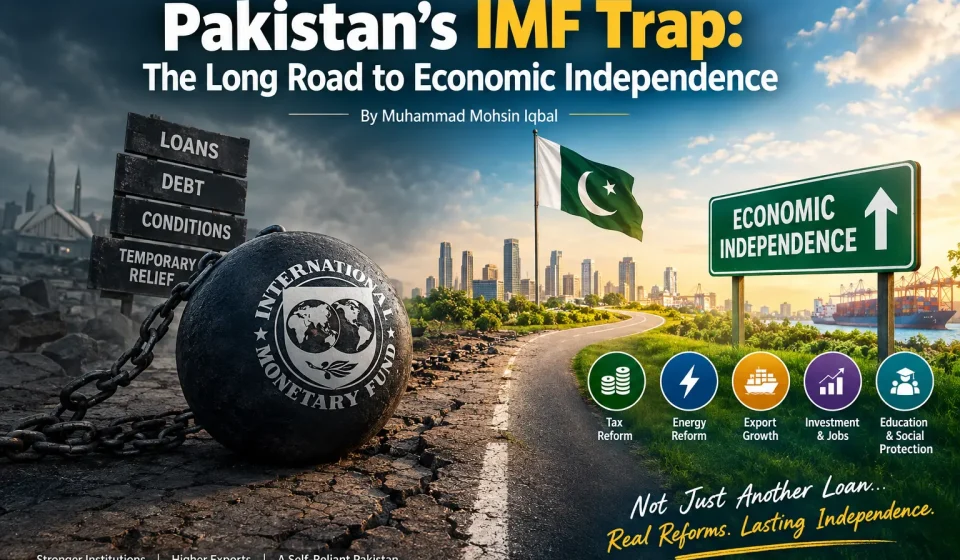
Pakistan’s IMF Trap: The Long Road to Economic Independence
By Muhammad Mohsin Iqbal
Pakistan’s recurring dependence on the International Monetary Fund (IMF) has become an enduring feature of its economic history. Every new programme brings temporary relief, helps restore confidence in the country’s ability to meet its external obligations and offers another opportunity to place the economy on a sustainable path. Yet, as one agreement follows another, a fundamental question remains unanswered; why has Pakistan repeatedly needed external assistance to finance its needs and stabilise its economy?
The problem extends beyond the burden of debt. It lies in the structural weaknesses that have made borrowing an almost habitual instrument of economic management. Pakistan’s real challenge is not simply to negotiate another loan or secure the next tranche, but to reform the economic system that repeatedly makes such assistance necessary.
Pakistan’s predicament is particularly instructive because repeated recourse to the Fund has not produced lasting independence from it. Narrow exports, weak revenue collection, persistent fiscal deficits, expensive energy and insufficient investment have contributed to a recurring cycle. Whenever foreign exchange becomes scarce, the government seeks assistance; once immediate pressures ease, the urgency of deeper reforms often diminishes. The result is temporary stability without a durable solution.
The latest IMF programme must be assessed against this history. In October 2026, Pakistan reached a staff-level agreement on reviews under its Extended Fund Facility (EFF) and Resilience and Sustainability Facility (RSF). Subject to approval by the IMF Executive Board, the agreement could release approximately $1.2 billion in additional financing. While this support may strengthen short-term stability, it cannot guarantee that Pakistan will avoid another programme. That outcome depends on what the country does with the breathing space it receives.
Economic stabilisation is necessary, but it is not equivalent to economic transformation. Moderating inflation, rebuilding foreign-exchange reserves and maintaining fiscal discipline are important achievements. Their benefits, however, will remain fragile unless Pakistan expands production, creates employment and earns substantially more foreign exchange. A sustainable economy must finance its development through productive activity rather than rely repeatedly on external assistance.
Tax reform is an essential starting point. Pakistan cannot maintain a fair and effective fiscal system by placing a disproportionate burden on salaried employees and documented businesses while significant economic activity remains undertaxed. The tax base must be broadened, exemptions rationalised and collection modernised through digital monitoring and transparent administration. Agriculture, property and retail sectors should contribute fairly according to their economic capacity and the law. Provincial governments must also improve revenue mobilisation. Sustainable public finances require cooperation between the federation and the provinces, not the shifting of responsibility from one to another.
Energy reform is equally urgent. Circular debt, electricity theft, distribution losses and weak recoveries continue to burden public finances and undermine industrial competitiveness. Repeated tariff increases, without corresponding improvements in efficiency and governance, cannot provide a lasting remedy. Distribution companies must perform better, losses must be reduced, and private participation should be encouraged where it improves efficiency. Energy must become financially sustainable without making domestic production prohibitively expensive.
The decisive test, however, is Pakistan’s ability to earn foreign exchange. The government’s Uraan Pakistan framework envisages merchandise exports of approximately $63 billion by 2029. This ambition will remain unrealised without predictable policies, competitive energy costs, access to finance, modern technology and efficient trade procedures. Pakistan must move beyond excessive dependence on traditional exports by developing higher-value textiles, information technology, engineering goods and processed agricultural products. Export diversification is not merely a growth strategy; it is essential to reducing the need for external borrowing.
Investment requires confidence in the continuity of public policy. Investors are reluctant to commit capital when taxation, regulations and economic priorities change unpredictably. State-owned enterprises must be governed professionally, with restructuring or privatisation pursued where appropriate. Public expenditure should support productive investment rather than sustain inefficiencies that consume scarce national resources. Institutional credibility is therefore as important as financial incentives in attracting long-term investment.
Reform, however, cannot succeed if its social costs are ignored. Fiscal discipline must not become a justification for transferring the burden of adjustment to vulnerable citizens. Savings from wasteful expenditure and poorly targeted subsidies should help strengthen healthcare, education, vocational training and social protection. Pakistan’s young population can become a powerful engine of economic growth, but only if education, skills and employment opportunities prepare it for a competitive world. Stability that fails to improve ordinary lives cannot command the public confidence needed to sustain difficult decisions.
The ambition to conclude the present IMF programme without requiring another is worthy of serious commitment. Yet an exit date is not an exit strategy. Fiscal discipline, energy-sector reform, export growth and institutional improvements must survive political transitions and changes in leadership. Short-term political convenience must no longer take precedence over long-term economic resilience.
The experiences of other borrowers offer further lessons. Argentina’s enormous IMF exposure, Ukraine’s wartime financing needs and the Democratic Republic of the Congo’s deep poverty and insecurity demonstrate that debt distress has different causes and consequences. Economic structure, governance, conflict and external shocks all matter. Pakistan must draw lessons from international experience while pursuing reforms suited to its own circumstances.
The IMF is neither Pakistan’s permanent adversary nor a substitute for sound economic management. Its assistance can provide valuable breathing space, but the responsibility for using it wisely rests with the nation’s own leadership and institutions. Repeated borrowing will end only when the weaknesses that necessitate it are addressed.
Ultimately, success will not be measured by another agreement or the arrival of another financial tranche. It will be measured by an economy capable of meeting its obligations through competitive exports, fair taxation, productive investment and prudent public finances. Pakistan must escape not only its present debt burden but also the economic habits that continually recreate it.
Temporary relief can be negotiated across a table; lasting independence must be built at home through courage, consistency and the willingness to undertake reforms long postponed. That is the road Pakistan must travel if it is to replace recurring dependence with genuine economic sovereignty.