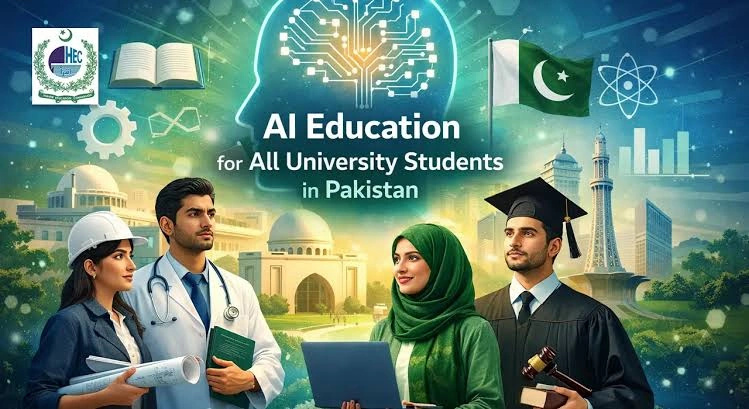

Pakistan is taking an important step toward preparing its universities for the artificial intelligence era. The Higher Education Commission (HEC) has announced a mandatory three-credit-hour AI course for undergraduate and postgraduate programmes from Fall 2026 and has also circulated a draft framework governing the use of generative AI in universities.
Both initiatives point in the right direction. But their success will depend on whether universities teach students how to build and evaluate AI systems, rather than simply showing them how to interact with chatbots.
The proposed rules place considerable emphasis on academic honesty. Students would not be allowed to submit AI-generated material as their own and would be expected to disclose the AI tools they used and explain their purpose.
The principles are understandable. The practical problem is enforcement.
A lecturer cannot reliably determine whether every assignment was written by a student, produced by an AI system or created through a mixture of both. AI-detection software is also far from reliable, which is why the draft policy appropriately states that students should not face punishment based solely on an AI detection report.
This raises a more important question: Why are universities trying to determine what students do privately when they can control what students are actually assessed on?
Instead of attempting to police every interaction between students and AI, universities should redesign assessments so that genuine understanding becomes difficult to fake.
Artificial intelligence can dramatically increase productivity, but its usefulness still depends on the person directing it.
A student who understands statistics can use an AI system to analyse a complicated dataset, test different models and identify patterns far more quickly. Someone without that foundation may still produce an impressive-looking answer without recognising that the underlying assumptions are wrong.
The difference is crucial.
AI can execute a task, but humans still have to decide which problem deserves attention, whether the available data is reliable and whether the final answer makes sense.
That requires knowledge.
Competitive data-science platforms provide a useful example. Participants may have access to similar datasets and increasingly powerful AI tools, yet their results are not identical. Human judgement continues to influence how problems are framed, models are selected and results are interpreted.
The lesson is not that AI cannot perform difficult tasks. It can. The lesson is that using AI effectively requires expertise.
One argument gaining attention is that universities should stop teaching skills that machines can already perform.
If an AI assistant can clean data, write code or build a forecasting model within minutes, why should students spend an entire semester learning those subjects?
The answer lies in the purpose of education.
Students are not taught mathematics simply because society needs people who can perform calculations by hand. They learn mathematics to develop reasoning, numerical intuition and problem-solving ability.
The same principle applies to writing, programming, statistics and scientific research.
A student writing an essay without AI is not merely producing a piece of text. They are learning how to develop an argument, organise evidence and communicate an idea.
The final essay may have little value once it has been graded. The intellectual abilities developed while producing it can remain useful for decades.
AI therefore does not necessarily make traditional education irrelevant. Instead, it changes the value of the finished product and places greater importance on the underlying capabilities developed during the learning process.
The HEC’s compulsory AI course could become one of the most significant changes to Pakistan’s university curriculum in years.
But its content will determine whether it becomes genuinely valuable.
A course centred primarily on prompt engineering would have limited long-term value. Teaching students how to write increasingly clever instructions for ChatGPT or another chatbot may be useful as an introduction, but it should not constitute an entire university course.
AI tools are evolving too quickly for a curriculum built around individual products to remain relevant.
Instead, students should learn the principles that allow them to work with many different AI systems.
University students should understand concepts such as APIs, structured data, automation, model evaluation and workflow design.
For example, there is a major difference between asking an AI system to summarise one document and building a system capable of processing 50,000 documents automatically.
The first requires basic chatbot skills.
The second requires an understanding of how AI can be incorporated into a larger technical system.
That distinction could become particularly important in Pakistan’s public and private sectors, where organisations handle enormous amounts of documents, records and data.
Students should therefore learn how to identify repetitive tasks that can be automated, connect AI models to existing systems, process information at scale and evaluate whether the resulting output is reliable.
They do not necessarily need to become expert programmers.
They do need to understand what can be built, how it can be built and where it can fail.
The most important lesson for universities may be that AI tends to amplify the abilities of the person using it.
A knowledgeable professional can use an AI system to work faster and explore more possibilities. A person without the necessary understanding may simply produce incorrect answers more efficiently.
That makes foundational education more important, not less.
The emergence of powerful AI tools should encourage universities to ask a different question. Instead of asking whether students used AI, educators should ask whether students understand the work they submitted.
Examinations, oral assessments, practical projects and supervised assignments can help test that understanding.
Students can then use AI as part of their learning without turning education into a contest between teachers and detection software.
Pakistan’s compulsory AI education initiative could become much more ambitious than a course about chatbots.
The country needs graduates who can use artificial intelligence in government, healthcare, agriculture, finance, education, manufacturing and scientific research.
That requires people who understand both their own professional disciplines and the capabilities and limitations of AI.
A medical student should understand how AI can assist with medical information while recognising its risks. A lawyer should know how to use AI for document analysis without blindly trusting generated legal arguments. An engineer should be able to automate technical workflows. A public-sector graduate should know how large collections of government records can be processed responsibly.
That is the kind of AI literacy universities should aim to develop.
Artificial intelligence is changing what humans need to do themselves. Tasks that once required hours of manual work can now be completed in minutes.
But education has never been solely about producing outputs.
Its deeper purpose is to develop judgement, knowledge, creativity and the ability to solve unfamiliar problems.
The HEC’s new AI course provides Pakistan with an opportunity to rethink university education around those principles.
The danger is that universities may mistake learning to use a chatbot for learning artificial intelligence.
The opportunity is much larger: teach students how to combine human expertise with machine capability.
The future will not belong simply to people who can ask AI the best question. It will belong to people who know which questions matter, how to build systems around the answers and when those answers should not be trusted.
That is the real AI skill Pakistani universities should be preparing their graduates to possess.