
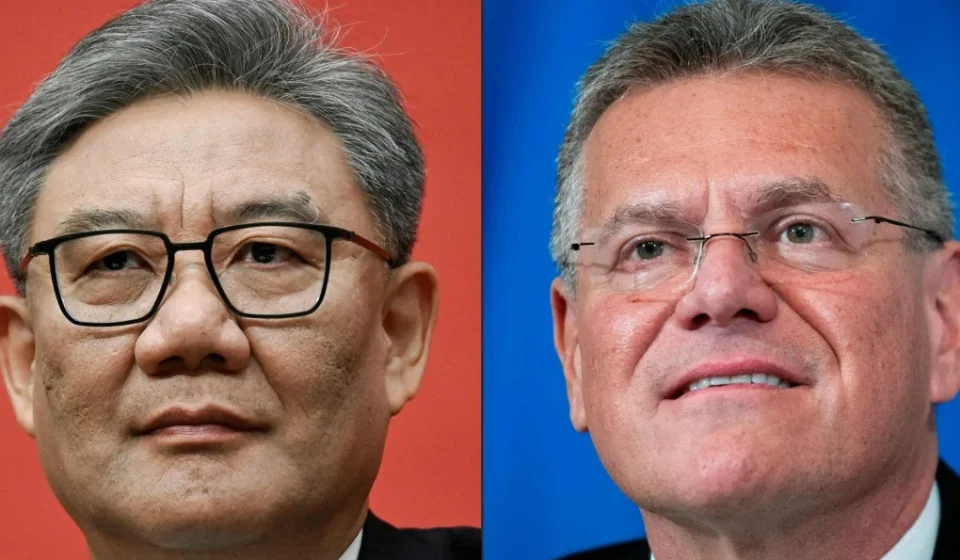

BEIJING: China and the European Union have agreed to explore reducing tariffs on certain goods, strengthen cooperation on export controls, and address outstanding market access issues as the two sides seek to stabilise bilateral economic and trade relations. The agreements were reached during the second meeting of the China-EU Trade and Investment Consultation Mechanism, which was held in Beijing on October 8 and 9. A joint statement was released on Friday. The EU described the outcome as a “first step” toward rebalancing trade.
Background: A Large Trade Gap and Rising Tension
China and the EU are two of the world’s biggest trading partners, but their relationship has become more difficult in recent years. The EU has a very large trade deficit with China, and it has accused Beijing of unfair subsidies and of flooding European markets with cheap goods. China, for its part, has objected to European tariffs on its electric vehicles and has used export controls on critical materials such as rare earths.
According to Eurostat, the EU exported €199.6 billion worth of goods to China in 2025 and imported €559.4 billion, which left a deficit of €359.8 billion. Exports fell by 6.5% and imports rose by 6.4% compared with 2024. Analysts have said that part of the increase came from Chinese goods that were redirected to Europe after US tariffs on China.
Details: What the Two Sides Agreed
The talks were co-chaired by EU Trade Commissioner Maroš Šefčovič and Chinese Commerce Minister Wang Wentao. Both sides agreed to continue exploring, within the framework of World Trade Organization rules, the possibility of reducing or eliminating tariffs on certain goods. According to Šefčovič, the understanding includes lower Chinese tariffs for some European products, such as automotive components, olive oil and footwear, covering nearly €4 billion in existing exports and bringing at least €225 million in tariff savings.
One of the most important points is the understanding on hybrid vehicles. China said the arrangement complies with WTO rules, while Šefčovič said it includes halving exports of hybrid and plug-in hybrid cars to the EU. The Chinese statement did not mention the scale of the reduction. The EU will also continue its anti-subsidy procedures related to Chinese electric vehicles.
On export controls, both sides stressed the need for stronger dialogue and more transparency. China will continue to speed up licences for rare earths and permanent magnets through a “green channel,” while the EU will facilitate priority licences for dual-use goods going to China. They also agreed to continue talks on market access for medical devices, with a procurement-matching meeting planned during the ninth China International Import Expo, as well as technical talks on cosmetics, pharmaceutical rules and computer reservation systems.
Quotes: What Officials Said
Šefčovič wrote on X that EU-China trade “needs real rebalancing,” and said the understandings with Wang cover halving hybrid exports, better access to China’s market and further easing of rare earth export licensing. He described the progress as a first step, according to CnEVPost.
The joint statement said that the two sides will continue to work toward addressing issues of concern in export controls. It also said that both sides will make progress on intellectual property protection and on coordination over WTO reform. The next steps include a ministerial videoconference in January and a third regular meeting in March, according to Caixin.
Note for the writer: if you can find a fresh comment from Wang Wentao, European industry groups or a trade analyst, add it here. Do not publish invented quotes.
Impact: Industry, Consumers and the Global Picture
For European carmakers, the hybrid understanding may reduce pressure from Chinese competition, but it may also raise prices or limit choice for consumers. For Chinese exporters, the tariff cuts and the promise of a stable process could ease uncertainty, although the EU has said that it will continue to use trade defence tools where it sees unfair practices.
Rare earths are another key area. These materials are used in electric vehicles, wind turbines and electronics, and European industry has complained about delays in Chinese export licences. A fast-track system could help factories that depend on these supplies, but it will depend on how smoothly it works in practice.
Many people looking for China-EU trade statistics, the 2024 figures or EU-China trade 2025 data will find that the numbers differ according to whether goods only or goods and services are counted. In 2024, the EU’s goods deficit with China was €304.5 billion. In the wider picture, the talks show how Beijing and Brussels are trying to manage a trade conflict while the global trading system is under pressure from tariffs and export controls.
Conclusion: What to Watch Next
The key test will be whether the promises turn into concrete action, especially on hybrid vehicle volumes, tariff cuts and licence approvals. Industry groups on both sides will be watching closely, and any disagreement over the details could quickly revive tension.
The next meetings, in January and March, will show whether the progress continues. Further updates will follow as officials publish more information.
Frequently Asked Questions (FAQs)
What is the EU’s relationship with China?
The relationship is a mix of cooperation, competition and disagreement. The European Union has described China as a partner on issues such as climate change, a competitor in the economy and a systemic rival on governance and values. The two sides trade a huge amount of goods, but they have clashed over subsidies, the EU’s tariffs on Chinese electric vehicles, Chinese export controls on rare earths and market access for European companies. They also hold regular dialogues. The talks in Beijing on October 8 and 9 were the second round of the Trade and Investment Consultation Mechanism, and a third meeting is planned for March. The overall relationship remains important but difficult.
Is the EU China’s biggest trading partner?
It depends on how trade is measured. For the EU, China is the largest source of goods imports, accounting for 22.3% of the total in 2025, according to Eurostat, and it is one of the EU’s top trading partners overall, behind the United States when imports and exports are combined. From China’s side, the EU is among its largest trading partners, and it is often described as the second largest after the Association of Southeast Asian Nations (ASEAN), although the ranking can change by year and by the method used. Readers who need an exact ranking should check the latest data from Eurostat and China’s customs authority, and note whether the figures include goods only or goods and services.
Does the EU have a trade deficit with China?
Yes. The EU has run a large goods trade deficit with China for years. In 2025, it exported €199.6 billion worth of goods to China and imported €559.4 billion, resulting in a deficit of €359.8 billion, according to Eurostat. That was higher than the €304.5 billion deficit recorded in 2024. Over the last decade, EU imports from China have nearly doubled, while exports have grown much more slowly. Electrical machinery and equipment were the biggest import category in 2025. Economists point out that trade deficits do not always mean losses for consumers, since imports can lower prices, but European officials say the imbalance needs to be addressed and want better access for EU companies in China.