
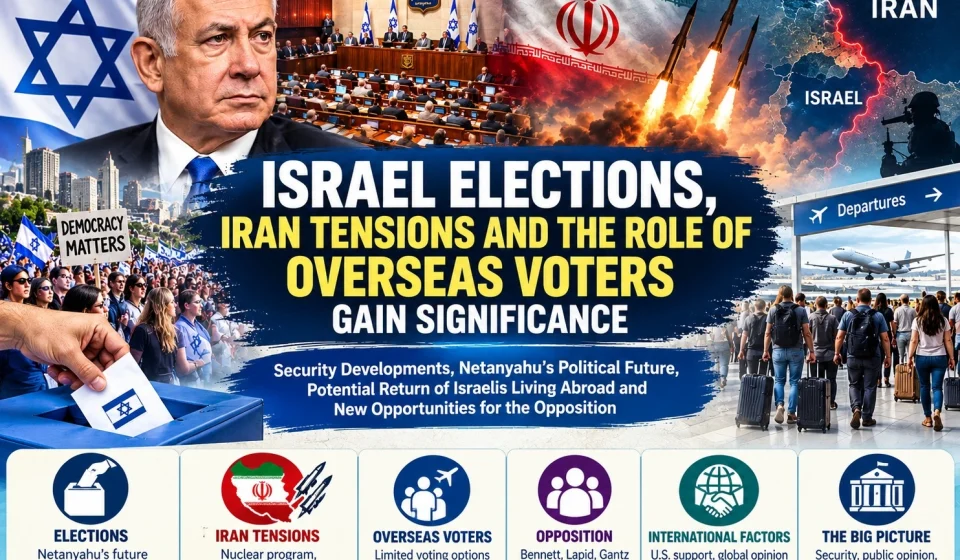
Israel Elections, Iran Tensions and the Role of Overseas Voters Gain Significance
Security Developments, Netanyahu’s Political Future, Potential Return of Israelis Living Abroad and New Opportunities for the Opposition
BY Mian Iftikhar Ahmad
LAHORE, Pakistan: As Israel’s parliamentary elections approach, discussions surrounding Prime Minister Benjamin Netanyahu’s political future, escalating tensions with Iran and the electoral role of Israeli citizens living abroad are gaining significance. Alongside the contest between Netanyahu’s right-wing governing coalition and various opposition parties, regional security, judicial reforms, government performance and Israel’s international standing could also influence the electoral landscape. International political analysis increasingly focuses on whether Netanyahu will be able to use security concerns effectively to maintain his political support or whether the opposition will capitalize on his policies and government decisions to pave the way for a change of power.
Netanyahu Faces a Major Challenge in Retaining Power: In Israeli politics, Netanyahu’s Likud Party and its right-wing and religious allies face political challenges from various opposition parties. Political factions associated with leaders such as Naftali Bennett, Yair Lapid and Benny Gantz have emerged as alternatives to the government’s policies. However, the opposition’s success will depend on the extent to which these parties can agree on electoral strategy, leadership and the prospects for forming a government. One of Netanyahu’s key advantages in maintaining political support could be his experience in national security, defense capabilities and his hard-line stance toward the perceived threat from Iran. On the other hand, critics of the government may demand change by highlighting security policy, domestic political divisions and the consequences of government decisions. Netanyahu’s relationship with US President Donald Trump also carries significance for the international dimension of Israeli politics. Nevertheless, American support alone cannot guarantee electoral victory in Israel.
Tensions with Iran Emerge as a Key Focus of Electoral Politics :The conflict between Iran and Israel could become a major issue in Israeli electoral politics. Concerns over Iran’s nuclear program, missile capabilities, regional allies and Israel’s defense strategy are likely to keep security high on the political agenda. Netanyahu and his supporters may argue that strong leadership, an effective defense system and a hard-line policy are essential to counter threats from Iran. In contrast, the opposition may question the effectiveness of the government’s strategy and raise concerns about the consequences of military decisions, diplomatic relations and the impact of security policies on domestic stability. The electoral impact of an escalation or reduction in tensions with Iran will depend on how Israeli voters perceive the situation and how they assess the government’s performance. It would therefore be premature to conclude that security concerns will necessarily benefit Netanyahu or, alternatively, create insurmountable difficulties for his political future.
Overseas Israeli Voters and the Question of Returning Home: The electoral role of Israeli citizens living abroad could also attract considerable attention, as ordinary Israeli citizens generally do not have access to voting at Israeli embassies overseas. Limited provisions for overseas voting apply to specific official categories, while ordinary citizens generally need to be physically present in Israel to cast their ballots. In this context, the return of Israelis living abroad, travel expenses and the availability of flights could affect their ability to participate in the electoral process. As elections approach, certain political or civic groups may encourage citizens to return to Israel to vote. However, claims about organized campaigns, discounted tickets or special flights for a particular election would need to be verified before being presented as confirmed developments. Similarly, disruptions to air travel caused by conflict with Iran or restrictions on airspace could make it more difficult for overseas Israelis to return home. This raises an important question: Are Israelis living abroad opposed to Netanyahu?
Are Most Overseas Israelis Opposed to Netanyahu? :The claim that most Israelis living abroad oppose Netanyahu requires careful examination. Israeli citizens residing in North America and Europe do not share identical political views. Their preferences may vary according to age, religious affiliation, social background, connections to Israel and individual political beliefs. Protests against judicial reforms in Israel and criticism of government policies have also mobilized some Israelis living abroad. Among these groups, concerns have been raised about democratic institutions, judicial independence and the growing influence of right-wing parties. However, such demonstrations do not justify categorizing all overseas Israelis as opponents of Netanyahu. Some Israelis living abroad, including religious and conservative citizens, may support right-wing politics and the government’s hard-line security policies. Reliable surveys and electoral data are therefore essential to establish the actual political preferences of Israelis living overseas.

How Much Influence Could Overseas Voters Have on Election Results? : The return of Israeli citizens living abroad could influence election results, but the extent of their impact would depend on several factors. These include the number of voters returning to Israel, their political preferences, overall voter turnout and the distribution of seats among political parties. Israel’s Knesset has 120 seats, and a government generally requires the support of at least 61 members to secure a parliamentary majority. Consequently, if the governing coalition and the opposition are closely matched in an election, additional votes could influence the outcome in certain constituencies and affect the prospects for forming a government. However, without reliable data on the number of overseas voters returning to Israel and their party preferences, it would be inaccurate to claim that their participation would necessarily prove decisive in favor of the opposition.
Israel’s Potential Political Outlook : Looking at the overall situation, three factors are likely to remain central to Israel’s electoral landscape: the regional security situation and tensions with Iran, public opinion regarding Netanyahu’s domestic and foreign policies, and the opposition parties’ ability to build a united front. The electoral participation of Israelis living abroad could also prove significant, particularly if the contest is closely fought and a small number of seats could alter the balance of power in parliament. Nevertheless, it would be misleading to assume that overseas Israelis share uniform political preferences or that their potential return to Israel would inevitably lead to Netanyahu’s defeat. The final political outcome will depend on the decisions of Israeli voters, the issues dominating the election campaign, the formation of political alliances and the prevailing security and economic conditions.