Surah At-Tariq and Modern Scientific Research: Cosmic Pulsation, Human Creation, and the Scientific Veracity of the Quran
Mian Iftikhar Ahmad
Surah At-Tariq is the eighty-sixth chapter of the Holy Quran, revealed during the Makkan period, and consists of only seventeen verses, yet in terms of its volume this surah possesses immense depth and vast themes. This surah begins with an oath by the sky and a specific star which the Quran has termed At-Tariq, meaning the one that knocks at night, and An-Najm Ath-Thaqib, meaning the luminous, piercing star. Thereafter comes mention of the process of human creation, that man should look at what he was created from, and it was stated that he was created from a gushing fluid that emerges from between the backbone and the ribs. Then mention is made of the Day of Resurrection when hidden secrets will be examined, and after the testimony of the sky and the earth, the Quran is declared a decisive word that is no jest. Finally, mention is made of the conspiracies of the disbelievers and the plan of Allah, and the Prophet is commanded to be patient and grant respite. This surah encompasses within itself a complete collection of cosmic sciences, biological sciences, spiritual realities, and moral guidance, and its analysis in the light of modern science is an interesting and important scholarly discussion on which research institutions around the world are working.
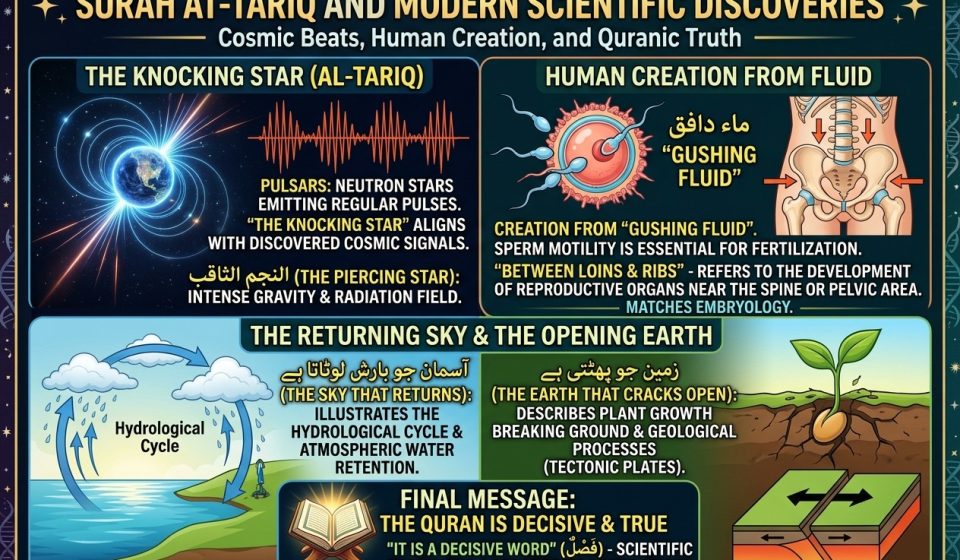
In the first three verses of Surah At-Tariq, Allah Almighty swears by the sky and by At-Tariq, and then Himself explains that At-Tariq is An-Najm Ath-Thaqib, meaning the piercing or luminous star. The word Tariq in the Arabic language carries the meaning of one that comes at night and knocks, that is, something that suddenly appears in the dark night and makes its presence felt. In modern astronomy, the discovery of pulsar stars has opened new doors for the interpretation of this verse. Pulsars are in fact neutron stars composed of extremely dense matter that rotate on their axes at tremendous speed. Their most prominent characteristic is that they continuously and regularly emit pulses in the form of electromagnetic waves in space, which can be heard as an organized pulse through radio telescopes. This is why they are called pulsars, meaning pulsating stars. The Quran, fourteen hundred years ago, described a star as one that knocks at night, which astonishingly corresponds to the characteristics of neutron stars that continuously pulsate in space according to modern science. The literal meaning of An-Najm Ath-Thaqib is the piercing star, and according to modern research the gravity and radiation of neutron stars are extremely intense, affecting matter in their surroundings to great depths. Researchers at Darul Salam University Gontor in Indonesia published a research paper in the year two thousand twenty-six in which, combining Semitic rhetorical analysis and scientific interpretation, it was established that the rhetorical structure of Surah At-Tariq exhibits remarkable harmony with cosmic phenomena such as pulsar stars. This research clarified that the Quran’s statement about the nature of stars transcends the scientific conceptions of its era and is not contrary to but rather confirms the discoveries of modern astronomy.
In the fourth verse of the surah, Allah Almighty states that there is no soul without a guardian over it. The revealed interpretation of this verse is that angels appointed by Allah watch over and protect every human being’s deeds, and man is at every moment under a higher supervision, therefore he should take account of his deeds. In the domain of modern science, the concept of supervision and recording can be seen at the level of the genetic code, where the complete information of every human cell is preserved. DNA is in fact an informational repository that keeps a complete record of a person’s physical structure, color, height, and other characteristics. Similarly, in modern digital technology, the digital footprint of every action is preserved which can later be retrieved. This verse points to the reality that every deed of man is preserved and recorded in one form or another, and on the Day of Resurrection a complete account will be taken of it.
The fifth to seventh verses of the surah mention the process of human creation, and this is the portion on which modern scientific research has placed the greatest emphasis. The Quran states that man should look at what he was created from, that he was created from a gushing fluid that emerges from between the backbone and the ribs. The literal meaning of Ma’in Dafiq is gushing or flowing water, and in modern science this refers to the union of the sperm and the ovum. The attribute Dafiq points to the motile nature of the sperm, which is extremely essential for the process of fertilization, because the sperm cell swims to reach the egg and this very movement is the beginning of human creation. The words Sulb and Tara’ib have been the subject of lengthy discussion among exegetes and researchers. According to the traditional interpretation, Sulb refers to the man’s spinal column or back, and Tara’ib refers to the woman’s chest bones. In modern scientific interpretations, numerous aspects have been considered. According to one interpretation, Sulb and Tara’ib actually point to the pelvic region which relates to the reproductive organs of both man and woman. According to a second interpretation, the subject of Yakhruj is not the sperm but the child, that is, the embryo, which develops in the mother’s womb, and the womb is also situated in this very bodily region. A third interpretation is that the testes, where the sperm is produced, are formed during embryonic development inside the abdomen near the spinal column and later descend, thus their relation is to the region between the back and the chest bones. According to a fourth interpretation, the mention of Sulb and Tara’ib is a metonymy for the entire human body, because the sperm and the ovum are formed under the system of the whole body. In an article in the Iranian research journal Tafsir Ma’rifat in the year two thousand twenty, the conclusion was drawn that the meaning of “between Sulb and Tara’ib” is the entire human body in which both man and woman have a role, and this is harmonious with modern medical sciences. An article published in a Moroccan research journal in the year two thousand twenty-five declared this verse a scientific miracle and established that this verse interprets the process of human creation as the union of sperm and ovum, while the mention of Sulb and Tara’ib points to the spinal column and the pelvic region which relate to reproductive functions. An article in the Iranian research journal Quran and Medicine in the year two thousand twenty-six, in the light of linguistic analysis, clarified that there is no contradiction between the Quran and medicine, and that doubts arise from failure to identify the correct meaning of these key words. In a research review by the Islamic University of Malaysia in the year two thousand twenty-three, the sayings of various exegetes were examined and it emerged that some exegetes consider this verse harmonious with modern science, while according to others its reference is to the child, that is, the embryo, which emerges from the womb. In a scientific workshop held at Al-Kafeel University in Iraq in the year two thousand twenty-five, light was shed on the scientific miracles of the Quran through Surah At-Tariq, and the modern concepts of anatomy, embryology, physiology, and hormones were linked to Quranic terms. The summary of all these researches is that the verses of Surah At-Tariq present deep and accurate observations about human creation that transcended the scientific backdrop of their era and are not contrary to the discoveries of modern embryology and anatomy.
In the eighth verse of the surah, Allah Almighty states that He is certainly able to return him. This verse is a clear proof of being raised again on the Day of Resurrection, that just as Allah created man from a drop, likewise He is able to revive him after death. In modern science, research is underway on the renewal of cells and the ability to regenerate dead or damaged tissues through stem cell technology. In DNA exists the code of the complete information of man which theoretically permits recreation at any time, although practically this is not yet possible. This verse points to the informational nature of human existence which is in accordance with modern genetics, and it establishes that the creation of man and his rebirth is, under the power of Allah, a scholarly and logical process.
In the ninth and tenth verses of the surah, mention is made of the Day of Resurrection, the day when all hidden secrets will be examined and man will have neither any power nor any helper. Sira’ir refers to all those deeds, intentions, and thoughts that were hidden in the world, and on that day no human being will be able to save himself from punishment through his own power or anyone else’s help. In modern science, the concept of examining secrets resembles forensic science and digital forensics, where even the smallest data can be retrieved. In modern technology, the digital footprint of every action exists; similarly, with Allah there is a complete account of every deed. This verse demonstrates the reality that on that day no human invention or power will avail, and every person will have to answer for his deeds.
In the eleventh and twelfth verses of the surah, Allah Almighty swears by the sky that returns rain and by the earth that splits. Sama’ Dhat Ar-Raj’ means the sky that returns the rain, that is, water rises as vapor and then returns in the form of rain. Ard Dhat As-Sad’ means the earth that splits, that is, it splits to bring forth plants and trees from the earth. In modern science, the interpretation of Sama’ Dhat Ar-Raj’ is given as the hydrological cycle, in which water evaporates, clouds form, rain falls, and the water is again absorbed into the earth. A research paper presented at the International Conference of Islamic Studies held in Indonesia in the year two thousand twenty-five analyzed the linguistic and scientific meanings of Ar-Raj’ and established that Raj’ does not mean only returning but also storing or withholding, which perfectly corresponds to the process of the atmosphere storing water vapor, condensing it, and returning it as rain. In the interpretation of Ard Dhat As-Sad’, the splitting of the earth is not only essential for the growth of plants but may also point to the movement of tectonic plates and earthquakes. Both these phenomena demonstrate the continuous cycle of the universe which points to an organized system, and they establish that the Quran mentioned these fundamental principles of nature which science discovered centuries later.
In the thirteenth and fourteenth verses of the surah, it is stated that this Quran is certainly a decisive word and it is no jest. This verse clarifies the reality and importance of the Quran, that it is the word that distinguishes between truth and falsehood and it cannot be taken as a jest or a plaything. This verse invites man to reflect on the message of the Quran and to accept it seriously, because it is the guarantor of success in both his world and his hereafter.
In the fifteenth to seventeenth verses of the surah, mention is made of the conspiracies of the disbelievers and the plan of Allah. It is stated that certainly these people are plotting and I too am planning, so O Prophet, grant the disbelievers respite, grant them a little respite. These verses indicate that the disbelievers were devising conspiracies against the Messenger of Allah and Allah Almighty will frustrate their plans through His way and justice. The Prophet was commanded to be patient and grant them a little respite, because the punishment is certain. In modern science, the concept of Kayd, meaning plot or plan, resembles strategic planning and cybersecurity, where every action has a reaction. The law of respite recalls natural selection and the balance of the ecosystem, that everything happens at its own time and nothing remains unaccounted for. These final verses point to the law of history, that is, the rise and fall of nations, which applies to every civilization, and they establish that the plan of Allah always prevails over human conspiracies.
Overall, Surah At-Tariq is a brief yet profound surah that sets forth together the grandeur of the universe, the intricacy of human creation, and the reality of the hereafter. Each of its verses invites man to reflection so that he may recognize the power of his Creator. Modern scientific research has opened new doors for the interpretation of numerous verses of this surah, and research institutions around the world are comparing this surah with modern science in fields such as astronomy, embryology, anatomy, and environmental science. Although there is disagreement among exegetes regarding the interpretation of certain terms, modern researches indicate that the Quran’s statement exhibits remarkable harmony with modern scientific discoveries, and this is a strong proof of its divine origin. Surah At-Tariq in fact invites man to reflect on the universe around him and on his own creation, and to recognize the reality that all this is from a Wise Creator who created man and granted him the Quran for guidance. This surah encompasses within itself such a treasure of scientific facts, spiritual insight, and moral guidance that is equally worthy of consideration and action for the people of every era.