Election Night Snapshot: Control of US House and Senate Remains Wide Open
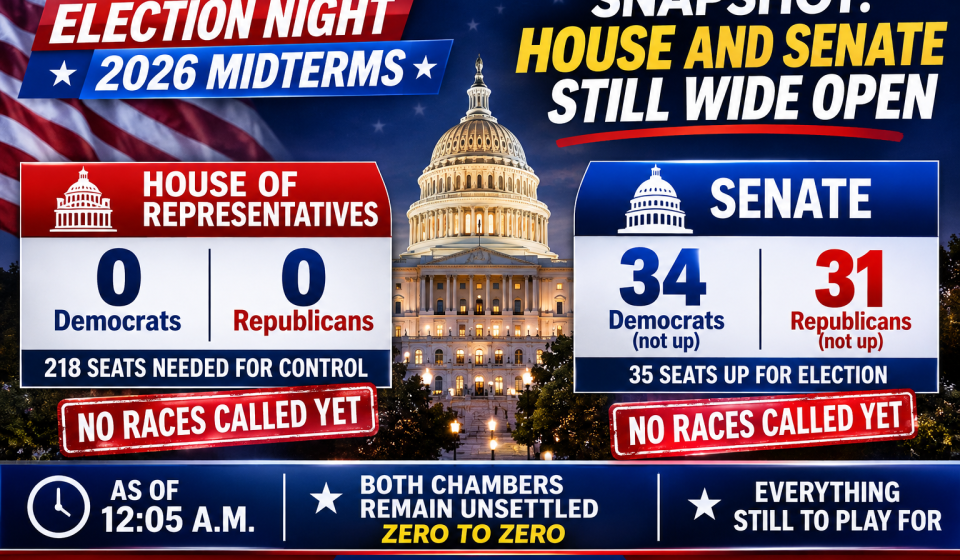
WASHINGTON, November 3, 2026: The 2026 US midterm elections began with no congressional races called by the Associated Press as of 12:05 a.m. Eastern Time, leaving control of both the House of Representatives and the Senate undecided.
With all 435 House seats and 35 Senate seats being contested, voters are deciding the balance of power in Congress during the second half of President Donald Trump’s term. At this early stage, no winners had been declared in either chamber.
House of Representatives: All 435 Seats Await Results
All 435 seats in the House of Representatives are on the ballot, and a party needs at least 218 seats to secure a majority.
As of the reported snapshot, the AP had not called any House races. The results therefore stood at zero seats called for Democrats and zero for Republicans, with all 435 contests still awaiting decisions.
Although every House seat is being contested, the chamber is not starting from scratch: existing party control and incumbency remain important factors as votes are counted. The narrow balance of power means that relatively small shifts in competitive districts could determine which party controls the House.
Senate: 35 Contests Remain Uncalled
The Senate presents a different picture because only 35 of its 100 seats are being contested in this election cycle. The remaining 65 seats are not on the ballot.
At the reported early snapshot, none of the 35 Senate races had been called. The 65 seats not up for election were held by 34 Democratic-aligned senators and 31 Republicans, leaving the starting position unchanged.
The Senate requires 51 seats for a Democratic majority. Republicans can retain control with 50 seats because the vice president can break a 50–50 tie. This makes the outcome of the competitive Senate contests particularly important.
Why the Two Chambers Face Different Challenges
The House and Senate have different election structures. Because all House seats are contested every two years, a broad national shift in voter sentiment can affect control of the chamber.
The Senate operates on staggered six-year terms, with approximately one-third of its seats contested every two years. As a result, only a portion of the chamber can change hands during a single election cycle.
The existing balance of seats not up for election therefore plays a significant role in determining how many victories either party needs to secure control.
Results Await Poll Closures
The first polling places are scheduled to close at 6 p.m. Eastern Time in parts of Indiana and Kentucky, with other states following according to their local schedules.
The Associated Press will assess individual races as vote counts become available and declare winners when the available evidence shows that trailing candidates no longer have a plausible path to victory. Close contests and different state ballot-counting procedures could delay final calls.
For now, the early scoreboard remains unchanged: no House or Senate races had been called at the time of the snapshot. The battle for congressional control is still ahead as Americans cast their ballots.