
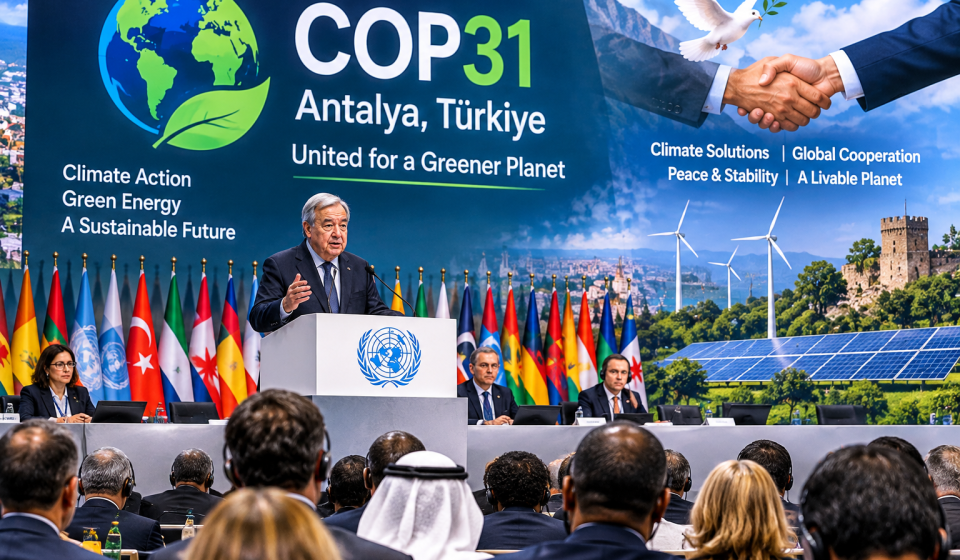
Global Diplomacy and Climate Action Take Centre Stage as World Leaders Gather at COP31
ANTALYA, Türkiye: World leaders, diplomats, climate scientists and international organisations have gathered in Antalya for the 31st United Nations Climate Change Conference (COP31), as governments face growing pressure to turn climate commitments into practical action and strengthen financial support for vulnerable countries.
Hosted by Türkiye from November 9 to 20, 2026, the summit has brought together representatives from nearly 200 countries to discuss emissions reduction, climate finance, renewable energy, adaptation and international cooperation. The Antalya Leaders’ Summit, held on November 11 and 12, has provided a platform for heads of state and government to outline their priorities for addressing the global climate crisis.
UN Calls for Stronger Climate Finance and Climate Justice
Climate finance has emerged as one of the central issues at the summit, particularly for developing countries facing severe climate impacts despite contributing comparatively little to global emissions.
At the opening of COP31, United Nations General Assembly President Khalilur Rahman called for climate commitments to be supported by adequate, accessible and affordable funding. He highlighted the gap between the financial resources required for adaptation and the amount currently reaching vulnerable countries.
He cited an estimated annual adaptation financing requirement of up to $305 billion for developing countries, compared with approximately $26 billion currently received. He also stressed the importance of delivering the agreed $300 billion annual climate finance goal by 2035 and progressing towards the broader $1.3 trillion target.
UN Secretary-General António Guterres also urged governments to accelerate climate action and advance a new Climate Justice Compact. Addressing leaders in Antalya, he called for greater financial support, a just transition away from fossil fuels and stronger protection for communities exposed to climate disasters.
On November 12, Guterres also urged governments to consider taxing fossil fuel companies to help finance climate action in countries bearing the greatest consequences of global warming.
Geopolitical Tensions and Environmental Responsibility
Climate discussions at COP31 are taking place against a backdrop of international conflicts, energy insecurity and economic pressures. Leaders have highlighted the connections between geopolitical instability, dependence on fossil fuels and the need for more resilient energy systems.
Turkish President Recep Tayyip Erdoğan linked environmental protection with international solidarity and raised concerns about the ecological consequences of armed conflicts. Other leaders, including Brazil’s President Luiz Inácio Lula da Silva, called for diplomacy and stronger cooperation to prevent wars and political divisions from overshadowing climate priorities.
The discussions have reinforced the importance of treating climate change as a shared international challenge requiring cooperation across political and geographical boundaries.
Türkiye Promotes Zero Waste and Renewable Energy
Türkiye has placed considerable emphasis on its zero-waste initiative, circular economy policies and the transition towards cleaner energy.
At COP31, President Erdoğan urged countries to strengthen waste reduction and recycling efforts. Türkiye presented progress in its national recycling rate, which it said had increased from approximately 13 per cent in 2017 to 40 per cent in 2025.
The summit’s programme also includes discussions on electrification, methane reduction, sustainable buildings, clean cooking and the development of green industries. These priorities aim to encourage governments and businesses to move beyond broad environmental commitments and establish measurable programmes.
Leaders Stress the Need for Practical Implementation
UN climate officials have urged governments to focus on implementing existing commitments rather than repeatedly announcing new targets.
UN Climate Change Executive Secretary Simon Stiell told world leaders that climate action could reduce economic and political pressures associated with dependence on fossil fuels. He called for progress on electrification, adaptation finance and practical solutions capable of delivering measurable benefits.
The World Meteorological Organization has also highlighted the importance of climate science, reliable observations and early-warning systems in protecting communities from extreme weather events and other climate-related hazards.
A Critical Test for International Cooperation
COP31 provides an important opportunity for governments to address the gap between climate pledges and implementation. Its discussions cover not only emissions reduction but also financial assistance, technology transfer, disaster resilience and the responsibilities of developed and developing economies.
The summit is scheduled to continue in Antalya until November 20, when governments are expected to conclude negotiations and adopt further decisions.
Ultimately, the significance of COP31 will depend on whether its diplomatic discussions translate into accessible climate finance, stronger environmental protections and practical action. As climate impacts intensify around the world, international cooperation remains essential to protecting vulnerable communities and building a more sustainable future.