
A History Brought to Life in Colors
Muhammad Ali Bhatti’s Art Casts a New Light on Quaid-e-Azam
Abdul Rehman Patel
Some portraits simply adorn walls, while others compel the viewer to stop, look, and reflect.
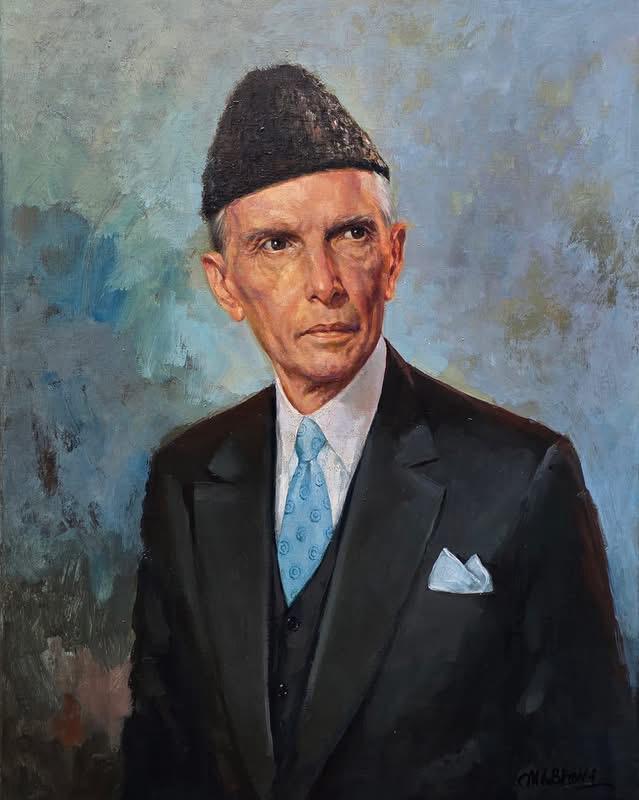
This classic portrait of Quaid-e-Azam Muhammad Ali Jinnah, created by renowned Houston-based artist Muhammad Ali Bhatti, belongs to the latter category.
We have grown up seeing images of Quaid-e-Azam: the dignified face, the iconic Jinnah cap, and those deep, penetrating eyes that seem to look far beyond the present. But when Muhammad Ali Bhatti brought this historic figure onto canvas through his brush and colors, it felt as though a familiar image had suddenly been infused with new life.
Especially the eyes.
Looking into them, one can sense the determination, intellect, self-confidence, and vision that defined Quaid-e-Azam. There is seriousness in the face, but no lifeless rigidity; dignity, but no artificiality. Perhaps this is the true gift of a great portrait artist: not merely to reproduce a face, but to make us feel the personality behind it.
Muhammad Ali Bhatti is certainly no unfamiliar name within Houston’s Pakistani community. His decades of artistic dedication, his distinctive command of color, and his ability to capture the emotions hidden within human faces have earned him a unique place in the world of art. I have previously written about his art and personality in my series “Faces That Became Light,” but this portrait of Quaid-e-Azam has the potential to occupy a particularly distinguished place in his artistic journey.
The significance of this creation became even greater when, on August 14, 2026, during celebrations marking Pakistan’s 79th Independence Day, the portrait was formally presented at the Consulate General of Pakistan in Houston and unveiled by Consul General Aftab Chaudhry.
It was more than the unveiling of a painting.
On one side was the face of Pakistan’s founder. On the other was the lifelong artistic devotion of a Pakistani-origin artist. And surrounding them was a community living thousands of miles from Pakistan, yet still deeply connected to its homeland, history, and identity.
Muhammad Ali Bhatti created this portrait using several historic photographs of Quaid-e-Azam as references. But true artistry lies not simply in using references. It lies in going beyond them and capturing, through color and brushstrokes, the dignity, intelligence, strength of character, and commanding presence of the person behind those photographs.
That is perhaps why, while looking at this portrait, one can almost imagine Quaid-e-Azam’s luminous gaze addressing future generations:
“Pakistan was a dream that became a reality.
My children, it is now your trust. Preserve it, protect it, and take it forward through knowledge, hard work, unity, and integrity. Build it into a prosperous and dignified nation of which generations to come can also be proud.”
Perhaps that is art’s greatest achievement. It does not merely preserve the past; it transforms the light of the past into hope for the future.
Muhammad Ali Bhatti deserves heartfelt congratulations for this beautiful and historic creation. It is undoubtedly a great honor for him that his portrait of Quaid-e-Azam was selected for unveiling at the Consulate General of Pakistan in Houston on Independence Day. Yet, in my view, this honor belongs not only to the artist, but also to Houston’s entire Pakistani community.
Consul General Aftab Chaudhry and the Consulate General of Pakistan in Houston also deserve appreciation for bringing Pakistani art, an accomplished Pakistani artist, and our national history together under one roof, and for giving this work the dignity and recognition it deserves.
Quaid-e-Azam gave us a country.
Through his colors, Muhammad Ali Bhatti has, for a moment, given us back the gaze of Quaid-e-Azam.
And perhaps the most beautiful aspect of this portrait is that, while it may hang silently on a wall, in its eyes, the dream of a bright, prosperous, and dignified Pakistan is still very much alive.