
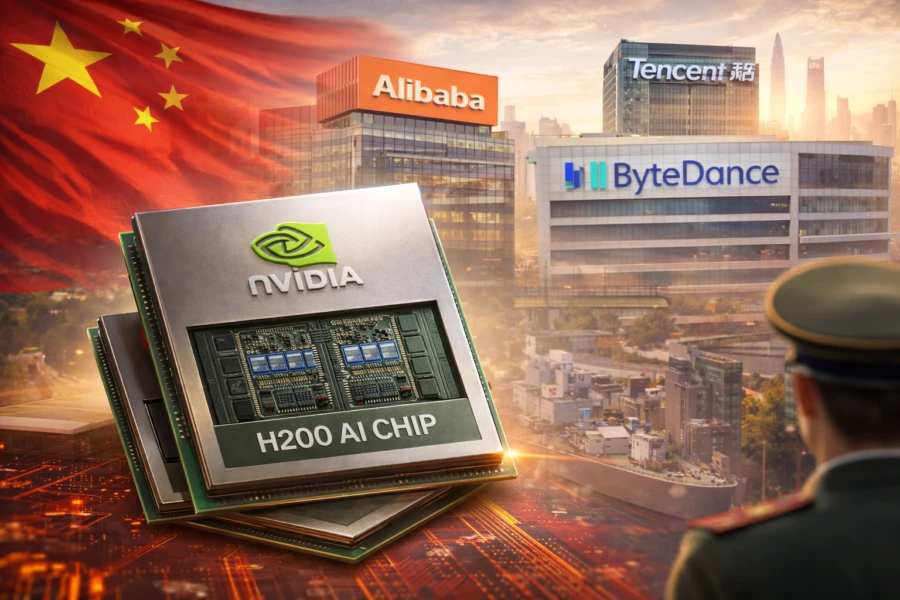
AI chip shipments to China Nvidia have become a major global technology and economic issue as new restrictions and export controls reshape the semiconductor market. The policy changes are directly affecting Nvidia China market demand, investor sentiment, and global AI hardware supply chains.
AI chip shipments to China Nvidia are now under strict scrutiny as governments tighten rules around advanced semiconductor exports. The development is influencing Nvidia stock today China impact trends and raising concerns across the tech industry.
Background
The global AI race has intensified in recent years, and China has emerged as one of the largest markets for artificial intelligence infrastructure. Nvidia China market growth has played a key role in the company’s revenue expansion, especially through demand for high-performance GPUs used in AI training and data centers.
However, US export controls targeting advanced semiconductors have significantly affected AI chip shipments to China Nvidia. These restrictions aim to limit access to cutting-edge chips that could be used for military or strategic AI systems. As a result, AI semiconductor restrictions have become a central issue in US-China trade relations.
At the same time, China is accelerating its push toward domestic chip production. Companies in the Chinese AI industry growth sector are investing heavily in alternative technologies, including efforts to reduce dependency on Nvidia China supply chains.
Details
Recent developments show that AI chip shipments to China Nvidia are increasingly restricted under updated export rules. These rules not only target direct shipments but also impact indirect sales through third countries.
The Chinese market remains highly important for Nvidia despite regulatory challenges. Demand for AI chips continues due to rapid expansion in cloud computing, AI model training, and large-scale data processing systems. However, Nvidia stock today China impact reflects investor uncertainty about long-term revenue stability from this region.
China’s response has been to double down on local innovation. The China AI chips development sector is growing rapidly, with companies aiming to build alternatives to Nvidia GPUs. At the same time, global attention has shifted toward AI platforms like DeepSeek AI model China, which symbolizes China’s growing independence in AI software and infrastructure.
Another major factor affecting AI chip shipments to China Nvidia is geopolitical tension. US China chip ban policies continue to evolve, creating uncertainty for semiconductor manufacturers and global investors. The semiconductor supply chain crisis has also intensified due to fluctuating demand and restricted trade flows.
Quotes
Industry experts suggest that the situation remains highly volatile. One analyst noted that “AI chip shipments to China Nvidia restrictions are reshaping global AI competition and forcing companies to rethink their supply chain strategies.”
Nvidia CEO AI warning statements have also highlighted potential risks in over-regulation. According to industry commentary, excessive restrictions could slow down global AI innovation and fragment technology ecosystems between East and West.
Impact
The impact of AI chip shipments to China Nvidia restrictions is being felt across multiple layers of the global economy.
For Nvidia, China remains a critical revenue market, and any limitation directly influences Nvidia earnings China demand projections. Investors are closely monitoring Nvidia stock today China impact trends as uncertainty grows.
For China, restrictions have accelerated efforts toward semiconductor independence. The China AI chips development ecosystem is receiving strong government and private investment support, which may reduce reliance on foreign technology in the long term.
Globally, AI semiconductor restrictions are reshaping supply chains. Countries dependent on Nvidia China market technology are now diversifying suppliers and investing in alternative chip manufacturers. This shift is contributing to volatility in the semiconductor supply chain crisis.
In financial markets, tech stocks are reacting strongly. AI-related equities are experiencing fluctuations as traders assess the long-term effects of AI chip export controls and geopolitical tensions.
Conclusion
The future of AI chip shipments to China Nvidia will depend heavily on evolving US-China relations and global technology policy frameworks. While restrictions are tightening, demand for AI infrastructure continues to grow in China, ensuring the market remains strategically important.
China’s push toward AI self-reliance and semiconductor innovation suggests a long-term shift in global tech balance. However, Nvidia’s advanced chip technology still plays a central role in global AI development.
The coming years will likely see continued competition between US export controls and China AI chips development, shaping the direction of the global AI economy.
FAQs
Will China buy Nvidia chips?
China continues to be interested in Nvidia chips due to strong demand for AI computing power. However, AI chip shipments to China Nvidia are now subject to strict export controls. This means that while some Nvidia products may still reach China, access to the most advanced chips is increasingly limited. The future depends on evolving US regulations and Nvidia compliance strategies.
Is China making their own AI chips?
Yes, China is actively developing its own AI chips as part of its China AI chips development strategy. Domestic companies are investing heavily in semiconductor research to reduce reliance on Nvidia China market products. Although Chinese chips are improving, they still face challenges in matching the performance of Nvidia’s most advanced GPUs.
Did China ban foreign AI chips?
China has not fully banned foreign AI chips, but it is encouraging domestic alternatives and reducing dependency on imported semiconductors. AI chip shipments to China Nvidia remain possible under restrictions, but policy direction strongly favors local innovation and self-sufficiency in AI hardware.